Author Archives: rdmyers75@hotmail.com

cognitive empathy

This article in the “Nonzero Newsletter” has a litany of complaints about how the U.S. is seen by many people around the world to be hypocritical when it talks about peace and democracy. This lack of trust goes back at least to the Vietnam War, so it might take us a long time to dig ourselves out of this hole, if we were to actually start digging.

We think a “rules based order” is a morally good thing, but we also think it serves the interests of other nations by fostering a peaceful, stable, predictable world.

And it’s true that their interests would be served by this kind of order—but unfortunately this isn’t the kind of order America actually supports. Our “rules based order” allows us to inflict mayhem when and where we please, because it doesn’t involve the consistent application of rules. It’s an “order” that camouflages the pursuit of US interests as the US (however confusedly) conceives of them. And people in the “nonaligned world” see this—which helps explain why they’re not signing onto our mission.

The people who don’t see it are the people responsible for it: US foreign policy elites. So their failure to understand the motivations of other world actors is sometimes intertwined with, and in a sense rooted in, a failure to understand their own motivations—the ultimate blind spot. If we saw ourselves more clearly, we’d have an easier time understanding why others react to us as they do. Sometimes cognitive empathy begins at home, with simple self awareness.

Nonzero Newsletter

Here are some shovels, “foreign policy elites”, now start digging.

I was recently reading George W. Bush’s memoir Decision Points at the suggestion of a relative. The book helped me to see him as a better-intentioned leader than I did previously, but it also reinforced my sense that he had an extraordinarily oversimplified understanding of other parties’ motivations. Take Al Qaeda for example. His understanding was that they “hated us because they hate freedom”. Nothing could justify their cowardly attacks on civilians, of course. But try to put yourself in their shoes, and it seems clear that they saw themselves acting in self defense in response to what they (Bin Laden at least) saw as a U.S. occupation of Muslim holy lands, going back to at least the 1990s. Then, following the U.S. and NATO actual occupation of Afghanistan, they perpetrated more cowardly attacks on civilians in the UK and Spain, in their minds in response to the occupation. So there was a cycle of escalating violence, and just being able to recognize this might have been a first step in figuring out how to deal with it. We might be making similar errors in our dealings with Russia and China today.

accuracy of a model vs. its “decisional quality”

I like the way the abstract of this paper distinguishes between (1) the accuracy of a model as measured by comparing it to physical observations (always assuming those are an accurate or at least unbiased measurement of the true state of the universe and (2) the appropriateness of a model to be used in decision making. I find these concepts very, very difficult to get across even to scientists and engineers.

Ecological forecasting models: Accuracy versus decisional quality

We consider here forecasting models in ecology or in agronomy, aiming at decision making based upon exceeding a quantitative threshold. We address specifically how to link the intrinsic quality of the model (its accuracy) with its decisional quality, ie its capacity to avoid false decisions and their associated costs. The accuracy of the model can be evaluated by the [Greek symbol rho – I don’t know what they mean by this just from reading the abstract] of the regression of observed values versus estimated ones or by the determination coefficient. We show that the decisional quality depends not only of this accuracy but also of the threshold retained to make the decision as well as on the state of nature. The two kinds of decisional errors consists either in deciding no action while an action is required (false negatives) or to act while it is useless (false positives). We also prove that the costs associated to those decisions depend also both of the accuracy of the model and of the value of the decision threshold.

Ecological Modeling

yes, the CIA mucks about in other countries’ elections

The CIA has always mucked around in other countries’ elections. This is from Monthly Review, a self-described Marxist magazine based in New York, so you be the judge of its credibility. But anyway, this is about Mexico around the late 1970s or so.

The documents, most of which are related to a CIA probe into the assassination of President John F. Kennedy in 1963, contains a memo from a meeting of CIA agents held on November 29, 1976. In said meeting, U.S. intelligence official Bill Sturbitts said to his colleagues that “Mexico will soon have a new president, a man who has had control of Liaison for a number of years…”

López Portillo was not the only former president of Mexico to have been on the payroll of the CIA. Three other presidents who preceded him, namely, Adolfo López Mateos (1958-1964), Gustavo Díaz Ordaz (1964-1970), and Luis Echeverría (1970-1976) were also revealed to be CIA assets in earlier declassification of official U.S. documents. All these former presidents committed acts of grave human rights violations and crimes against humanity against the people of their own country, but that did not stop the United States, the self-proclaimed champion of “human rights,” from cultivating close relations with them.

Cultivating national leaders was not the only interventionist act that the CIA did in Mexico. Declassified documents over the years have revealed a range of illegal activities of U.S. intelligence in Mexico, including spying on Soviet and Chinese embassies in Mexico City; financing extreme right groups; supporting and coordinating the Mexican armed forces; and infiltrating and subverting left-wing students’ organizations and social movements all over Mexico, in COINTELPRO style, often with fatal consequences for the Mexican people.

Monthly Review

That was quite awhile ago, but fast forward to Russia claiming that the 2014 election in Ukraine was a “coup” orchestrated by the United States. It is certainly not implausible to ask if politicians in Ukraine were CIA “assets” at the time (I am not making claims or claiming to have evidence about specific people), if the CIA was spying on say the Russian and Chinese embassies, financing Ukrainian-nationalist anti-Russian groups without asking too many questions about their politics, training and supporting the armed forces (completely in the open on this one). These are dirty tricks, and Russia is certainly not above engaging in any of these dirty tricks itself. I am not claiming any of these dirty tricks would justify Russia invading its sovereign neighbor, but I can put myself in Russian shoes and consider why they might feel a bit paranoid.

Houston Flood Protection

The U.S. Army Corps of Engineers is undertaking a $31 billion, two decade project to build a system of flood protection levees and gates for Houston. At first I thought maybe it was designed during the Eisenhower administration and the Corps is just now getting around to building it. But no, it’s nickname comes from Hurricane Ike in 2008. According to Grist, this is “the largest project that the Corps has ever undertaken”. This is impressive, considering the size, scale, and speed (by Corps standards) of the levee construction to protect New Orleans after Hurricane Katrina. Both systems are being questioned as possibly under-designed for projected future climate conditions. It does tell me one thing though – the U.S. Congress will pony up to protect major coastal cities when push comes to shove. There will be more to come.

spac0562

short naps good, long naps bad

As I move deeper into middle age, I consider the luxury of a mid-afternoon nap to be one of life’s great pleasures. 30 minutes is about right, according to this article. After reading the article though, I can’t help wondering if longer naps are more of a symptom of other health problems or poor lifestyle choices rather than a driver of them.

My personal prescription for a little mid-afternoon pick-me-up:

  1. Read a book (Kindle is okay, computer or phone not recommended) until you start to feel a bit sleepy.
  2. Close eyes for 20-30 minutes. Just relax, don’t put any pressure on yourself to sleep, or consider meditation if you don’t feel sleepy.
  3. Open your eyes and read a bit more.
  4. Get up and exercise for 20-30 minutes.
  5. Take a shower.
  6. Have a cocktail. Don’t overdo it, just one is good.
  7. Now you’re ready for dinner, people, or whatever you want/need to do in the evening.

Obviously this is not a daily prescription for the harried working parent. I find maybe one afternoon per month to do this, but it is oh so rejuvenating mentally and physically. I fantasize about doing this every day in retirement.

another depressing U.S. statistic

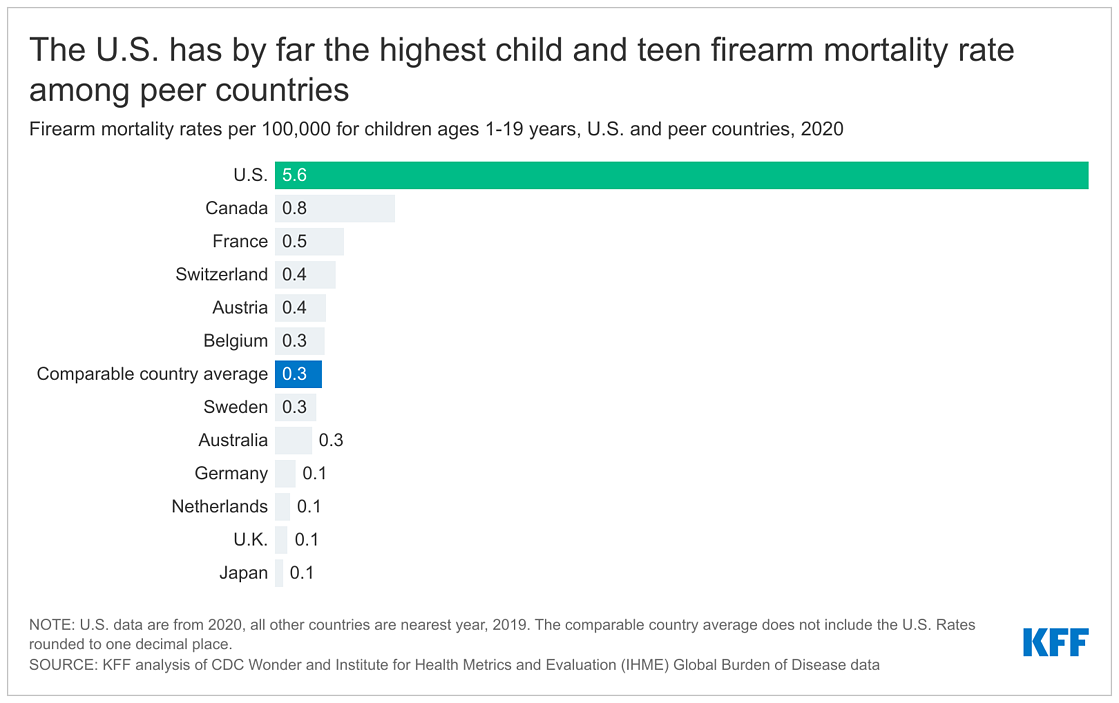
According to KFF (which I hadn’t previously heard of, but describes itself as “the independent source for health policy research, polling, and news”), firearms are the leading cause of death among children in the United States.

Guns – including accidental deaths, suicides, and homicides – killed 4,357 children (ages 1-19 years old) in the United States in 2020, or roughly 5.6 per 100,000 children.

In each of the peer countries, guns kill fewer children than motor vehicles, cancer, congenital diseases, and other injuries, and often behind other conditions such as heart disease.

The U.S. is the only country among its peers that has seen a substantial increase in the rate of child firearm deaths in the last two decades (42%). All comparably large and wealthy countries have seen child firearm deaths fall since 2000. These peer nations had an average child firearm death rate of 0.5 per 100,000 children in the year 2000, falling 56% to 0.3 per 100,000 children in 2019.

KFF

This is certainly disturbing and upsetting. I suppose there is some context to consider. For example, children don’t die in large numbers of preventable diseases, which is a great thing, so when they do die it is mostly from rare diseases and accidehttps://www.kff.org/wp-content/uploads/2022/07/guntrol.pngnts. I would want to know how the U.S. compares in overall child mortality to the other industrialized countries considered in this study. Probably not favorably, but not mentioned in this study. I would be interested to know what the breakdown between children and older teens is, and what the breakdown between accidents, homicides, and suicides is. These are all tragedies, but each cause of death within each age group would have different root causes and different solutions.

Regardless, it is negligent and ignorant that we are letting this happen, and yet more proof our country is truly “exceptional”, just not in the good way.

April 2023 in Review

I made several posts with numbers on crime, suicide, and poverty. The U.S. is a violent, unequal country. I’ve talked about these issues a lot, so far without any noticeable effect on our political class. So I’ve picked some other things below.

Most frightening and/or depressing story: Chemicals, they’re everywhere! And there were 20,000 accidents with them in 2022 that caused injuries, accidents, or death. Some are useful, some are risky, and some are both. We could do a better job handling and transporting them, we could get rid of the truly useless and dangerous ones, and we could work harder on finding substitutes for the useful but dangerous ones. And we could get rid of a corrupt political system where chemical companies pay the cost of running for office and then reward candidates who say and do what they are told.

Most hopeful story: There has been some progress on phages, viruses intentionally designed to kill antibiotic-resistant bacteria. Also, anti-aging pills may be around the corner.

Most interesting story, that was not particularly frightening or hopeful, or perhaps was a mixture of both: I had heard the story of the Google engineer who was fired for publicly releasing a conversation with LaMDA, a Google AI. But I hadn’t read the conversation. Well, here it is.

“nuclear capable states”

I knew Japan was considered a nuclear capable state, meaning they have the technology, raw materials, and expertise to produce nuclear weapons if they so choose. I recently heard this claim about Taiwan, which was news to me. Now I have heard it about South Korea.

The risk of nuclear war is getting unacceptable. The U.S., Russia, and China could be leading on this issue, but are instead fanning the flames.

SEPTA tries micro-transit

The Philadelphia-area Southeastern Pennsylvania Transit Authority (SEPTA) is experimenting with micro-transit. I have heard that the idea of micro-transit, including semi-fixed but flexible bus routes people can schedule with apps, has not worked all that well in trials elsewhere. And SEPTA has a history and tendency of underwhelming. Nonetheless, I think that if the U.S. remains committed to its low-density sprawl land use preferences, traditional fixed bus and rail routes are just not going to work. Something more flexible is needed, and if public agencies can find ways to do it more efficiently or cost-effectively than the private sector then it’s worth a try. If we are tempted to say it is unfair for a subsidized government agency to compete with the private sector in this area, we should remember the enormous public funding that has gone into building and maintaining our enormous public road network over the past 70 or so years at the expense of nearly all other types of public infrastructure.

I’m still skeptical of you though SEPTA. You have never exceeded my low and steadily declining expectations. Prove me wrong.

Peter Turchin has a new book

His new book is called End Times but it does not appear to be about the apocalypse, but about a cyclical view of political history with some evidence to back it up.

When a state, such as the United States, has stagnating or declining real wages, a growing gap between rich and poor, overproduction of young graduates with advanced degrees, declining public trust, and exploding public debt, these seemingly disparate social indicators are actually related to each other dynamically. Historically, such developments have served as leading indicators of looming political instability. In the United States, all of these factors started to turn in an ominous direction in the 1970s. The data pointed to the years around 2020 when the confluence of these trends was expected to trigger a spike in political instability.

Peter Turchin

I haven’t read the book, but I have officially added it to my queue of too-many-books-to-read-before-I die. (I’m not terminally ill that I know of, it’s just a long and growing list.) The queue is periodically randomized, so just because it already has too many books to read before I die does not mean I will never read this particular book.

Anyway, one disturbing implication just from the brief description above is that we may not be able to educate our society out of economic inequality. That seems to go against the data which clearly show that people with more education earn more than people with less education. So it’s a case where a dynamic model leads to a different, counterintuitive conclusion compared to a linear extrapolation of data from the recent past.