Category Archives: Web Article Review

Obama on self driving cars

I like the byline on this article from The Pittsburgh Post-Gazette.

Barack Obama is president of the United States.

I suppose there are people out there who don’t know that. But are they people who read newspapers?

Anyway, Obama appears to be a fan of self-driving cars:

In the seven-and-a-half years of my presidency, self-driving cars have gone from sci-fi fantasy to an emerging reality with the potential to transform the way we live.

Right now, too many people die on our roads – 35,200 last year alone – with 94 percent of those the result of human error or choice. Automated vehicles have the potential to save tens of thousands of lives each year…

Even as we focus on the safety of automated vehicles, we know that this technology, as with any new technology, has the potential to create new jobs and render other jobs obsolete. So it’s critical that we also provide new resources and job training to prepare every American for the good-paying jobs of tomorrow.

It’s interesting to measure technological progress in Presidential terms. This is a major technological advance that happened fast, and yet, like most advances, we get used to it so fast we kind of think we saw it coming all along. But many of us remember where we were and what we were thinking about the year Obama got elected, and I don’t remember thinking much about self-driving cars. And if I was mentioning them to friends, I was getting laughed at. Of course, now it turns out those friends knew it all along. What am I predicting for the next eight years. Perhaps we will all have pet glow-in-the-dark woolly mini-mammoths. Or maybe not, but I don’t think exotic genetically engineered pets would be far out of the realm of possibility. You heard it here first.

the U.S. and Russia are at war

It’s kind of donned on me slowly that the U.S. and Russia are at war. We have military forces operating in the same places inside Syria, in support of opposite sides in that war. We have the ability to stop the fighting at any time by negotiating directly with each other. The only thing we are not doing is intentionally targeting each other’s forces directly. The idea that we are both there fighting a shadowy third side that we both oppose defies logic to me. This is getting more and more dangerous. Still, I’m glad it is being discussed in the Security Council which seems like the right venue.

U.S. Central Command admitted Saturday that airstrikes conducted that morning by American-led forces unintentionally hit Syrian government targets instead of members of the Islamic State.

“Coalition forces believed they were striking [an ISIS] fighting position that they had been tracking for a significant amount of time before the strike,” Centcom said. “The coalition airstrike was halted immediately when coalition officials were informed by Russian officials that it was possible the personnel and vehicles targeted were part of the Syrian military.”

Following the announcement, which threatens the recent U.S.-Russia cease-fire deal, Moscow called an emergency United Nations Security Council meeting. The U.S. ambassador to the United Nations, Samantha Power, criticized Russia for the meeting request, and Moscow in turn bristled at her slam. The mistake has potentially big ramifications because Russia and the United States support opposite sides of the Syrian civil war, though both oppose ISIS.


minimum parking requirements

Here’s a short, visually engaging video about the problem with minimum parking requirements. Apparently, this worked in Ottawa. I don’t want to be cynical, but I am not convinced the residents, politicians, and bureaucrats of my town would respond similarly to such a logical argument. I would love for everyone to prove me wrong.

leading cause of death among children

This quote in a Strong Towns article caught my eye:

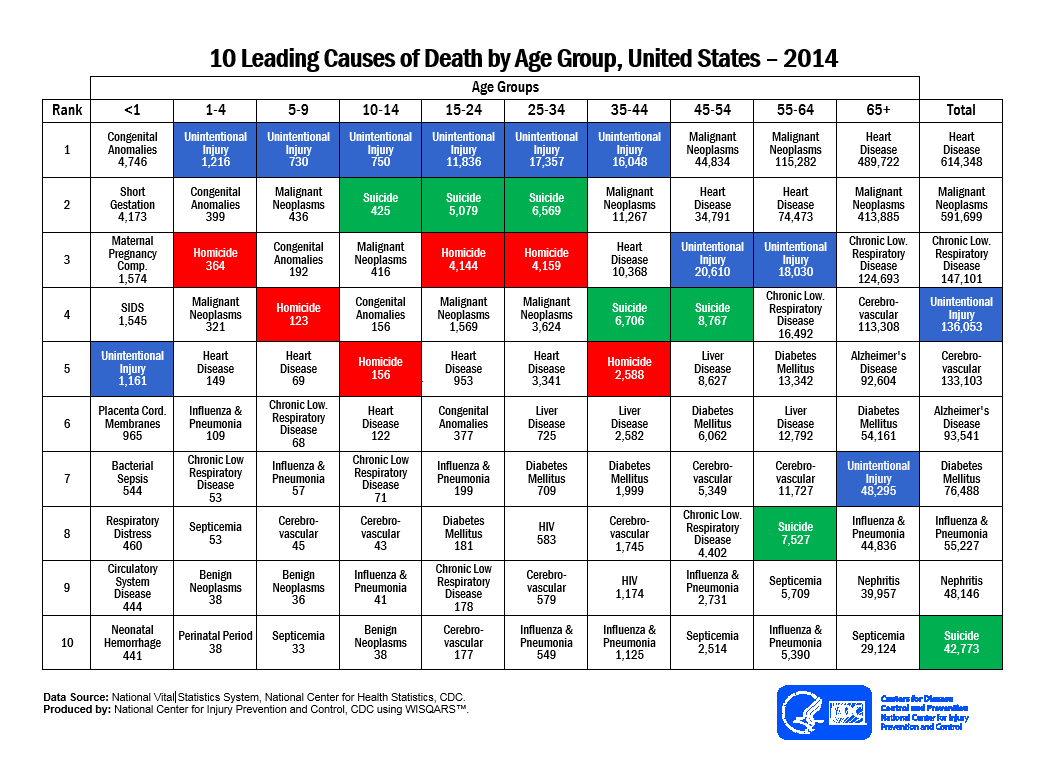
According to the Centers for Disease Control, for children ages 5 through young adults age 24, the leading cause of deathis auto accidents. For accidental causes of mortality, there is no close second. Even drowning, which we are militant about here in terms of baths, pools and time at the lake, is just a fraction of auto accidents. Imagine two 9/11 attacks each year that killed just kids and you still would not have the number of child fatalities America has each year from auto accidents…

If we are serious about wanting what is best for kids, shouldn’t we be doing everything we can to reduce the number of auto trips people are required to take each day? And when people do take trips, shouldn’t our top priority be reducing the travel speeds on local streets? Once outside of the local street network, shouldn’t our top priority be the removal of the greatest source of accidents – intersections – so traffic can flow smoothly?

The best thing we can do for the safety of our children is to get them out of the car by building mixed-use, walkable neighborhoods.

The post also mentions a controversial Freakonomics article suggesting that the biggest increase in children’s safety came from putting them in the back seat of cars, not from car seats.

This brings up a couple interesting questions that I grapple with. First, I think it is crystal clear that the less your child is in cars, the safer they are. So living in a neighborhood where they can walk to school, and you can walk together on most shopping and recreation trips, is a big win for the child’s safety. The difficult questions are, when you are occasionally caught in the rain or late for school, is it okay to jump in the back seat of a cab or Uber with your child, even though you haven’t lugged along the car seat, and it may even be illegal? And second, if you have a school within walking distance that doesn’t have the reputation of a school that requires a car or bus ride everyday, what is the overall best choice for the child? My wife and I make these decisions every day, and the choices we make are not the ones most people we know would make in the same situation. In fact, we just don’t talk about these choices much because people tend to have strongly held opinions. So I’ve added car seats and urban school districts along with politics and religion to the list of topics I don’t bring up in polite company. And yet, to me the choices are clear and I feel perfectly fine about the ones I have made.

Theranos

This is the story of Theranos, a biotech startup that was supposed to have a revolutionary blood-testing technology but ultimately turned out to be a scam. It turned out the technology didn’t work. It probably didn’t start out as a scam. They probably thought they were close to getting it to work, sold investors and consumers on the idea, thought if they could hide the problems for awhile they could buy some time to make it work and get away with it. But, it never worked and they eventually couldn’t hide the problems.

The most interesting part of the story, to me, is whether the tech startup model will translate to the biotech sector. The article has a little bit to say about that:

Holmes had indeed mastered the Silicon Valley game. Revered venture capitalists, such as Tim Draper and Steve Jurvetson, invested in her; Marc Andreessen called her the next Steve Jobs. She was plastered on the covers of magazines, featured on TV shows, and offered keynote-speaker slots at tech conferences. (Holmes spoke at Vanity Fair’s 2015 New Establishment Summit less than two weeks before Carreyrou’s first story appeared in theJournal.) In some ways, the near-universal adoration of Holmes reflected her extraordinary comportment. In others, however, it reflected the Valley’s own narcissism. Finally, it seemed, there was a female innovator who was indeed able to personify the Valley’s vision of itself—someone who was endeavoring to make the world a better place…

Holmes subsequently raised $6 million in funding, the first of almost $700 million that would follow. Money often comes with strings attached in Silicon Valley, but even by its byzantine terms, Holmes’s were unusual. She took the money on the condition that she would not divulge to investors how her technology actually worked, and that she had final say and control over every aspect of her company. This surreptitiousness scared off some investors. When Google Ventures, which focuses more than 40 percent of its investments on medical technology, tried to perform due diligence on Theranos to weigh an investment, Theranos never responded. Eventually, Google Ventures sent a venture capitalist to a Theranos Walgreens Wellness Center to take the revolutionary pinprick blood test. As the V.C. sat in a chair and had several large vials of blood drawn from his arm, far more than a pinprick, it became apparent that something was amiss with Theranos’s promise…

Silicon Valley, once so taken by Holmes, has turned its back, too. Countless investors have been quick to point out that they did not invest in the company—that much of its money came from the relatively somnolent worlds of mutual funds, which often accrue the savings of pensioners and retirees; private equity; and smaller venture-capital operations on the East Coast. In the end, one of the only Valley V.C. shops that actually invested in Theranos was Draper Fisher Jurvetson. Many may have liked what Holmes represented about their industry, but they didn’t seem to trust her with their money.

I think we are on the cusp of some kind of biotech boom. The question is, what will it look like, who exactly will it benefit, and who will want it? The health care and agricultural sectors are the most obvious fields. In fact, I think it is already pervasive in those fields. We are starting to here about biotech methods of fighting mosquitoes, and I suspect we will pull out all the stops when diseases like dengue and Zika start to affect people in the rich world. Agricultural pests won’t be far behind. Maybe stingless, pesticide resistant bees to replace our lost pollinators. Food science may weigh in with yeast vats that produce food without photosynthesis and animal protein without animals, although consumers are going to be very wary of these products at first. Viruses targeting specific bacteria might be the answer to antibiotic resistance. We may see cures for diseases that have alluded us until now, and a steady uptick in total life span and healthy life span at least among the moderately affluent. New fertility treatments, ways to preserve egg and sperm cells for long periods of time or even across generations, organ and whole organism cloning, ways for same-sex couples to have biological children, children carried by surrogate mothers, etc.

But these technologies all seem like they will benefit a few big corporate players, not the kind of broad-based startup ecosystem we have seen with information technology. Maybe that is okay. The idea of dorm room and garage genetic engineering labs is a little scary after all. But if there was a kind of broad-based, consumer-focused biotech innovation ecosystem, what would it look like? Maybe novel pets and houseplants. Maybe novel bioelectrical devices like radios, batteries, chargers, night lights, phones, computers, watches and other things that glow in the dark. Maybe energy-related devices like solar cells, fuel cells, oil-producing algae and bacteria that produce methane, methanol or other useful organic products from garbage. Maybe new forms of water and wastewater treatment that can work at many scales. Maybe new forms of biodegradable packaging. Maybe building materials and machines that can grow and heal. New forms of manufacturing. Maybe somebody will figure out how to put DNA in a computer or a computer in DNA.

This all sounds like nutty stuff now, when we are just starting to yawn at the wonders of the infotech age that seemed nutty a decade or two ago. They are such a part of our lives now that we have already forgotten life without them, and we think we saw them coming all along. I think biotech is already here behind the scenes, much as infotech was in the 80s and early 90s, and at some point it is going to seem to burst into the public consciousness just as infotech did in the mid-90s with the advent of the internet. I just don’t know what the biotech equivalent of the internet is going to be.
a career in ice delivery

Apparently, not only was ice delivery a pretty good business early in the 20th century, but ice delivery men also did okay with the ladies. I guess not too many ladies could afford a pool boy back then. But in all seriousness, the transition from ice to refrigeration is a pretty interesting case of a new technology displacing an old. It took about 10 years for sales of the new technology to exceed the old, and about 30 years for the ice box to go away entirely.

In Philadelphia, one major ice company, Knickerbocker, had massive plants, one with 125 employees and storage capacity for a million tons throughout the city. With the help of 1,200 horses and mules, Knickerbocker drivers kept more than 500 delivery wagons mobile on the streets. At the start of the 20th century, America seemed to need every last one its 1,320 ice plants. And the nation’s iceboxes multiplied. Between 1889 and 1919, the value [of] iceboxes manufactured in the United States increased from $4.5 million to $26 million…In 1920, a household refrigerator cost $600 (more than $7,500 in today’s dollars) and broke down about every tenth week…

Between 1920 and 1925, the number of refrigerators in American kitchens rose from 4,000 to 75,000. In 1926 they boomed to 248,000 units and by 1928, 468,000. The following year, Frigidaire manufactured its millionth refrigerator. By 1930, the sales of electric household refrigerators surpassed those of iceboxes…By 1940, 63 percent of all households had refrigerators—13.7 million of them. Four years later, 85 percent of America’s kitchens were equipped…

By 1953, when the last U.S. icebox manufacturer went out of business, the young, virile delivery man carrying dripping, often dirty, blocks of ice into millions of clean American kitchens, the man whose proximity to wives and daughters fueled countless rumors, would-be scandals and jokes on stage and screen, that man, the iceman, finally found a new home—and new purpose—in nostalgia purgatory.

And now , just because, the relevant Top Gun clip:

parking benefit districts

This article explains why eliminating minimum parking requirements is such a good idea, and suggests the idea of parking benefit districts as a way to get past misguided political and neighborhood opposition.

Eliminating existing requirements currently on the books in almost every city, namely that housing builders install lots of off-street parking spaces, is a key strategy for housing affordability. Most people wouldn’t guess it, but parking requirements (or “quotas”) raise the rent—and not just by a little, but by a lot. Here’s a full rundown of how they do so, but some major ways include:

  • Parking quotas raise the cost of building housing, especially inexpensive housing, and they suppress the number of apartments and houses that can fit on a lot—often by a quarter to a half.
  • Parking quotas block adaptive reuse of old buildings, such as vacant warehouses, to housing.
  • Parking quotas disperse housing by suppressing housing units per city block, which exacerbates sprawl and therefore distances traveled, which makes transit less practical and driving more common. And driving is expensive.

I’m all for it. The only concern I can think of is that neighborhoods with higher-cost parking (likely to be more desirable, richer, less diverse neighborhoods in most cities) would get greater benefits than other neighborhoods. So it seems like maybe a portion of it could stay in the neighborhood, and a portion could be shared across all neighborhoods in a city or even metro area that agree to the policy.

This is both a great example of progressive policy innovation, and a market-based way of aligning peoples’ economic incentives with the best policies. So it should be able to gain support across the political spectrum. But the article also talks about how bureaucrats at existing transit agencies can be an obstacle to this sort of policy (as they can to other good ideas like flexible bus routes). This is sad. In my ideal world, there would be a single agency in charge of getting people from point A to point B and using space in the most efficient, safest and healthiest ways, open to innovation and stakeholder input.

why I don’t bike in Philadelphia

I’m a huge believer that bicycling should be the second most common form of transportation in cities, after walking. Walking is the perfect way to run errands in a residential neighborhood. Some people are lucky enough to be able to walk to work, but not everybody wants to live in the central business district, so the nicest neighborhoods are often a few miles from the center, a little far to walk but perfect for biking. Biking promotes the perfect city layout, and the perfect city layout promotes biking. It also saves time, promotes exercise, physical and mental health, saves energy, promotes cleans air, and is good for business. So I’m a huge believer. But I don’t bike very much. Occasionally on the weekend for recreation, but almost never on weekdays to get to work, and absolutely never to take children to and from school. Here’s why:

On a bicycle in Philly, I’ve been spit on, cussed at, honked at, clipped by rearview mirrors, and told to do things to myself that can’t be written in any respectable publication. More times than I can count, I’ve had vehicles clearly try to make a point by speeding by me way too closely … only to be stopped at a red light half a block away. And all for riding my bike in a legal, responsible way…

But what about all those scofflaw bikers, blowing through stop signs and weaving through traffic with their devil-may-care attitudes? Bikers just don’t follow the rules of the road! …

But, I’ve also got some top-secret info: Cars in Philly break traffic laws, too. In fact, you might think that sliding through a stop sign perfectly, pulling a fast U-turn on Broad Street, driving down a one-way street the wrong way, and texting while driving, steering with your knees, are all on the PennDOT driving test. (Swerving around potholes and deciphering parking signs is probably on there too.) Because we’ve all seen cars do these things, and more, in Philly. All the time.

And the fact is, when drivers do these things surrounded by two tons of steel, it’s a whole lot more dangerous for everyone on the street and sidewalks than when a bicyclist does the same with a 20-pound bike.

Recently, City Council President Darrell Clarke said, “This is Philadelphia. People drive to the corner store. This is what we do.”

Sigh.

“This is what we do,” sounds a whole lot like “This is the way we’ve always done things.” And “this is the way we’ve always done things” has got to be the laziest, worst excuse for doing anything ever…

Those are appalling statistics. Philly’s got a problem. And it has to do with cars hitting bicyclists.

What’s best for the city is not the status quo. What’s best is more protected bike lanes, real progress toward Mayor Kenney’s commitment to Vision Zero, and more access to modes of transportation other than private vehicles.

I couldn’t agree more. One thing the article doesn’t mention is that the police openly state that they don’t enforce the traffic laws because they are busy fighting violent crime on our city’s streets. Well, how exactly is the murder of pedestrians and bicyclists on our city’s streets by illegal driver behavior not considered violent crime on our streets?

Enforcement could help in the short term, but human behavior should be taken mostly out of the equation by better street design in the longer term. Safe street designs have been nearly perfected in Northern Europe and are slowly coming to U.S. cities, even including our cousins over in Pittsburgh. But in Philadelphia, supposedly a leader on progressive policies, our political and bureaucratic leaders seem to believe that what is common in sister cities is crazy or impossible here, because they have apparently never left the county. People are dying as a result of these ignorant cowards.

I would love to see Mr. Kenney show real leadership and appoint some real leaders instead of the same old ignorant, cynical, can’t-do bullshit that has held Philadelphia back from being a world-class city for decades. It seemed like we were finally turning the corner under Mayor Nutter, but it seems to me that we are backsliding now. Please prove me wrong, Mr. Kenney!

Lake Powell

from the Arizona Daily Star:

a new study warns that the lake [Lake Powell] could virtually dry up in as few as six years if the region gets a repeat of the dry spell it experienced from 2000 to 2005…

During the 2000-2005 drought, Lake Powell lost 13 million acre-feet of water and dropped almost 100 feet.

Today, the lake has about 13 million acre-feet left, said Eric Kuhn, general manager of the Colorado River Water Conservation District, which is helping to oversee the study.