I like this idea. It’s the kind of idea cowardly city councils across the USA can get behind because it costs them zero dollars. Just require employers providing “free” or discounted parking to their employees to let their employees opt out and receive the cash value instead. This makes more sense to me than free bus service, which is often not configured well for our urban areas (i.e., our urban areas are not configured right for transportation, but we don’t think of it this way, do we?).
“Conservatives” will support this because it is a free market solution, right? Don’t force people to pay extra taxes and fees to support other peoples’ subsidized parking. Let the market set the price of driving, parking, and all other modes of transportation. No, I’m not this naive. Conservatives generally support the status quo, even if it is demonstrably, logically and indisputably anti-free-market.
When I first heard ideas for year-round school, my thought was that it might be easier for working parents (the main pitch here in Philadelphia) but worse for student and teacher burnout. According to at least one advocacy organization though, the idea is to spread the year out by taking more short breaks rather than one long one. This kind of makes sense to me, but apparently a number of school districts have tried it and ended up scaling it back.
The National Association of Year Round Education advocates for districts to implement the “balanced calendar,” which shortens summer vacation and adds longer breaks called “intersessions” during the school year. The group’s suggested calendar uses a 30-day summer break and breaks for fall, winter, and spring of 15 days each, plus a three-day break for Thanksgiving…
After a long summer break, according to Hornak, teachers generally spend the first 20 to 40 days in school reteaching students to compensate for summer learning loss. With traditional school calendars, “schools are asked to remediate learning gaps that they are contributing to,” Hornak said.
For the affluent, and for the middle class willing to make some sacrifices, summer is a great time for enrichment for kids. Kids are susceptible to burnout like other human beings and deserve a break from the pressure of academics once in awhile. They can connect with nature, learn practical skills, or dive deeper into an interest like a sport or fine art, and meet like-minded kids that they might not meet other times. Work experiences and job training can be enriching if done right – but need to be careful with this one.
For working parents of limited means or just other priorities than spending all their money on private school and summer camp, school can be a godsend as a form of childcare, like it or not. School breaks can cause a lot of stress for parents who have to organize childcare and transportation to and from said childcare, without any corresponding change in their work schedules or responsibilities. Organizing childcare for a long summer break is stressful, but at least it can be done once and and then set for a few months, rather than having to do this for many short breaks during the course of the year.
For the most part, kids aren’t allowed to just run around in the woods or on city streets any more. This is probably good for their physical safety overall, and those days are not going to come back any time soon.
In an ideal world, all children would be able to have the types of enrichment experiences that affluent children have today. It could be done. It would take money and organization. Investing in children is the best investment our society can make, even from a purely hard-nosed economic perspective. It has to be the whole of society investing. It can’t be just parents of young children for a few years during what is supposed to also be their peak career years. That just doesn’t work for anyone from a financial or mental health perspective.
But affluent families vacationing in the Catskills, please just watch your teenage daughters around those “dirty dancing” instructors!
The (paywalled) Philadelphia Inquirer reports on a citizen science bird count showing a massive drop in the pigeon population over the last few years. At the same time, raptor populations like red-tailed hawks and Peregrine falcons are up. There are reasons the data are uncertain, but this is still pretty cool.
I’ve had some memorable raptor sitings in Philly over the years. Recently, I heard a significant commotion and looked up to see a red-tailed hawk in a tree very close to my front door. This was early spring before there were leaves on the trees, so I imagine it had a good line of site to the ground. Mice and rats were the first prey species that popped into my mind, but yeah there are pigeons around too.
Peregrine falcons are not very shy in urban environments. I remember seeing one sitting on a street map above a busy street, next to a park that I know from personal experience is full of mice, rats, and pigeons.
Once I saw a falcon that had trapped a squirrel under a bench in Rittenhouse Square. Like I said, they are not shy around people, but when the park is busy they will tend to be hire up in the trees or on buildings. This was very early in the morning, and the falcon was just sitting there on the bench with the squirrel underneath. The squirrel would try to run out, and the falcon would swoop out and try to get its talons around the squirrel, and the squirrel would slip out and dart back under the bench. Falcons are big birds. I gave this one a respectful distance, but it took no notice of me whatsoever.
We have a presumptive mayor-elect who won less than a third of the vote. This is because we have a first-past-the-post system. It is not a democratic system because the absolute lowest bar you can set for a democratic system is majority rule. Cherelle Parker is a Black woman who beat a Jewish woman and an Asian-American woman who (the latter two) had very similar policy positions and together won about 45% of the vote. I mention race here not because it should matter, but because racial politics are a reality in this city and some voters are never going to cross racial lines no matter what policy positions or records of achievement are on display.
https://vote.phila.gov/results/
Now, I wish presumptive Mayor-elect Parker well. I promise to give her some time and ultimately judge her by her actions and not just her rhetoric. But during her campaign, she did not speak to issues that matter most to me. She spoke mostly about violence and education. Of course, I care about violence and education. I am raising (incidentally, mixed-race, not that it should matter) children in this city. But the mayor ultimately has limited control over these issues. Nobody knows, absolutely 100%, what has caused the current spike in gun violence. You can come up with some ideas, look at the evidence for what has worked in the past and in other cities, and try some things. But Cherrelle Parker is not a candidate who talked about evaluating evidence or best practices from other cities. In fact, a large part of her campaign pitch was that other candidates had spent time in other cities and were bringing ideas from elsewhere, and Philadelphia voters do not want people from elsewhere “telling us what to do”. As for schools, they are controlled by the School District of Philadelphia, which the mayor has only some limited control over, and which is limited by decisions of state legislators, some with pointy white hoods in their closets. Again, you can look at evidence and best practices and try some things, but her campaign platform if anything had an anti-intellectual bent, and that seemed to appeal to a plurality of voters in this city. Cherelle Parker was a state legislator at one point, and she is clearly a talented, successful politician, so maybe she will have some ideas on how to get more state funding and remove barriers imposed by the anti-city pointy white hood crowd in the middle of the state.
Philadelphia has outdated sanitation practices. Mayors have 100% direct control over these practices. The trash situation is a major nuisance, and the Atlantic Ocean will be full of Philadelphia trash for 10,000 years after our civilization is gone. I am a civil engineer and an environmentalist, and I am morally outraged by this. I somewhat doubt Mayor Parker is going to fix it, but again I will give her the benefit of the doubt.
Philadelphia has outdated and, I will just say it, incompetent street design practices. Whether children are dying on our city streets from gun violence or car violence, they are dying and this is morally outrageous. I somewhat doubt Mayor Parker is going to fix it, but again I will give her the benefit of the doubt.
You see my point here. Competent leadership at the Philadelphia Streets Department, which oversees sanitation and street design and maintenance, is absolutely crucial. Our city is decades behind even average practice elsewhere in the county, let alone the world, and people and the environment are suffering as a result. Part of Cherelle Parker’s campaign pitch, which apparently resonated with voters, is that she has spent her whole life in Philadelphia and never lived anywhere else. Will she be the one to bring our city up to even average standards of safety? Prove me wrong, presumptive Mayor-elect Parker.
Here are some insights into what happened.
This is so obviously a false choice. Safe, modern street designs, along with reliable public transportation, allow people to get to work and earn a living. They keep children from dying on public streets. But people don’t see it this way. Philadelphia has a concentrated poverty problem. The field of economics predicts that people whose basic needs are not met will not be advocates for what are seen as luxuries, such as environmental quality and convenient, safe travel. People whose basic needs are not met are going to be advocates for the basic needs such as food and shelter. Then, when people whose basic needs are met advocate for a higher level of services, such as safe streets, people whose basic needs are not met resent this. People also just tend to be resistant to change, and opposition to upgrades to safe street design reflect this, even if they would mean fewer dead children.
Sadly, concentrated poverty is the result of a century or more of racist land use and housing policy. It can’t be solved within the narrow political jurisdictions where it occurs, but rather needs to be solved by some income distribution and basic service provision at the state and federal scale. The working class and middle class in Philadelphia is absolutely tapped out when it comes to taxes, so even those of us who might support some level of income redistribution at the state and federal level are struggling to get by. Meanwhile, our local politicians try to address concentrated poverty by narrowing the tax base, restricting development, and creating disincentives for affluent taxpayers to move into the city or university graduates to stay and join the tax base. We were a city of 2 million people at our peak and are down to about 1.6 million. Like it or not, growing the tax base would benefit the poor. Safe modern streets, excellent public transportation, and schools that just meet modern building codes would all help. But our politicians just can’t get out of their own way.
I love you, Philadelphia. Prove me wrong, Mayor Parker.
Fox News mentions three possible third party candidates in the 2024 U.S. Presidential election:
Asked if three moderates — Democratic Sen. Joe Manchin of West Virginia, Republican Sen. Susan Collins of Maine, and former GOP Gov. Larry Hogan of Maryland — would be considered for the potential ticket, Lieberman said they “are very active members of No Labels” and “would be naturals to consider” as he pointed toward their “strong records of bipartisanship and getting things done for the country and for their constituents.”
Third party candidates matter. I tend to think Ross Perot almost certainly hurt George Bush in 1992, an outcome I liked, and made a decisive difference against Al Gore (and Lieberman!) in 2000, an outcome I hated. It would be much better to have a runoff or instant runoff system which would allow us to elect a President who actually gets a majority of the votes, but that is not the system we have for the foreseeable future.
Just a quick reminder that Bernie Sanders took the moral high ground in 2000 and chose not to run as an independent, or “pull a Nader” as one could say. That would have almost certainly have hurt Biden.
What would a “moderate” (by U.S. standards, “well-right-of-center” by international standards) candidate mean in 2024? It’s hard to say. Biden is firmly center-right, and I somewhat doubt a self-described moderate candidate would be much to his right, if at all. But that is the reality. The perception is that the Republican party has successfully tarred him as a “liberal” as they have successfully done to every center-right candidate since Clinton at least. So a “moderate” candidate might take voters away from Biden who self-identify as centrists. The “moderate” candidate would almost certainly take votes away from Trump, especially if they managed to attract the religious conservative vote. So after thinking it through, I think Trump could actually come in third in a contest involving a third-party candidate, and there could be a pretty close contest between Biden and the third party. Which would leave the Republican Party wondering how it got left on the outside of the “establishment” looking in. The Democrats could be even more dismissive of the actual center-left which favors better benefits for working people in line with other industrialized countries. Long live the Pro-Business, Pro-War (which is a business after all) Consensus!
This article in the “Nonzero Newsletter” has a litany of complaints about how the U.S. is seen by many people around the world to be hypocritical when it talks about peace and democracy. This lack of trust goes back at least to the Vietnam War, so it might take us a long time to dig ourselves out of this hole, if we were to actually start digging.
We think a “rules based order” is a morally good thing, but we also think it serves the interests of other nations by fostering a peaceful, stable, predictable world.
And it’s true that their interests would be served by this kind of order—but unfortunately this isn’t the kind of order America actually supports. Our “rules based order” allows us to inflict mayhem when and where we please, because it doesn’t involve the consistent application of rules. It’s an “order” that camouflages the pursuit of US interests as the US (however confusedly) conceives of them. And people in the “nonaligned world” see this—which helps explain why they’re not signing onto our mission.
The people who don’t see it are the people responsible for it: US foreign policy elites. So their failure to understand the motivations of other world actors is sometimes intertwined with, and in a sense rooted in, a failure to understand their own motivations—the ultimate blind spot. If we saw ourselves more clearly, we’d have an easier time understanding why others react to us as they do. Sometimes cognitive empathy begins at home, with simple self awareness.
Here are some shovels, “foreign policy elites”, now start digging.
I was recently reading George W. Bush’s memoir Decision Points at the suggestion of a relative. The book helped me to see him as a better-intentioned leader than I did previously, but it also reinforced my sense that he had an extraordinarily oversimplified understanding of other parties’ motivations. Take Al Qaeda for example. His understanding was that they “hated us because they hate freedom”. Nothing could justify their cowardly attacks on civilians, of course. But try to put yourself in their shoes, and it seems clear that they saw themselves acting in self defense in response to what they (Bin Laden at least) saw as a U.S. occupation of Muslim holy lands, going back to at least the 1990s. Then, following the U.S. and NATO actual occupation of Afghanistan, they perpetrated more cowardly attacks on civilians in the UK and Spain, in their minds in response to the occupation. So there was a cycle of escalating violence, and just being able to recognize this might have been a first step in figuring out how to deal with it. We might be making similar errors in our dealings with Russia and China today.
The CIA has always mucked around in other countries’ elections. This is from Monthly Review, a self-described Marxist magazine based in New York, so you be the judge of its credibility. But anyway, this is about Mexico around the late 1970s or so.
The documents, most of which are related to a CIA probe into the assassination of President John F. Kennedy in 1963, contains a memo from a meeting of CIA agents held on November 29, 1976. In said meeting, U.S. intelligence official Bill Sturbitts said to his colleagues that “Mexico will soon have a new president, a man who has had control of Liaison for a number of years…”
López Portillo was not the only former president of Mexico to have been on the payroll of the CIA. Three other presidents who preceded him, namely, Adolfo López Mateos (1958-1964), Gustavo Díaz Ordaz (1964-1970), and Luis Echeverría (1970-1976) were also revealed to be CIA assets in earlier declassification of official U.S. documents. All these former presidents committed acts of grave human rights violations and crimes against humanity against the people of their own country, but that did not stop the United States, the self-proclaimed champion of “human rights,” from cultivating close relations with them.
Cultivating national leaders was not the only interventionist act that the CIA did in Mexico. Declassified documents over the years have revealed a range of illegal activities of U.S. intelligence in Mexico, including spying on Soviet and Chinese embassies in Mexico City; financing extreme right groups; supporting and coordinating the Mexican armed forces; and infiltrating and subverting left-wing students’ organizations and social movements all over Mexico, in COINTELPRO style, often with fatal consequences for the Mexican people.
That was quite awhile ago, but fast forward to Russia claiming that the 2014 election in Ukraine was a “coup” orchestrated by the United States. It is certainly not implausible to ask if politicians in Ukraine were CIA “assets” at the time (I am not making claims or claiming to have evidence about specific people), if the CIA was spying on say the Russian and Chinese embassies, financing Ukrainian-nationalist anti-Russian groups without asking too many questions about their politics, training and supporting the armed forces (completely in the open on this one). These are dirty tricks, and Russia is certainly not above engaging in any of these dirty tricks itself. I am not claiming any of these dirty tricks would justify Russia invading its sovereign neighbor, but I can put myself in Russian shoes and consider why they might feel a bit paranoid.
The U.S. Army Corps of Engineers is undertaking a $31 billion, two decade project to build a system of flood protection levees and gates for Houston. At first I thought maybe it was designed during the Eisenhower administration and the Corps is just now getting around to building it. But no, it’s nickname comes from Hurricane Ike in 2008. According to Grist, this is “the largest project that the Corps has ever undertaken”. This is impressive, considering the size, scale, and speed (by Corps standards) of the levee construction to protect New Orleans after Hurricane Katrina. Both systems are being questioned as possibly under-designed for projected future climate conditions. It does tell me one thing though – the U.S. Congress will pony up to protect major coastal cities when push comes to shove. There will be more to come.
As I move deeper into middle age, I consider the luxury of a mid-afternoon nap to be one of life’s great pleasures. 30 minutes is about right, according to this article. After reading the article though, I can’t help wondering if longer naps are more of a symptom of other health problems or poor lifestyle choices rather than a driver of them.
My personal prescription for a little mid-afternoon pick-me-up:
Read a book (Kindle is okay, computer or phone not recommended) until you start to feel a bit sleepy.
Close eyes for 20-30 minutes. Just relax, don’t put any pressure on yourself to sleep, or consider meditation if you don’t feel sleepy.
Open your eyes and read a bit more.
Get up and exercise for 20-30 minutes.
Take a shower.
Have a cocktail. Don’t overdo it, just one is good.
Now you’re ready for dinner, people, or whatever you want/need to do in the evening.
Obviously this is not a daily prescription for the harried working parent. I find maybe one afternoon per month to do this, but it is oh so rejuvenating mentally and physically. I fantasize about doing this every day in retirement.
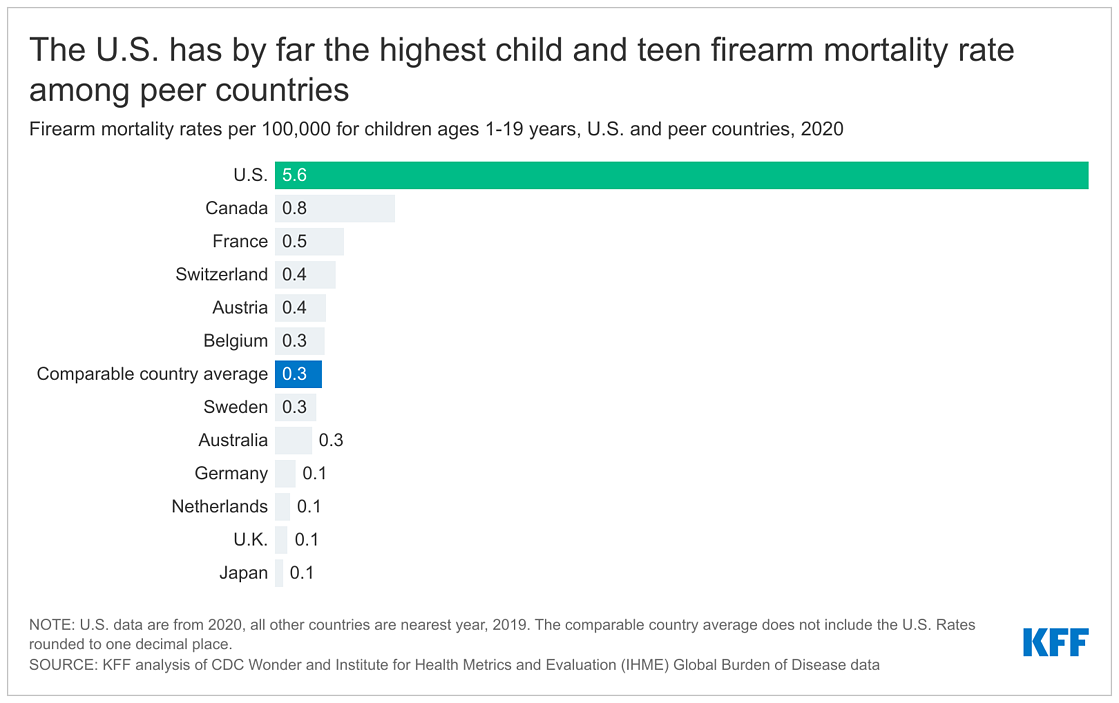
According to KFF (which I hadn’t previously heard of, but describes itself as “the independent source for health policy research, polling, and news”), firearms are the leading cause of death among children in the United States.
Guns – including accidental deaths, suicides, and homicides – killed 4,357 children (ages 1-19 years old) in the United States in 2020, or roughly 5.6 per 100,000 children.
In each of the peer countries, guns kill fewer children than motor vehicles, cancer, congenital diseases, and other injuries, and often behind other conditions such as heart disease.
The U.S. is the only country among its peers that has seen a substantial increase in the rate of child firearm deaths in the last two decades (42%). All comparably large and wealthy countries have seen child firearm deaths fall since 2000. These peer nations had an average child firearm death rate of 0.5 per 100,000 children in the year 2000, falling 56% to 0.3 per 100,000 children in 2019.
This is certainly disturbing and upsetting. I suppose there is some context to consider. For example, children don’t die in large numbers of preventable diseases, which is a great thing, so when they do die it is mostly from rare diseases and accidehttps://www.kff.org/wp-content/uploads/2022/07/guntrol.pngnts. I would want to know how the U.S. compares in overall child mortality to the other industrialized countries considered in this study. Probably not favorably, but not mentioned in this study. I would be interested to know what the breakdown between children and older teens is, and what the breakdown between accidents, homicides, and suicides is. These are all tragedies, but each cause of death within each age group would have different root causes and different solutions.
Regardless, it is negligent and ignorant that we are letting this happen, and yet more proof our country is truly “exceptional”, just not in the good way.