Category Archives: Year in Review

2021: Year in Review

As per usual, I’ll list out and link to the stories I chose as the most frightening, most hopeful, and most interesting each month in 2021. Then I’ll see if I have anything smart to say about how it all fits together.

Survey of the Year’s Stories and Themes

Most frightening and/or depressing stories:

  • JANUARY: A China-Taiwan military conflict is a potential start-of-World-War-III scenario. This could happen today, or this year, or never. Let’s hope for the latter. This is a near-term existential risk, but I have to break my own “rule of one” and give honorable mention to two longer-term scary things: crashing sperm counts and the climate change/fascism/genocide nexus.
  • FEBRUARY: For people who just don’t care that much about plants and animals, the elevator pitch on climate change is it is coming for our houses and it is coming for our food and water.
  • MARCH: In the U.S. upper Midwest (I don’t know if this region is better or worse than the country as a whole, or why they picked it), electric blackouts average 92 minutes per year, versus 4 minutes per year in Japan.
  • APRIL: One of the National Intelligence Council’s scenarios for 2040 involves “far-reaching changes designed to address climate change, resource depletion, and poverty following a global food catastrophe caused by climate events and environmental degradation”.
  • MAY: The Colorado River basin is drying out.
  • JUNE: For every 2 people who died of Covid-19 in the U.S. about 1 additional person died of indirect effects, such as our lack of a functioning health care system and safe streets compared to virtually all our peer countries.
  • JULY: The western-U.S. megadrought looks like it is settling in for the long haul.
  • AUGUST: The U.S. is not prepared for megadisasters. Pandemics, just to cite one example. War and climate change tipping points, just to cite two others. Solutions or at least risk mitigation measures exist, such as getting a health care system, joining the worldwide effort to deal with carbon emissions, and as for war, how about just try to avoid it?
  • SEPTEMBER: The most frightening climate change tipping points may not be the ones we hear the most about in the media (at least in my case, I was most aware of melting ice sheets in Greenland and Antarctica, collapse of ocean circulation patterns). The most damaging may be melting permafrost on land and methane hydrates underwater, both of which contain enormous amounts of methane which could set off a catastrophic and unstoppable feedback loop if released in large quantities.
  • OCTOBER: The technology (sometimes called “gain of function“) to make something like Covid-19 or something much worse in a laboratory clearly exists right now, and barriers to doing that are much lower than other types of weapons. Also, because I just couldn’t choose this month, asteroids can sneak up on us.
  • NOVEMBER: Freakonomics podcast explained that there is a strong connection between cars and violence in the United States. Because cars kill and injure people on a massive scale, they led to an expansion of police power. Police and ordinary citizens started coming into contact much more often than they had. We have no national ID system so the poor and disadvantaged often have no ID when they get stopped. Everyone has guns and everyone is jumpy. Known solutions (safe street design) and near term solutions (computer-controlled vehicles?) exist, but are we going to pursue them as a society? I guess I am feeling frightened and/or depressed today, hence my choice of category here.
  • DECEMBER: Mass migration driven by climate change-triggered disasters could be the emerging big issue for 2022 and beyond. Geopolitical instability is a likely result, not to mention enormous human suffering.

Most hopeful stories:

  • JANUARY: Computer modeling, done well, can inform decisions better than data analysis alone. An obvious statement? Well, maybe to some but it is disputed every day by others, especially staff at some government regulatory agencies I interact with.
  • FEBRUARY: It is possible that mRNA technology could cure or prevent herpes, malaria, flu, sickle cell anemia, cancer, HIV, Zika and Ebola (and obviously coronavirus). With flu and coronavirus, it may become possible to design a single shot that would protect against thousands of strains. It could also be used for nefarious purposes, and to protect against that are ideas about what a biological threat surveillance system could look like.
  • MARCH: I officially released my infrastructure plan for America, a few weeks before Joe Biden released his. None of the Sunday morning talk shows has called me to discuss so far. Unfortunately, I do not have the resources of the U.S. Treasury or Federal Reserve available to me. Of course, neither does he unless he can convince Congress to go along with at least some portion of his plans. Looking at his proposal, I think he is proposing to direct the fire hoses at the right fires (children, education, research, water, the electric grid and electric vehicles, maintenance of highways and roads, housing, and ecosystems. There is still no real planning involved, because planning needs to be done in between crises and it never is. Still, I think it is a good proposal that will pay off economically while helping real people, and I hope a substantial portion of it survives.
  • APRIL: Giant tortoises reach a state of “negligible senescense” where they simply don’t age for a long time. Humans are distant relatives of giant tortoises, so maybe we can aspire to this some day. They are not invulnerable to injury and disease.
  • MAY: An effective vaccine for malaria may be on the way. Malaria kills more children in Africa every year than Covid-19 killed people of all ages in Africa during the worst year of the pandemic. And malaria has been killing children every year for centuries and will continue long after Covid-19 is gone unless something is done.
  • JUNE: Masks, ventilation, and filtration work pretty well to prevent Covid transmission in schools. We should learn something from this and start designing much healthier schools and offices going forward. Design good ventilation and filtration into all buildings with lots of people in them. We will be healthier all the time and readier for the next pandemic. Then masks can be slapped on as a last layer of defense. Enough with the plexiglass, it’s just stupid and it’s time for it to go.
  • JULY: A new Lyme disease vaccine may be on the horizon (if you’re a human – if you are a dog, talk to your owner about getting the approved vaccine today.) I admit, I had to stretch a bit to find a positive story this month.
  • AUGUST: The Nordic welfare model works by providing excellent benefits to the middle class, which builds the public and political support to collect sufficient taxes to provide the benefits, and so on in a virtuous cycle. This is not a hopeful story for the U.S., where wealthy and powerful interests easily break the cycle with anti-tax propaganda, which ensure benefits are underfunded, inadequate, available only to the poor, and resented by middle class tax payers.
  • SEPTEMBER: Space-based solar power could finally be in our realistic near-term future. I would probably put this in the “interesting” rather than “hopeful” category most months, but I really struggled to come up with a hopeful story this month. I am at least a tiny bit hopeful this could be the “killer app” that gets humanity over the “dirty and scarce” energy hump once and for all, and lets us move on to the next layer of problems.
  • OCTOBER: The situation with fish and overfishing is actually much better than I thought.
  • NOVEMBER: Urban areas may have some ecological value after all.
  • DECEMBER: Covid-19 seems to be “disappearing” in Japan, or at least was before the Omicron wave. Maybe lessons could be learned. It seems possible that East Asian people have at least some genetic defenses over what other ethnic groups have, but I would put my money on tight border screening and an excellent public health care system. Okay, now I’m starting to feel a bit depressed again, sitting here in the U.S. where we can’t have these nice things thanks to our ignorant politicians.

Most interesting stories, that were not particularly frightening or hopeful, or perhaps were a mixture of both:

  • JANUARY: There have been fabulous advances in note taking techniques! Well, not really, but there are some time honored techniques out there that could be new and beneficial for many people to learn, and I think this is an underappreciated productivity and innovation skill that could benefit people in a lot of areas, not just students.
  • FEBRUARY: At least one serious scientist is arguing that Oumuamua was only the tip of an iceberg of extraterrestrial objects we should expect to see going forward.
  • MARCH: One study says 1-2 days per week is a sweet spot for working from home in terms of a positive economic contribution at the national scale. I think it is about right psychologically for many people too. However, this was a very theoretical simulation, and other studies attempting to measure this at the individual or firm scale have come up with a 20-50% loss in productivity. I think the jury is still out on this one, but I know from personal experience that people need to interact and communicate regularly for teams to be productive, and some people require more supervision than others, and I don’t think technology is a perfect substitute for doing these things in person so far.
  • APRIL: Hydrogen fuel cells may finally be arriving. Not so much in the U.S., where we can’t have nice things.
  • MAY: I learned about Lawrence Kohlberg, who had some ideas on the use of moral dilemmas in education.
  • JUNE: The big U.S. government UFO report was a dud. But what’s interesting about it is that we have all quietly seemed to have accepted that something is going on, even if we have no idea what it is, and this is new.
  • JULY: “Cliodynamics” is an attempt at a structured, evidence-based way to test hypotheses about history.
  • AUGUST: Ectogenesis is an idea for colonizing other planets that involves freezing embryos and putting them on a spaceship along with robots to thaw them out and raise them. Fungi could also be very useful in space, providing food, medicine, and building materials.
  • SEPTEMBER: Philip K. Dick was not only a prolific science fiction author, he also developed a comprehensive theory of religion which could possibly even be the right one. Also, possibly related but not really, if there are aliens out there they might live in creepy colonies or super-organisms like ants or termites.
  • OCTOBER: I thought about how to accelerate scientific progress: “[F]irst a round of automated numerical/computational experiments on a huge number of permutations, then a round of automated physical experiments on a subset of promising alternatives, then rounds of human-guided and/or human-performed experiments on additional subsets until you hone in on a new solution… [C]ommit resources and brains to making additional passes through the dustbin of rejected results periodically…” and finally “educating the next generation of brains now so they are online 20 years from now when you need them to take over.” Easy, right?
  • NOVEMBER: Peter Turchin continues his project to empirically test history. In this article, he says the evidence points to innovation in military technologies being driven by “world population size, connectivity between geographical areas of innovation and adoption, and critical enabling technological advances, such as iron metallurgy and horse riding“. What does not drive innovation? “state-level factors such as polity population, territorial size, or governance sophistication“. As far as the technologies coming down the pike in 2022, one “horizon scan” has identified “satellite megaconstellations, deep sea mining, floating photovoltaics, long-distance wireless energy, and ammonia as a fuel source”.
  • DECEMBER: Time reminded us of all the industries Elon Musk has disrupted so far: human-controlled, internal-combustion-fueled automobiles; spaceflight; infrastructure construction (I don’t know that he has really achieved any paradigm shifts here, but not for lack of trying), “artificial intelligence, neurotechnology, payment systems and cryptocurrency.” I’m not sure I follow a couple of these, but I think they missed satellites.

Continuing Signs of U.S. Relative Decline

Signs of U.S. decline relative to our peer group of advanced nations are all around us. I don’t know that we are in absolute decline, but I think we are now below average among the most advanced countries in the world. We are not investing in the infrastructure needed in a modern economy just to reduce friction and let the economy function. The annual length of electric blackouts in the U.S. (hours) compared to leading peers like Japan (minutes) is just one telling indicator. In March, I looked at the Build Back Better proposal and concluded that it was more like directing a firehose of money at a range of problems than an actual plan, but I hoped at least some of it would happen. My rather low but not zero expectations were met, as some limited funding was provided for “hard infrastructure” and energy/emissions projects, but little or nothing (so far, as I write this) to address our systemic failures in health care, child care, or education. The crazy violence on our streets, both gun-related and motor vehicle-related, is another indicator. Known solutions to all these problems exist and are being implemented to various extents by peer countries. Meanwhile our toxic politics and general ignorance continue to hold us back. Biden really gave it his best shot – but if this is our “once in a generation” attempt, we are headed down a road where we will no longer qualify as a member of the pack of elite countries, let alone its leader.

The Climate Change, Drought, Food, Natural Disaster, Migration and Geopolitical Instability Nexus

2021 was a pretty bad year for storms, fires, floods, and droughts. All these things affect our homes, our infrastructure, our food supply, and our water supply. Drought in particular can trigger mass migration. Mass migration can be a disaster for human rights and human dignity in and of itself, and managing it effectively is difficult even for well-intentioned governments. But an insidious related problem is that migration pressure can tend to fuel right wing populist and racist political movements. We see this happening all over the world, and the situation seems likely to get worse.

Tipping Points and other Really Bad Things We Aren’t Prepared For

We can be thankful that nothing really big and new and bad happened in 2021. My apologies to anyone reading this who lost someone or had a tough year. Of course, plenty of bad things happened to good people, and plenty of bad things happened on a regional or local scale. But while Covid-19 ground on and plenty of local and regional-scale natural disasters and conflicts occurred, there were no new planetary-scale disasters. This is good because humanity has had enough trouble dealing with Covid-19, and another major disaster hitting at the same time could be the one that brings our civilization to the breaking point.

So we have a trend of food insecurity and migration pressure creeping up on us over time, and we are not handling it well even given time to do so. Maybe we can hope that some adjustments will be made there to get the world on a sustainable track. Even if we do that, there are some really bad things that could happen suddenly. Catastrophic war is an obvious one. A truly catastrophic pandemic is another (as opposed to the moderately disastrous pandemic we have just gone through.) Creeping loss of human fertility is one that is not getting much attention, but this seems like an existential risk if it were to cross some threshold where suddenly the global population starts to drop quickly and we can’t do anything about it. Asteroids were one thing I really thought we didn’t have to worry much about on the time scale of any human alive today, but I may have been wrong about that. And finally, the most horrifying risk to me in the list above is the idea of an accelerating, runaway feedback loop of methane release from thawing permafrost or underwater methane hydrates.

We are almost certainly not managing these risks. These risks are probably not 100% avoidable, but since they are existential we should be actively working to minimize the chance of them happening, preparing to respond in real time, and preparing to recover afterward if they happen. Covid-19 was a dress rehearsal for dealing with a big global risk event, and humanity mostly failed to prepare or respond effectively. We are lucky it was one we should be able to recover from as long as we get some time before the next body blow. We not only need to prepare for much, much worse events that could happen, we need to match our preparations to the likelihood of more than one of them happening at the same time or in quick succession.

Technological Progress

Enough doom and gloom. We humans are here, alive, and many of us are physically comfortable and have much more leisure time than our ancestors. Our social, economic, and technological systems seem to be muddling through from day to day for the time being. We have intelligence, science, creativity, and problem solving abilities available to us if we choose to make use of them. Let’s see what’s going on with technology.

Biotechnology: The new mRNA technology accelerated by the pandemic opens up potential cures for a range of diseases. We need an effective biological surveillance system akin to nuclear weapons inspections (which we also need) to make sure it is not misused (oops, doom and gloom trying to creep in, but there are some ideas for this.) We have vaccines on the horizon for diseases that have been plaguing us for decades or longer, like malaria and Lyme disease. Malaria kills more children worldwide, year in and year out, than coronavirus has killed per year at its peak.

Promising energy technologies: Space based solar power may finally be getting closer to reality. Ditto for hydrogen fuel cells in vehicles, although not particularly in the U.S. (I’m not sure this is preferable to electric vehicles for everyday transportation, but it seems like a cleaner alternative to diesel and jet fuel when large amounts of power are needed in trucking, construction, and aviation, for example.)

Other technologies: We are actually using technology to catch fish in more sustainable ways, and to grow fish on farms in more sustainable ways. We are getting better at looking for extraterrestrial objects, and the more we look, the more of them we expect to see (this one is exciting and scary at the same time). We are putting satellites in orbit on an unprecedented scale. We have computers, robots, artificial intelligence of a sort, and approaches to use them to potentially accelerate scientific advancements going forward.

The State of Earth’s Ecosystems

The state and trends of the Earth’s ecosystems continue to be concerning. Climate change continues to churn through the public consciousness and our political systems, and painful as the process is I think our civilization is slowly coming to a consensus that something is happening and something needs to be done about it (decades after we should have been able to do this based on the evidence and knowledge available.) When it comes to our ecosystems, however, I think we are in the very early stages of this process. This is something I would like to focus on in this blog in the coming year. My work and family life are busy, and I have decided to take on an additional challenge of becoming a student again for the first time in the 21st century, but somehow I will persevere. If you are reading this shortly after I write it in January 2022, here’s to good luck and prosperity in the new year!
Wired on the technology of 2021

The Wired Gadget Lab podcast asked what the important (consumer) technologies of 2021 were, and came up with cloud gaming, e-scooters, Peloton, and “unplugging from the internet”. Someone also mentioned the Covid-19 vaccine, which I would tend to agree with.

On cloud gaming, I am looking forward to getting back into video games (I’m middle aged and still call them that) when and if my intensive child rearing years start to slowly and gradually wind down. I used to be a fan of “real time strategy” games, and just assumed I had missed a lot of awesome ones over the last decade or so. But according to another Wired article that is not the case, as the genre has been overshadowed by other, more profitable types of games. Hopefully they will come back, because I think lots of people like them. I can also imagine hybrid games where you take direct a large-scale, long-term strategy but get to zoom in and take part in a battle or other short-term simulation when you want. Sure, this would take a lot of programming and computing power, but the technology is getting there right?

I’ve hit the Wired paywall. I like Wired, but I just can’t subscribe to everything piecemeal and have 99 little charges on my credit card each month that add up to all my money. Can somebody come up with some sort of clever cross-platform discounted bundling service for magazines, newspapers, apps, games and other subscriptions?

Okay, on e-scooters, my position is they are a menace on the sidewalk and have no place on the street. I don’t think I am turning into a grumpy old man – what I mean is our streets and sidewalks are designed with no safe place for them, except where we have safe, well-designed “bike lanes” and signals, which is almost nowhere in the United States. They’re a menace to themselves in the main travel lanes, and people zipping around on fast battery-powered devices have become pretty threatening to pedestrians on our narrow sidewalks. I am not particularly excited about getting an e-scooter, but if their proliferation means we get more safe protected lanes for bikes and scooters, I am all for them. If we get to a place where maybe one in ten people traveling from point A to point B in a city is inside a one-ton steel killing machine, but they are still taking up 90% of the space and killing our children, will our ignorant, cynical politicians and bureaucrats give us safe streets? I will try to be optimistic.

On Peloton, it looks fairly neat. I’d still prefer to exercise outside, but maybe one day I’ll give it a try, or if someone else in the house were to express an interest that might tip the scales in its favor.

I’m trying to think of a technology that changed my life in 2021. When the Apple podcast app glitched out on me after an update, I switched to Overcast and haven’t looked back. I wouldn’t call that life changing. I love my Audible audiobooks and my Kindle from 2013 that is still working just fine. I am still totally addicted to RSS feeds – Feedly is still my go-to app and I hope it and the feeds never go away (they are, though, one by one). I’m been using Microsoft OneNote for years at work. In 2021 I figured out there is a magic button that generates a meeting note template for any Microsoft Outlook meeting, with the date, subject, attendees, etc. all pre-populated. I started using OneNote for personal notes before 2021, but in 2021 I found myself using it more and more and using it across platforms. It all syncs pretty well, and being a helplessly compulsive list maker all my life I love being able to jot down a note anywhere, anytime. I use Philadelphia’s public bike share system, Indego, which works pretty well except a month or so ago I misplaced by bike helmet and haven’t gotten around to replacing it (I’ve dropped a hint with family members I hope have a line to Santa). I use a number of fitness and health tracking apps – including but not necessarily limited to Apple Health (for tracking steps and weight), Virgin Pulse (required by my employer, not necessarily recommended), LoseIt (for calorie counting), MyLimit (for blood alcohol, which to be clear is 0 most of the time but it’s interesting and useful to understand how alcohol affects the mind and body), and MyChart (for medical records). Each of these has a reason behind it, but taken together they are too much. For the month of December, I have decided to just try to maintain healthy habits but not actually track anything. I’d like to find more automated ways of collecting data on these things and reviewing it occasionally so I can consider some healthy adjustments, without opening half a dozen apps and typing things into them every day. And finally, I bought something dumb, expensive and fun called Twinkly, which is an app-controlled string of LED lights.

Project Censored Top 25 Stories of 2021

Let’s see what Project Censored has come up with as their top 25 “censored” stories of 2021. “Censored” has a broad definition here which includes “under-reported”. News stories are under-reported when there is no market for them in our mostly profit-driven media. Anyway, here are a handful that caught my eye:

  • “Coastal darkening” – I hadn’t heard this term, but it encompasses organic matter in the water (from farms and urban runoff and wastewater), algal blooms, and sediment stirred up by human activity. These are all forms of water pollution scientists and engineers have been familiar with for a long time. Solutions are known, but the scale of the problem and cost of dealing with it is difficult. Our industrialized, urbanized, heavily populated civilization creates these forms of pollution. We should appreciate that a lot of money and hard work go on behind the scenes to make these problems much, much less bad than they would be if nothing was done – wastewater treatment, etc. But still, the scale of the problem is daunting to solve completely and we prefer to pay in environmental damage which affects everybody a little bit rather than divert the money and effort it would require to solve them completely. Under the basic economic principle of scarcity, something else would have to give if we did this, at least in the near- to medium-term. In the long term, there is a virtuous cycle where once we get started, technology tends to improve and we learn by doing. But cynical politicians elected on 2-4 year cycles are not going to pitch these ideas to the public, even if they understand them.
  • The pollutants mentioned above (organic matter, nutrients, etc.) are yucky but at least biodegradable. Another article is about microplastics and PFAS in the ocean. They are going to be there until the end of time now, but we could start working on trying not to add more of them.
  • “tens of thousands of satellites” – driven by civilian communications but inevitably useful for military applications. Companies like SpaceX are getting billions of dollars of military-industrial-complex money.
  • factory farming creates a risk for future pandemics – the article is about “U.S. factory farming”, but even if we invented it, it is being done all over the world, and the scale of what is done in Asia dwarfs anything the U.S. or Europe does at this point
  • things are not good for Amazon (the rain forest)
  • You could think of the social cost of past carbon emissions by industrial economies as a kind of debt owed to countries that are less industrialized or have industrialized more recently. That would mean that they have taken up much more than their fair share of the atmosphere’s and ocean’s ability to absorb emissions over time. The US, UK and Europe would probably prefer to focus on their share of current annual emissions rather than their share of cumulative emissions since they got the first lumps of coal in their Christmas stockings and burned them a couple centuries ago.
  • The sky is up, the Earth is down, and US drug prices are still insane. The article estimates the human toll of this in terms of premature deaths.

Longreads Best of 2021

(Too)Long(didn’t)reads.com picks a best article every week, and once a year they list all of them from the past year. I probably won’t have time to really dig into many of these, but there are certainly interesting topics here and they provide a look back on the year.

  • a look back at the January 6 attack on the US Congress by a fascist mob, just a few days after it happened
  • the story of the Covid vaccine development, and on a much less happy note, the Covid carnage in US prisons, and the crisis in India as it was happening
  • “Inside Xinjiang’s Prison State” – I think I may have actually read this. What is happening there meets the UN definition of genocide and must stop. A wrinkle is that its genesis came shortly after the 9/11 attacks and U.S. invasion of Afghanistan. Almost anything could be justified as part of the Global War on Terror at the time. Xinjiang is next door to Afghanistan, and is home to a Muslim ethnic group, and within that ethnic group a resistance/terrorist group formed which perpetrated attacks on the imperial capital. The parallels are surprising when you think about it. The Chinese approach is not acceptable, but did that make the American approach in Afghanistan any more acceptable?
  • Anti-Asian-American violence. I continue to be a bit puzzled by this. I am not questioning its reality, it just doesn’t seem to be happening in the places or to the Asian-Americans I cross paths with. I wonder if it is really new or something like shark attacks that happens periodically and the media suddenly picked up on and made a big deal of for awhile. People could also be reporting it more often now that they feel someone is listening and something might be done about it.
  • Salem, Massachusetts witch tourism

Time person of the year Elon Musk

Hugo Drax…I mean…Elon Musk is Time’s man…I mean…person of the year for 2021. I guess I’m okay with it, since I am interested in electric cars, self-driving cars, and space travel.

He sees his mission as solving the globe’s most intractable challenges, along the way disrupting multiple industries across two decades. These include what was once the core American creation, combustion-engine automobiles, and what was once the core American aspiration, spaceflight, as well as a litany of other manifestations of our present and future: infrastructure construction, artificial intelligence, neurotechnology, payment systems and increasingly money itself through his dalliances with cryptocurrencies.

TIme

Project Syndicate Predictions for 2022

Wow, a dozen or more famous people asked to weigh in and it is almost 100% doom and gloom. To grossly summarize:

  • Carbon emissions will just keep getting worse, and not much will be done. About the most positive thing anyone can say is that pressure for change will increase and the “corporate and financial sectors” will get more serious about it. We are the corporate and financial sectors, and we are here to help!
  • Political dysfunction and polarization in the US and EU. Republicans will retake the US Congress (and both sides will say they knew it all along).
  • US vs. Russia, China vs. US, Iran vs. the US and/or Israel. Several commentators predict one more attempt to revive the Obama nuclear deal, which will fail, which will be followed by more uranium enrichment, which will be followed by a military strike by the US and/or Israel.
  • Bees will continue to decline. Does this seem less important than the other things? Bees pollinate around a third of crops, and even if we find other ways to pollinate crops or grow crops that don’t need pollination, we can look forward to:

Given that heatwaves, droughts, floods, and other extreme weather events prevent people from engaging in agricultural work, and that bees and other pollinators affect 35% of the world’s agricultural land and support the production of 87 of the leading food crops, we will see an increase of global insecurity, even in developed economies. Unable to sustain the production of the food they need, many of the world’s poor will be pushed into extreme poverty, suffer malnutrition, and migrate.

Agnes Binagwaho, Project Syndicate
  • Several point to mass migration as a big issue for 2022. Not a long term issue, but an issue that will come to a head in the next year.
  • On the Covid front, most people think it will just become another disease that kills us some times but we will get used to that.
  • Many commentators think inflation will tone down, and that the bigger risk is governments overreacting to it. Some predict a sharp decline in the US dollar (is this bad for the average Joe? hard to say), and there is already a real estate crash happening in China.
  • A few are optimistic that social safety nets may improve here and there.
  • On the technology front? “One hopes for more demonstrations of the power of recent biomedical and genetic research, amply validated by the rapid development of safe and effective COVID-19 vaccines. There also may be new leaps in additive manufacturing and machine learning.” (Diane Coyle) There may be some progress on “green hydrogen and an overhaul of mobility and transportation systems”.

I’m not known for unbridled optimism, but let me think of a few positive things that could happen in 2022. Electric vehicles could finally emerge in the public consciousness in the US. We will all be surprised if that happens, and then one day later we will all have known it all along. The US could make some progress on the childcare crisis that is holding our country back (see this Fresh Air interview if you don’t believe me). Covid will be annoying and disruptive, but I am predicting it will be less annoying and disruptive on December 31, 2022 than on January 1.

In a way, a good year at this point will be one in which nothing really catastrophic happens and we have some breathing room to chip away at the many challenges already on our plates. We have to hope there will not be a major war, nuclear detonation, epic new plague, major food crisis, catastrophic meltdown of the internet or financial system. Hoping is about all us average citizens can do about the latter list, but if you are one of the movers and shakers out there with the power to help manage these risks, WHAT ARE YOU DOING???

I tried to talk myself into being optimistic just now, and failed, oh well.

NYT best books of 2021

And continuing the “best books” theme, this year’s New York Times list is out. The only one that really catches my eye is When we Cease to Understand the World. This appears to be historical fiction somehow knitting together the 20th century’s great scientists and their ideas.

Other books mostly cover a variety of racial and multicultural topics that are interesting and good to know about, but I do not have time to learn about them in book form. There’s a new autobiography of Sylvia Plath, and I like and am saddened by Sylvia Plath, but I think I would rather spend time reading her original work rather than an autobiography about her. Just a random note since I was briefly talking about Margaret Attwood yesterday – when I think of The Handmaid’s Tale I often think of Sylvia Plath, and also Anne Frank, and also Frederick Douglas and other first-person slave narratives. All depressing, and all things everyone should read. The Handmaid’s Tale is at least a work of fiction although it seems quite real when you are in the middle of it, at least for me, and especially the audiobook version.

Planetizen top 10 books of 2021

Planetizen has its list of top ten urban planning books out. Here are a couple that caught my eye. I don’t know that I’ll actually read these – It’s not like I know everything there is to know about these topics, but I may know enough and be just bored enough to want to spend my dwindling budget of mortal reading time on other things.

  • Confessions of a Recovering Engineer. The case against car-dependence and for walkability. I’m 100% on board. It’s a long and exhausting fight. Also, the title is a bit insulting to engineers, who do not consider our profession an illness to be cured. I guess the point is to draw attention to the book. Well, engineers may not be the intended audience if you are going to insult us before we even open the cover.
  • Metropolis: A History of the City, Mankind’s Greatest Invention. I’m 100% on board with the idea that modern cities can be great places for human beings to live. It’s a long and exhausting fight (see above). This one looks interesting because it appears to be a comparative history of a number of famous cities in history.
  • The Ministry for the Future by Kim Stanley Robinson. This is fiction, and definitely on my list. The reviewer feels that Mr. Robinson (he is neither female nor Korean, Kim being a fairly common British dude name at least in the past) “lacks the superlative writing chops of Margaret Attwood” and “some sentences are begging for an editor”. This surprises me, because this is certainly not Kim Stanley Robinson’s first novel! Now I am even more curious to read it. I have always found Robinson a little challenging to read, but he has an astonishing imagination and is worth reading for this alone.

2021 garden retrospective

Here are a few random thoughts on this year’s growing season. We had our first below-freezing temperatures here in my Philadelphia neighborhood around November 20, which is 3 or so weeks later than “average” (although I’m not sure if what is reported is really the average, or something like a 30% probability to improve the odds a bit for farmers.)

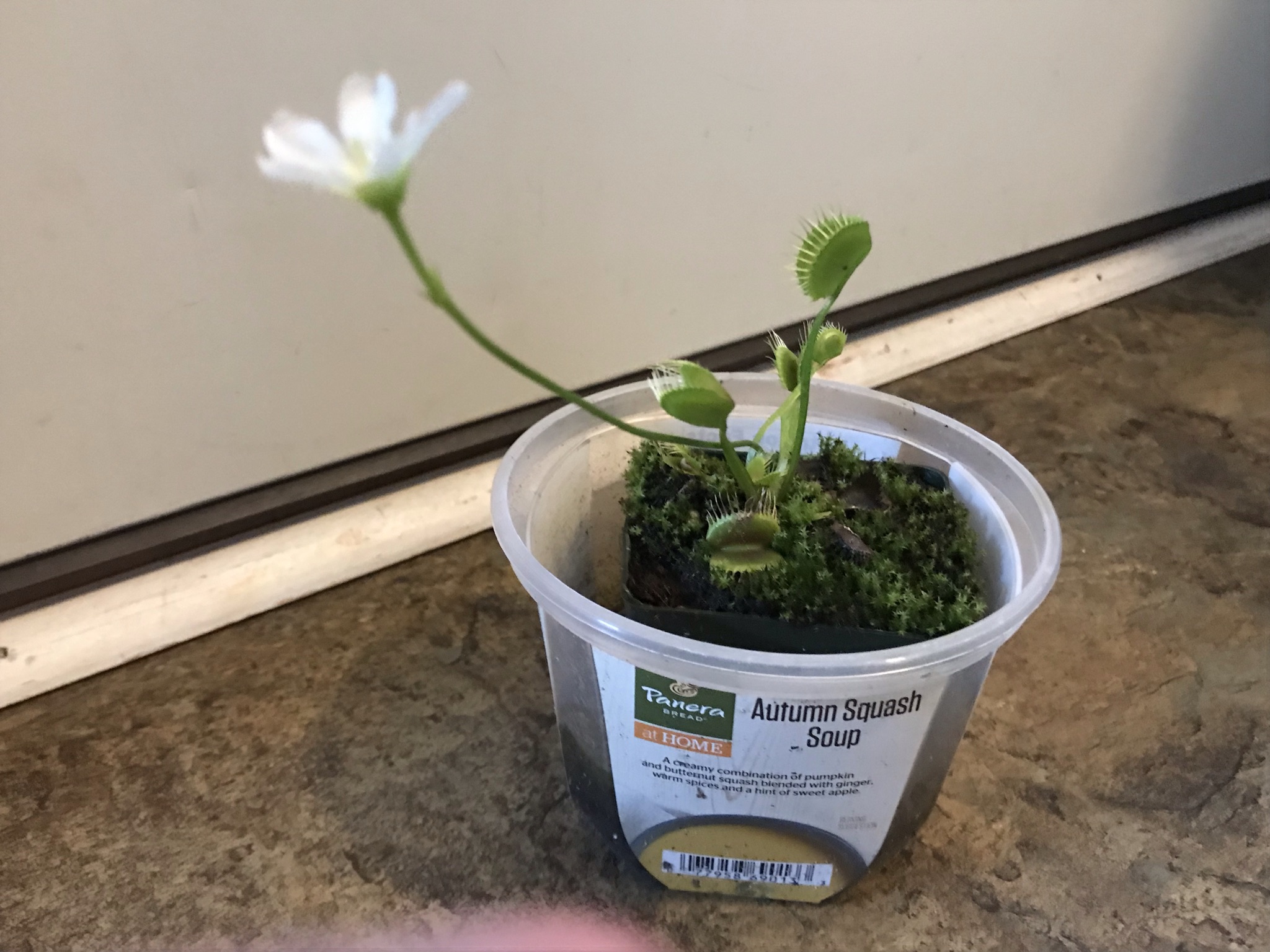
I got my son a Venus fly trap for his birthday in May. They are native to the Carolinas, which is cool, although I bought this one from California Carnivores. We looked at it for awhile, then left it in our buggy backyard for the summer where it seemed to be very, very happy. It even flowered – now a Venus fly trap flower is not a particularly breathtaking flower, but I was excited nonetheless. Most of the time, there was plenty of rain to keep it wet, but I invested in a gallon of distilled water to top it up occasionally. As I write this in early December, I’ve brought it inside for the winter. I’ll continue to give it distilled water, and no matter how sad or even dead it starts to look, I’ll keep watering it and put it back out in the spring. I threw one away a few years ago thinking it was dead, and was horrified to read later that they naturally go dormant in the winter. They can also supposedly handle some light freezes (again, think Carolinas) but not an extended deep freeze, so it seemed safest to just bring it in. My research said to put it in an “unheated garage or entryway” for the winter, but my urban home has neither of these things.

a fuzzy photo of a Venus Fly Trap flower

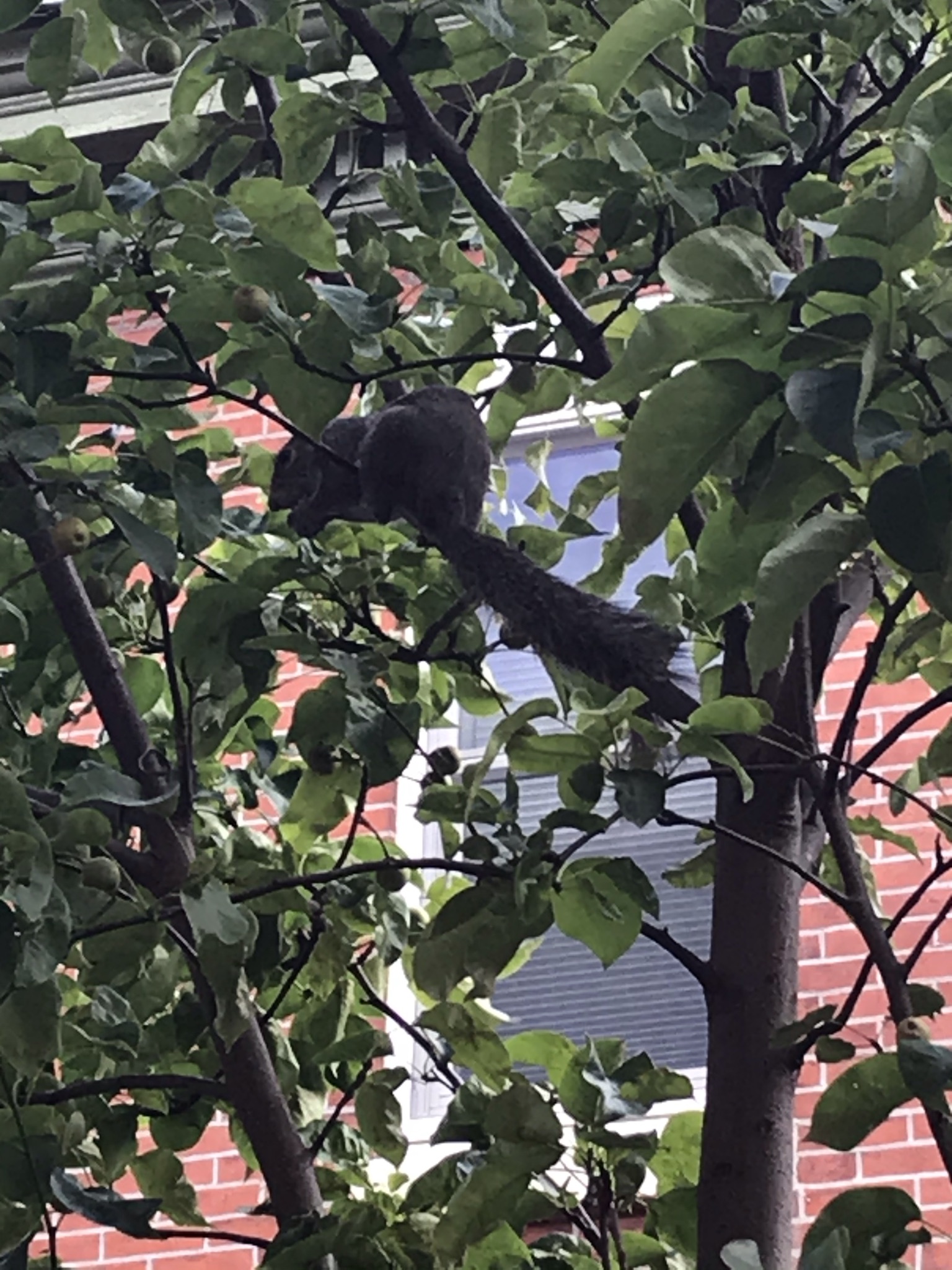
The “dwarf” (advertised as 15-feet but 20+ feet tall and maybe still growing) Asian pear tree grew lots of pears this years, which the squirrels really enjoyed. I picked and ate one unripe one just to get something, but there were no ripe ones left when the squirrels were done with them. The annoying thing is that they don’t actually eat all that fruit, they take a bite or two out of each one and drop the rest on the ground to rot. Luckily, I find squirrel antics fairly amusing and my family is not starving as a result of the fruit they are depriving us of.

On the first day of Christmas, my true love sent to me…a squirrel in an Asian pear tree

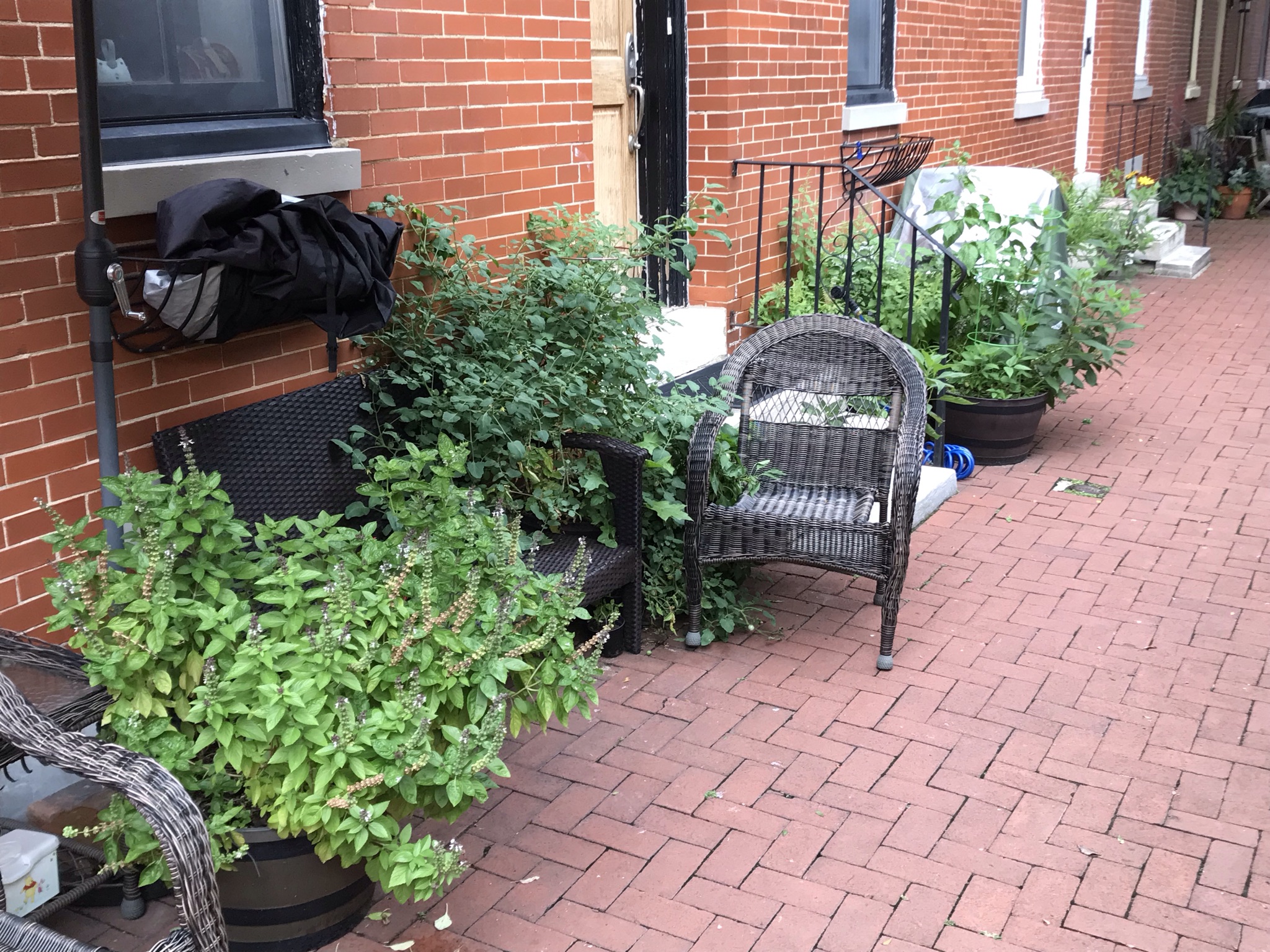
The Asian persimmon tree grew exactly one persimmon this year. This tree is a bit younger (4 years?) so hopefully there is more to come. The squirrels didn’t eat it – maybe they just don’t know what it is – and it was delicious. I thought I had a photo but can’t seem to find one. I believe persimmons are the most delicious fruit that most Americans have never tried. And I don’t know why – the trees are compact, prolific, pest and disease free (the flip side of this is they probably don’t have much ecological value locally), cold tolerant (there are several Japanese varieties), and the fruit is absolutely mouth watering and yet very tough on the outside which seems like it would make for easy shipping. There are native American varieties, but be warned these grow into very big trees which is why I chose the Asian variety. By the way, I am generally partial to native species, but I have not found the right native tree species that works in my small urban garden. I want trees that provide a little bit of shade for the front of the house but leave sunny areas to grow other things, and that I can easily get under or around. My basic principle is that a plant should have at least one other function, whether an ecological function or a food function, other than just looking good. Of course, plants that have all these things are awesome! But like I said, I haven’t identified the perfect tree yet that fits that bill.

Around July, my garden was clear cut (other than the trees) by a gardener hired by a neighbor. And not just mowed, but scraped absolutely to the ground. I was upset, but it was actually kind of interesting to watch how it responded. It’s a perennial garden, so it mostly grew back quickly. More aggressive and resilient plants outcompeted the less aggressive ones for the most part. Interestingly, some plants that are normally aggressive, like Black Eyed Susan, were probably about to flower when they were whacked and apparently decided they were done for the year. I assume their roots are fine and they will be back. Wild strawberries by contrast loved being mowed and took over an entire corner of the garden. There is way too much lemon balm now, even though I like lemon balm. A neighbor actually bought me some native plant seedlings after it happened, which I found really touching. So now I have an aromatic Aster and a Hubricht’s Blue Star in my garden.

After the garden was clear cut, I talked to the neighbor that (inadvertently) did it, and we agreed that I would just take over part of her garden from now on. To get things going quickly, I’ve picked a prairie seed mix (most “prairie” plants are native to the entire U.S. east of the Rockies). I’ve put down some cardboard to suppress weeds from growing back, put a mix of homemade and store-bought compost on top of that, and plan to sprinkle the seeds over the winter and see what happens in the spring. The only issue is that at least one cat has decided this bare soil makes a nice litter box. I intended to plant a fall cover crop but work, family, and life intervened to prevent that project.

Each year, I like to pick a “try again” species and a “new species”. The try again species is usually something I have tried to start from seed in a previous year without success, and still have seeds left over in my basement. This year, I finally got a sea kale seedling going. Squirrels dug it up multiple times for some reason, and it seemed to wilt during a fall heat wave, but now as we enter December it looks incredibly happy and has even flowered. We’ll see what happens. My “new species” was goldenrod variety “Golden Fleece”. I got it from a nursery out west somewhere, but the variety was originally bred at the Mount Cuba center in Delaware, which is nearby where I live and on my list of places to eventually go. It is advertised as a ground cover less than 18″ high. It is flowering and looks happy out there.

In pots, I did cherry tomatoes, Thai basil (both the “holy” variety as Indian people tend to refer to it, which Thai people insist is just “normal” Thai basil, and the “sweet” variety as Thai people refer to it, which seed companies in the U.S. consider normal Thai basil.) Both taste and smell awesome, and are much more heat and drought tolerant than Italian basil, which tends to wilt and die on me if I go away on a summer weekend. I also tried a mini-version of a polyculture mentioned in the book “Gaia’s garden”, which was fun although it didn’t really go as planned.

this year’s pots

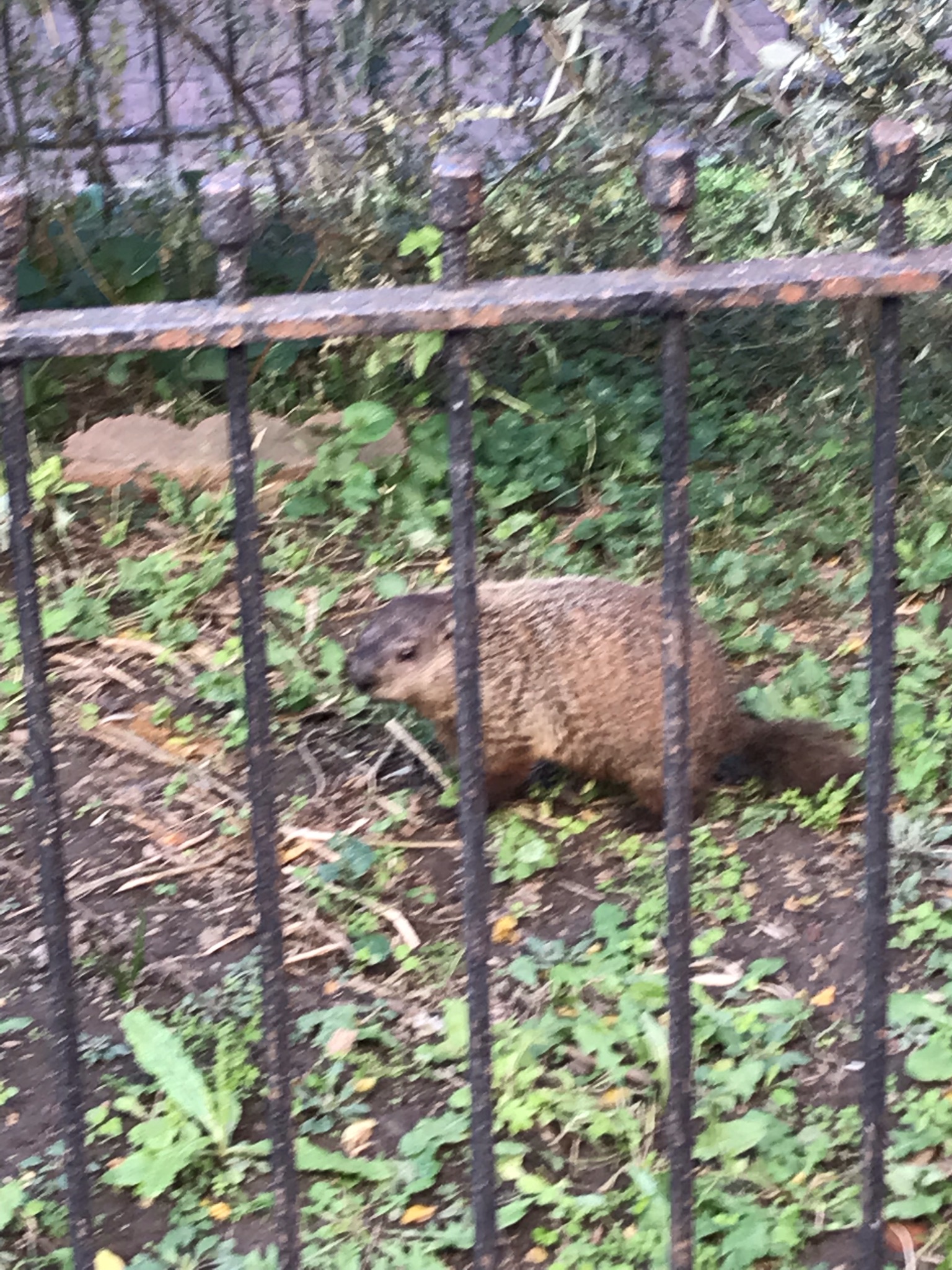
We had a groundhog. Not exactly a rare species, but a rare siting around our urban neighborhood so fairly exciting.

a furry friend

And finally, I loved this enormous sunchoke. It was not in my garden, but was likely spread by an enterprising squirrel from my garden to a neighbor’s garden, and then forgotten. I read The Dark Tower this summer, in which God is at least sometimes embodied as a rose bush. But I am not a big rose fan. If I were any sort of deity, I might choose to be a sunchoke.

an enormous sunchoke

Pension funds should never rely on correlation

Pension funds should not rely on correlations between mean annual return and variance in annual return when deciding how much stocks and bonds to own, according to this article on which Nassim Nicholas Taleb (the Black Swan guy) is the second author. To paraphrase/oversimplify my understanding of the article greatly, the main arguments are that (1) data from the past is not a perfect predictor of the future, and (2) short term volatility is not a good measure of the risk of achieving a long term goal.

In engineering, I hear #1 all the time from people – why don’t we rely on data instead of “modeling” when trying to predict the future? Of course we do both – try to understand the underlying structure of the system we are dealing with, then use data from the past to try to confirm that we got it right, at least for the conditions that prevailed when the data were collected (and assuming the data themselves are reasonably accurate or at least any measurement error is not biased one way or the other), and then use the resulting model of the system to try to predict the future. Conditions in the future may be different than conditions in the past, and that is why we don’t “just rely on data”. If external conditions are different but the underlying structure of the system doesn’t change (much), we can come up with reasonable predictions of the future. The only true test of whether the prediction is right comes from data which will be collected in the future, but is not available today when a decision has to be made. A lot of decisions are really just playing the odds about what might work in the most likely future, or what might work across several different possible futures that collectively are very likely (a “robust” decision). The decision that is best for the single most likely condition and a group of very likely conditions may not be the same one – now you are a gambler trying to decide whether you go for the biggest possible payoff while accepting a larger chance of a loss, or whether you want to maximize your chances of a positive payoff while giving up your shot at a really big payoff. You would think the pension fund would go for the latter.

#2 makes sense to me. Variability in annual returns doesn’t matter much if you are 25 and investing money you plan to need at 65. A pension fund is a little different, because it is essentially immortal but has obligations it has to meet each year.

In the case of investment returns, the approach seems to be almost purely “data-driven” with no real understanding of the underlying system, and this leads to an existential crisis when people try to figure out what asset allocation advice to stake their future on. We understand the real economy to some extent, we think, but we don’t really seem to confidently understand how the real economy and the financial economy are related, especially over shorter time frames. So we are reduced to just describing the data, which might lead to some insights about the system but has limited predictive value. Still, examining the evidence before making a decision seems like a good idea to me. What is the alternative – guessing, wishing, praying?