Tag Archives: education

2016 in Review

Each month this year, I picked three scary, three hopeful, and three interesting posts or groups of post from the month. Now I’m going to pick one of those three to represent each of the months. The choices are fairly arbitrary and the main point is just to review what the media was saying and what I was thinking about over the course of the year. Then I’ll see if I can identify any trends or come up with any insights.

Most Frightening Stories of the Year

  • JANUARYPaul Ehrlich is still worried about population. 82% of scientists agree.
  • FEBRUARY77% of jobs in China may be threatened by automation.
  • MARCH: An IMF official uttered the words “economic derailment“. That sounds like it could be a real train wreck. Meanwhile Robert Gordon has expanded his pessimistic article on future growth into a book.
  • APRIL: Robert Paxton says Trump is pretty much a fascist. Although conditions are different and he doesn’t believe everything the fascists believed. Umberto Eco once said that fascists don’t believe anything, they will say anything and then what they do once in office has nothing to do with what they said.
  • MAY: The situation in Venezuela may be a preview of what the collapse of a modern country looks like.
  • JUNE: Trump may very well have organized crime links. And Moody’s says that if he gets elected and manages to do the things he says, it could crash the economy.
  • JULY: The CIA is just not that good at spying.
  • AUGUST: A former U.S. secretary of defense thinks the risk of nuclear war is higher now than during the cold war. The Republic Party platform appears to be outright in favor of nuclear weapons, while the Democratic Party platform includes a tepid commitment to maybe “reducing reliance” and spending on nuclear weapons. Jeffrey Sachs says the Syria War has become essentially a U.S.-Russia proxy war.
  • SEPTEMBER: The ecological footprint situation is not looking too promising: “from 1993 to 2009…while the human population has increased by 23% and the world economy has grown 153%, the human footprint has increased by just 9%. Still, 75% the planet’s land surface is experiencing measurable human pressures. Moreover, pressures are perversely intense, widespread and rapidly intensifying in places with high biodiversity.” Meanwhile, as of 2002 “we appropriate over 40% of the net primary productivity (the green material) produced on Earth each year (Vitousek et al. 1986, Rojstaczer et al. 2001). We consume 35% of the productivity of the oceanic shelf (Pauly and Christensen 1995), and we use 60% of freshwater run-off (Postel et al. 1996). The unprecedented escalation in both human population and consumption in the 20th century has resulted in environmental crises never before encountered in the history of humankind and the world (McNeill 2000). E. O. Wilson (2002) claims it would now take four Earths to meet the consumption demands of the current human population, if every human consumed at the level of the average US inhabitant.” And finally, 30% of African elephants have been lost in the last 7 years.
  • OCTOBER: According to James Hansen, the world needs “negative” greenhouse gas emissions right away, meaning an end to fossil fuel burning and improvements to agriculture, forestry, and soil conservation practices to absorb carbon. Part of the current problem is unexpected and unexplained increases in methane concentrations in the atmosphere.
  • NOVEMBER: Is there really any doubt what the most frightening story of November 2016 was? The United Nations Environment Program says we are on a track for 3 degrees C over pre-industrial temperatures, not the “less than 2” almost all serious people (a category that excludes 46% of U.S. voters, apparently) agree is needed. This story was released before the U.S. elected an immoral science denier as its leader. One theory is that our culture has lost all ability to separate fact from fiction. Perhaps states could take on more of a leadership role if the federal government is going to be immoral? Washington State voters considered a carbon tax that could have been a model for other states, and voted it down, in part because environmental groups didn’t like that it was revenue neutral. Adding insult to injury, WWF released its 2016 Living Planet Report, which along with more fun climate change info includes fun facts like 58% of all wild animals have disappeared. There is a 70-99% chance of a U.S. Southwest “mega-drought” lasting 35 years or longer this century. But don’t worry, this is only “if emissions of greenhouse gases remain unchecked”. Oh, and climate change is going to begin to strain the food supply worldwide, which is already strained by population, demand growth, and water resources depletion even without it.
  • DECEMBER: The geopolitical situation is not good. If Russia did hack the U.S. election, it wouldn’t be the first election they have hacked. The wars in Afghanistan and Iraq are not over, and the rest of the greater Middle East is increasingly a mess.

Most Hopeful Stories of the Year

Most Interesting Stories of the Year

  • JANUARY: The World Economic Forum focused on technology: “The possibilities of billions of people connected by mobile devices, with unprecedented processing power, storage capacity, and access to knowledge, are unlimited. And these possibilities will be multiplied by emerging technology breakthroughs in fields such as artificial intelligence, robotics, the Internet of Things, autonomous vehicles, 3-D printing, nanotechnology, biotechnology, materials science, energy storage, and quantum computing.”
  • FEBRUARYTitanium dioxide is the reason Oreo filling is so white.
  • MARCH: Michael Pollan urged us to eat food. not too much. mostly psychedelic mushrooms.
  • APRIL: Genes can now be programmed just like circuits.
  • MAY: The world has about a billion dogs.
  • JUNE: Switzerland finished an enormous tunnel through the Alps that took 20 years to build.
  • JULY: I was a little side-tracked by U.S. Presidential politics. Nate Silver launched his general election site, putting the odds about 80-20 in favor of Hillary at the beginning of the month. The odds swung toward Trump over the course of the month as the two major party conventions took place (one in my backyard), but by the end of the month they were back to about 70-30 in favor of Hillary. During the month I mused about NAFTA, the fall of the Republic, the banana republicThe Art of the Deal, how to debate Trump, and Jon Stewart.
  • AUGUST: Here is a short video explaining the Fermi Paradox, which asks why there are no aliens. Meanwhile Russian astronomers are saying there might be aliens.
  • SEPTEMBERMonsanto is trying to help honeybees (which seems good) by monkeying with RNA (which seems a little frightening). Yes, biotech is coming.
  • OCTOBERNeil deGrasse Tyson says “we might expect to find as many as 100 alien civilizations in our galaxy communicating with radio waves right now.”
  • NOVEMBER: New technology can survey and create a 3D model of a room in seconds.
  • DECEMBER: According to Bill Gates, “new genome technologies are at the cusp of affecting us all in profound ways”. But an article in Nature says we should not be too hopeful about living much past 100.

And now for trends and insights…

Serious long-term threats related to population, food, water resources, natural capital depletion, biodiversity loss, and climate change. These are all inter-related. In past years I probably would have suggested that these threats are so likely and so consequential that we should focus nearly all our efforts on them. But things have changed a bit over the past year. Now it appears that we face dire short term threats as well in the form of serious geopolitical instability, risk of war and global economic stagnation. If you don’t deal with short term threats you might not be around to deal with the long term ones. And voters have chosen leaders in the past year who have no intention of dealing with the long term threats. They make no serious attempt to understand their nature or root causes. In fact, they don’t even acknowledge that the threats exist in many cases.

War. The possibility of war is certainly the biggest short-term threat we face. If we get through the next 4-8 years without a war between major powers or any sort of nuclear detonation, we will have to consider that a win. The greater Middle East from North Africa to Afghanistan is dangerously unstable, and the U.S. has already been drawn into a proxy war with Saudi Arabia and its allies on one side and Iran and Russia on the other side. And it appears that Russia may have played a direct role in influencing the U.S. election. An accidental clash between U.S. and Russian forces in Syria, Eastern Europe, or over the world’s oceans could be enough to set off a series of escalations and miscalculations that leads to a war nobody wants or stands to gain anything from. A naval confrontation between the U.S. and China could be a similar risk.

The Great Recession. Although the U.S. economy has picked up, the overall global growth and employment situation is deeply concerning. Rather than just a cyclical downturn, it may be a long term trend driven by demographics, debt, and underemployment caused by automation. The automation trend is going to be relentless. The 2007-8 financial crisis caused by excessive risk taking in the U.S. finance industry may just have been the straw that broke the camel’s back and made the long-term trends obvious, and another financial crisis that severe at a time of weakness might be the one the world doesn’t recover from. Our new U.S. leaders are already working with big business to roll back the necessary but still inadequate protections put in place after the ’07-8 crisis. Costs and risks imposed by climate change are not going to make the economy any better.

Technology. Technology brings us grave concern over the employment situation, but also great hope that we could see a long-term pickup in productivity, and therefore our overall wealth and quality of life. Of course, an increase in overall wealth and quality of life may help only a small slice of society if that society is structured to concentrate rather than share the wealth, and the leaders we have chosen in the U.S. for the next few years are clearly committed to the former. Extreme concentration of wealth could lead us eventually to a situation of such instability that the only outcomes are armed revolution in the streets or else absolute authoritarian control.

But let’s optimistically assume that our political system eventually comes up with a consensus on sharing the wealth. Now a higher rate of productivity growth (within ecological limits) would be good for everyone. In this world, people whose jobs are displaced by automation would be quickly retrained for new jobs, and they would be educated in the first place so that they are very flexible and adaptable to changing conditions. Over time, we could become so rich that we simply don’t have to work so much, and we could devote more of our time to leisure activities, learning for the sake of learning, the arts, civic and social activities, etc.

This might seem like a utopian vision, but it has happened in the past. People used to work incredibly long, hard hours to grow just enough food to survive, and they didn’t live all that long at that. Later people used to work long, hard hours in factories and sweat shops. Technology, cheap energy, and the wealth they have brought have made huge changes in working hours and life expectancy for most of us. With technology seemingly advancing all around us, the puzzle is why we aren’t seeing similarly spectacular advances today as we have seen in the past.

Advances like the tractor and electricity were enormous changes at the time of course. Maybe today’s technological advances, even though they seem impressive to us, simply aren’t as dramatic as these advances were in their time. That is the basic thesis of Robert Gordon, who I mention above. The World Economic Forum and Nouriel Roubini articles I mention above have good summaries of the advances we are seeing. Roubini categorizes them as:

  • ET (energy technologies, including new forms of fossil fuels such as shale gas and oil and alternative energy sources such as solar and wind, storage technologies, clean tech, and smart electric grids).
  • BT (biotechnologies, including genetic therapy, stem cell research, and the use of big data to reduce health-care costs radically and allow individuals to live much longer and healthier lives).
  • IT (information technologies, such as Web 2.0/3.0, social media, new apps, the Internet of Things, big data, cloud computing, artificial intelligence, and virtual reality devices).
  • MT (manufacturing technologies, such as robotics, automation, 3D printing, and personalized manufacturing).
  • FT (financial technologies that promise to revolutionize everything from payment systems to lending, insurance services and asset allocation).
  • DT (defense technologies, including the development of drones and other advanced weapon systems).

Roubini acknowledges the argument that these advances are not the equivalent of past advances, but also suggests that we may be in the lag phase between when technological advances happen and when they begin to have obvious effects on productivity. I think I said it pretty well in my post so I’ll repeat what I said:

Although the plow, the printing press, the steam engine, electricity, etc. were game changing, the game didn’t change as soon as they were invented. They had to catch on, infrastructure had to be built, resistance to change had to be overcome, and it took awhile. Each successive revolution happened faster though, which is why I am skeptical that this time is different… I think there is a lag, and it just hasn’t hit yet. If and when there is a sharp technology-driven surge in productivity, it doesn’t mean everything is going to instantly be great for everybody. As we produce more with less effort, there will be winners and losers, haves and have nots. And there will be a lag between when that starts and when it gets resolved. And just to beat a dead horse, we can’t just keep producing and consuming more forever unless we figure out a way to do that without growing our ecological footprint. And, we need to watch out for those defense technologies.

The information technology is all around us now, and the biotechnology is just starting to take off. 2017 could be the year when we have the same excitement in the popular imagination about biotech as we saw with the internet in the mid-1990s. Or maybe it will take a few years.

It is possible that our technology could advance so fast that ecological limits will cease to be relevant before they begin to exert a major drag force on our global economy and society. I don’t think it is safe to put all our eggs in that basket though. I am also saddened by the extreme and seemingly accelerating destruction of our planet’s ecosystems as we have known them throughout human history. We can try to preserve some of what is left, but even if we are successful it will be more like a museum or zoo recording what we used to have than a real, large-scale functioning planetary ecosystem.

There, I ended on a pretty pessimistic note. That’s how I feel at the moment. Not all stories have to have a happy ending. (This is exactly why King Lear is my favorite Shakespeare play, because the bad guys do bad things and get away with it, and sometimes real life is like that.) I just don’t want to get my hopes up about 2017. Come on 2017, maybe you will pleasantly surprise me.

more on the hollowing out of the middle class

This article from the Federal Reserve Bank of San Francisco talks about how the “wage premium” (how much educated workers make compared to less educated ones) seems to have stopped growing recently, although it is still large.

Recent Flattening in the Higher Education Wage Premium: Polarization, Skill Downgrading, or Both?

Wage gaps between workers with a college or graduate degree and those with only a high school degree rose rapidly in the United States during the 1980s. Since then, the rate of growth in these wage gaps has progressively slowed, and though the gaps remain large, they were essentially unchanged between 2010 and 2015. I assess this flattening over time in higher education wage premiums with reference to two related explanations for changing U.S. employment patterns: (i) a shift away from middle-skilled occupations driven largely by technological change (“polarization”); and (ii) a general weakening in the demand for advanced cognitive skills (“skill downgrading”). Analyses of wage and employment data from the U.S. Current Population Survey suggest that both factors have contributed to the flattening of higher education wage premiums.

relational algebra

R bloggers has a nice post on the theory behind database organization, and some tools that can used to manage and manipulate data through R. Maybe this seems very specialized, but many of our jobs involve dealing with data these days, so this knowledge and tools is potentially relevant to us, and yet I don’t think many of us even in technical fields outside math and computer science learn this stuff in school.

all opinions are now equal

David Remnick from the New Yorker interviewed Obama before, during, and after the election. I don’t want to write a lot of words rehashing the election for a couple reasons. First, everyone else is doing that. Second, I suspect we need to put some time and distance between us and the election before we can decide which combination of the many theories is correct (for example, Trump was a genius at connecting with the middle class, white Americans are a bunch of ignorant, paranoid racist assholes, Hillary was a uniquely weak candidate, Russia and/or the FBI stole the election, a majority of Americans actually preferred Hillary, Biden or Sanders would have won easily, it was essentially a tie and the electoral college is just quirky and outdated, etc.)

Obama offered a theory though that rang at least partly true to me, and I actually find it disturbing.

“Until recently, religious institutions, academia, and media set out the parameters of acceptable discourse, and it ranged from the unthinkable to the radical to the acceptable to policy,” Simas said. “The continuum has changed. Had Donald Trump said the things he said during the campaign eight years ago—about banning Muslims, about Mexicans, about the disabled, about women—his Republican opponents, faith leaders, academia would have denounced him and there would be no way around those voices. Now, through Facebook and Twitter, you can get around them. There is social permission for this kind of discourse. Plus, through the same social media, you can find people who agree with you, who validate these thoughts and opinions. This creates a whole new permission structure, a sense of social affirmation for what was once thought unthinkable. This is a foundational change…”

The new media ecosystem “means everything is true and nothing is true,” Obama told me later. “An explanation of climate change from a Nobel Prize-winning physicist looks exactly the same on your Facebook page as the denial of climate change by somebody on the Koch brothers’ payroll. And the capacity to disseminate misinformation, wild conspiracy theories, to paint the opposition in wildly negative light without any rebuttal—that has accelerated in ways that much more sharply polarize the electorate and make it very difficult to have a common conversation.”

That marked a decisive change from previous political eras, he maintained. “Ideally, in a democracy, everybody would agree that climate change is the consequence of man-made behavior, because that’s what ninety-nine per cent of scientists tell us,” he said. “And then we would have a debate about how to fix it. That’s how, in the seventies, eighties, and nineties, you had Republicans supporting the Clean Air Act and you had a market-based fix for acid rain rather than a command-and-control approach. So you’d argue about means, but there was a baseline of facts that we could all work off of. And now we just don’t have that.”

It’s disturbing to me because I really had the sense during the election that facts didn’t matter at all. I don’t think human nature is particularly good at analyzing and understanding the nature of complex problems, and our education system is not particularly good at helping us to overcome our innate tendency to oversimplify and misdiagnose these problems. But at least detecting and agreeing on the facts needs to be the common launching point for reasoned debate. If we are no longer even attempting to establish the facts, we can’t even get to that starting point for problem solving and we have actually taken a step back as a civilization.

I don’t want to blame the millennial generation for everything, but I do think the educational culture that generation grew up in and the new media culture are intertwined. I think this generation was encouraged to formulate and express opinions much more than I was at the tail end of generation X. This is not bad in itself. Young people need to be trained to establish the facts, understand the larger systems those facts are embedded in, define the problem, propose and discuss solutions. But that doesn’t mean all conclusions, opinions, and proposed solutions should be given equal weight. When young people express opinions, they need to get supportive but firm feedback from people with more experience and seasoned judgment, because that is how they gain their own experience, judgment and problem solving ability.

Now of course I want to offer some prescription for fixing this. Well, I am not feeling too optimistic at the moment. If we were rowing against the current before, now we seem to have turned the canoe around and we are enthusiastically rowing with the current toward the whirlpool. Like I said, I need some time and distance to think more objectively.

passive haptic learning

Researchers at Georgia Tech have taken a small step toward the dream of learning without effort.

Tactile taps teach rhythmic text entry: passive haptic learning of morse code

Passive Haptic Learning (PHL) is the acquisition of sensorimotor skills with little or no active attention to learning. This technique is facilitated by wearable computing, and applications are diverse. However, it is not known whether rhythm-based information can be conveyed passively. In a 12 participant study, we investigate whether Morse code, a rhythmbased text entry system, can be learned through PHL using the bone conduction transducer on Google Glass. After four hours of exposure to passive stimuli while focusing their attention on a distraction task, PHL participants achieved a 94% accuracy rate keying a pangram (a phrase with all the letters of the alphabet) using Morse code on Glass’s trackpad versus 53% for the control group. Most PHL participants achieved 100% accuracy before the end of the study. In written tests, PHL participants could write the codes for each letter of the alphabet with 98% accuracy versus 59% for control. When perceiving Morse code, PHL participants also performed significantly better than control: 83% versus 46% accuracy.

September 2016 in Review

3 most frightening stories

  • The U.S. and Russia may have blundered into a proxy war in Syria. And on a loosely related war-and-peace note, Curtis LeMay was a crazy bastard.
  • The ecological footprint situation is not looking too promising: “from 1993 to 2009…while the human population has increased by 23% and the world economy has grown 153%, the human footprint has increased by just 9%. Still, 75% the planet’s land surface is experiencing measurable human pressures. Moreover, pressures are perversely intense, widespread and rapidly intensifying in places with high biodiversity.” Meanwhile, as of 2002 “we appropriate over 40% of the net primary productivity (the green material) produced on Earth each year (Vitousek et al. 1986, Rojstaczer et al. 2001). We consume 35% of the productivity of the oceanic shelf (Pauly and Christensen 1995), and we use 60% of freshwater run-off (Postel et al. 1996). The unprecedented escalation in both human population and consumption in the 20th century has resulted in environmental crises never before encountered in the history of humankind and the world (McNeill 2000). E. O. Wilson (2002) claims it would now take four Earths to meet the consumption demands of the current human population, if every human consumed at the level of the average US inhabitant.” And finally, 30% of African elephants have been lost in the last 7 years.
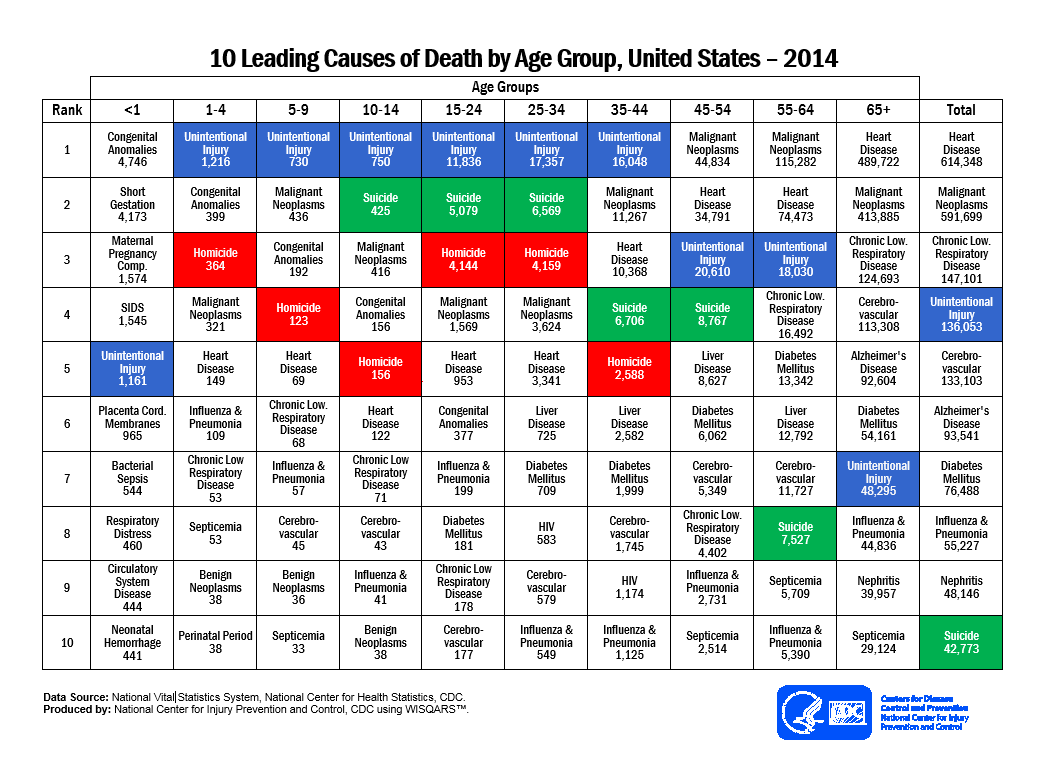
  • Car accidents are the leading cause of death for children ages 5 to 24. The obsession with car seats may not be saving all that many lives, while keeping children out of cars as much as possible would be 100% guaranteed to save lives. And one thing that would be guaranteed to help us create more walkable neighborhoods and therefore save children’s lives: getting rid of minimum parking requirements in cities once and for all. And yet you don’t hear this debate being framed in moral terms.

3 most hopeful stories

3 most interesting stories

  • Monsanto is trying to help honeybees (which seems good) by monkeying with RNA (which seems a little frightening). Yes, biotech is coming.
  • Some people think teaching algebra to children may actually be bad. Writing still seems to be good.
  • There have been a number of attempts to identify and classify the basic types of literary plots.

leading cause of death among children

This quote in a Strong Towns article caught my eye:

According to the Centers for Disease Control, for children ages 5 through young adults age 24, the leading cause of deathis auto accidents. For accidental causes of mortality, there is no close second. Even drowning, which we are militant about here in terms of baths, pools and time at the lake, is just a fraction of auto accidents. Imagine two 9/11 attacks each year that killed just kids and you still would not have the number of child fatalities America has each year from auto accidents…

If we are serious about wanting what is best for kids, shouldn’t we be doing everything we can to reduce the number of auto trips people are required to take each day? And when people do take trips, shouldn’t our top priority be reducing the travel speeds on local streets? Once outside of the local street network, shouldn’t our top priority be the removal of the greatest source of accidents – intersections – so traffic can flow smoothly?

The best thing we can do for the safety of our children is to get them out of the car by building mixed-use, walkable neighborhoods.

The post also mentions a controversial Freakonomics article suggesting that the biggest increase in children’s safety came from putting them in the back seat of cars, not from car seats.

This brings up a couple interesting questions that I grapple with. First, I think it is crystal clear that the less your child is in cars, the safer they are. So living in a neighborhood where they can walk to school, and you can walk together on most shopping and recreation trips, is a big win for the child’s safety. The difficult questions are, when you are occasionally caught in the rain or late for school, is it okay to jump in the back seat of a cab or Uber with your child, even though you haven’t lugged along the car seat, and it may even be illegal? And second, if you have a school within walking distance that doesn’t have the reputation of a school that requires a car or bus ride everyday, what is the overall best choice for the child? My wife and I make these decisions every day, and the choices we make are not the ones most people we know would make in the same situation. In fact, we just don’t talk about these choices much because people tend to have strongly held opinions. So I’ve added car seats and urban school districts along with politics and religion to the list of topics I don’t bring up in polite company. And yet, to me the choices are clear and I feel perfectly fine about the ones I have made.

writing and thinking

This 2012 article in The Atlantic talks about the connection between writing and thinking. I think it’s spot on – the exact reason I write this blog is because that is how I think things through (well, this hasn’t been the greatest sentence structure ever, now has it?)

Fifty years ago, elementary-school teachers taught the general rules of spelling and the structure of sentences. Later instruction focused on building solid paragraphs into full-blown essays. Some kids mastered it, but many did not. About 25 years ago, in an effort to enliven instruction and get more kids writing, schools of education began promoting a different approach. The popular thinking was that writing should be “caught, not taught,” explains Steven Graham, a professor of education instruction at Arizona State University. Roughly, it was supposed to work like this: Give students interesting creative-writing assignments; put that writing in a fun, social context in which kids share their work. Kids, the theory goes, will “catch” what they need in order to be successful writers. Formal lessons in grammar, sentence structure, and essay-writing took a back seat to creative expression.

The catch method works for some kids, to a point. “Research tells us some students catch quite a bit, but not everything,” Graham says. And some kids don’t catch much at all. Kids who come from poverty, who had weak early instruction, or who have learning difficulties, he explains, “can’t catch anywhere near what they need” to write an essay. For most of the 1990s, elementary- and middle-­school children kept journals in which they wrote personal narratives, poetry, and memoirs and engaged in “peer editing,” without much attention to formal composition. Middle- and high-school teachers were supposed to provide the expository- and persuasive-writing instruction…

Some writing experts caution that championing expository and analytic writing at the expense of creative expression is shortsighted. “The secret weapon of our economy is that we foster creativity,” says Kelly Gallagher, a high-school writing teacher who has written several books on adolescent literacy. And formulaic instruction will cause some students to tune out, cautions Lucy Calkins, a professor at Columbia University’s Teachers College. While she welcomes a bigger dose of expository writing in schools, she says lockstep instruction won’t accelerate learning. “Kids need to see their work reach other readers … They need to have choices in the questions they write about, and a way to find their voice.”

I had a lot of formal instruction in how to diagram a sentence in both English and Latin, and how to arrange an argument in a very structured way. I don’t always write that way now, but I am glad I had that because it was essentially instruction in thinking and communicating in a logical way. I had essentially no instruction in creative writing, and that is actually something I regret and would like to try in the future.

algebra, what is it good for?

This New York Times opinion piece (sort of) argues against teaching algebra.

Making mathematics mandatory prevents us from discovering and developing young talent. In the interest of maintaining rigor, we’re actually depleting our pool of brainpower. I say this as a writer and social scientist whose work relies heavily on the use of numbers. My aim is not to spare students from a difficult subject, but to call attention to the real problems we are causing by misdirecting precious resources…

What of the claim that mathematics sharpens our minds and makes us more intellectually adept as individuals and a citizen body? It’s true that mathematics requires mental exertion. But there’s no evidence that being able to prove (x² + y²)² = (x² – y²)² + (2xy)² leads to more credible political opinions or social analysis…

I WANT to end on a positive note. Mathematics, both pure and applied, is integral to our civilization, whether the realm is aesthetic or electronic. But for most adults, it is more feared or revered than understood. It’s clear that requiring algebra for everyone has not increased our appreciation of a calling someone once called “the poetry of the universe.”

I think everyone is capable of and needs to learn math, logic, critical reasoning and system thinking skills. I think there is some merit to the idea that the way math is taught is a turn-off to so many people. There is also some merit in the argument that teaching people to manipulate symbols on a page is not really logic or reasoning or system thinking. A more ideal way to teach math (and reading and writing, for that matter) would be to integrate it into more interesting subjects like science, economics and history. Students could be gaining an intuitive feel for the world we live in through those subjects, while at the same time understanding how reading, writing, and arithmetic (and algebra and calculus and statistics and physical and mathematical models of various types) are powerful tools that can help increase the depth of that understanding.