Tag Archives: risk

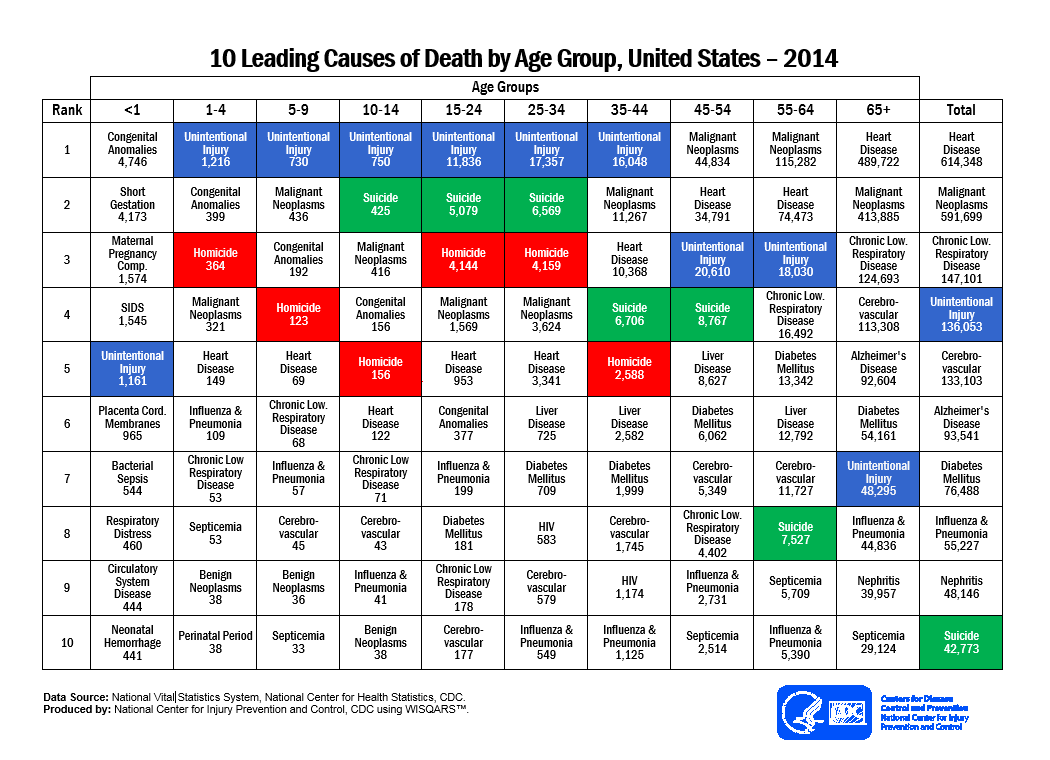
leading cause of death among children

This quote in a Strong Towns article caught my eye:

According to the Centers for Disease Control, for children ages 5 through young adults age 24, the leading cause of deathis auto accidents. For accidental causes of mortality, there is no close second. Even drowning, which we are militant about here in terms of baths, pools and time at the lake, is just a fraction of auto accidents. Imagine two 9/11 attacks each year that killed just kids and you still would not have the number of child fatalities America has each year from auto accidents…

If we are serious about wanting what is best for kids, shouldn’t we be doing everything we can to reduce the number of auto trips people are required to take each day? And when people do take trips, shouldn’t our top priority be reducing the travel speeds on local streets? Once outside of the local street network, shouldn’t our top priority be the removal of the greatest source of accidents – intersections – so traffic can flow smoothly?

The best thing we can do for the safety of our children is to get them out of the car by building mixed-use, walkable neighborhoods.

The post also mentions a controversial Freakonomics article suggesting that the biggest increase in children’s safety came from putting them in the back seat of cars, not from car seats.

This brings up a couple interesting questions that I grapple with. First, I think it is crystal clear that the less your child is in cars, the safer they are. So living in a neighborhood where they can walk to school, and you can walk together on most shopping and recreation trips, is a big win for the child’s safety. The difficult questions are, when you are occasionally caught in the rain or late for school, is it okay to jump in the back seat of a cab or Uber with your child, even though you haven’t lugged along the car seat, and it may even be illegal? And second, if you have a school within walking distance that doesn’t have the reputation of a school that requires a car or bus ride everyday, what is the overall best choice for the child? My wife and I make these decisions every day, and the choices we make are not the ones most people we know would make in the same situation. In fact, we just don’t talk about these choices much because people tend to have strongly held opinions. So I’ve added car seats and urban school districts along with politics and religion to the list of topics I don’t bring up in polite company. And yet, to me the choices are clear and I feel perfectly fine about the ones I have made.

cascading computer system failure at Delta

A cascading computer system failure knocked Delta airlines out of commission on August 8.

At least half of all Delta Air Lines flights Monday were delayed or canceled after a power outage knocked out the airline’s computer systems worldwide…

Delta representatives said the airline was investigating the cause of the meltdown. They declined to describe whether the airline’s information-technology system had enough built-in redundancies to recover quickly from a hiccup like a power outage…

Airlines depend on huge, overlapping and complicated systems to operate flights, schedule crews and run ticketing, boarding, airport kiosks, websites and mobile phone apps. Even brief outages can snarl traffic and cause long delays.

As the world becomes more automated, things might get smoother when everything is working well, but when something goes wrong it might get harder and harder to recover. Hopefully, major government, military and financial computer systems will have “enough built-in redundancies”.

They do, according to an article in The Week. Delta actually had backup systems in place, and the problem was that they didn’t kick in correctly. Major financial companies have even more layers of backups and pay more attention to them because they have even more at stake.

Delta, like most major airlines, likely had one or more back-up systems in place to take over in an emergency like this. Often a company has an extra system housed in its main data center identical to the main system, plus another one in a separate data center in case both local systems are taken out in a major event, like a fire. Some companies even have a third redundant system that is cloud-based or housed in a separate location.

“Some of these disruptions should not have occurred,” Hecht says. “Delta IT did something wrong that caused its redundancy structure to not function as needed. The problem was not the power failure itself; 99.9999 percent of power failures never cause service disruptions.” …

…most airlines use manual testing to verify their data protection, meaning a human being actually has to take time out of their day to test the system on a regular basis. Other industries, like banking and finance, rely on automatic systems to lower the risk of a full blackout. Automated systems can be pricey, and while Delta’s outage is probably costing the company a hefty sum (Southwest’s outage last month was expected to cost the airline up to $10 million), an hour-long outage in the banking sector would create far more mayhem and profit-loss, so finance companies are more likely to pay up for automated systems.


Bill Perry on today’s nuclear threat

Bill Perry, who was secretary of defense under Bill Clinton, has released a new book called My Journey at the Nuclear Brink – here’s an article at New York Review of Books. He was present at the front lines through a number of historic events, from Hiroshima to the Cuban missile crisis to development of submarine-launched missiles to efforts to secure weapons following the Soviet collapse. I’ll pick a short excerpt below but this whole article is really worth a read.

…Perry concluded that there could be no acceptable defense against a mass nuclear attack, an opinion from which he has never deviated. Many political leaders, including several presidents, have disagreed with Perry and have sponsored various types of anti-missile defense systems, the latest being the ballistic missile defense system now being installed in Eastern Europe.

Then as now, Perry writes, he believed that America would possess all the deterrence it needs with just one leg of the so-called triad: the Trident submarine. It is very difficult for armies to track and destroy it, and it contains more than enough firepower to act as a deterrent. The bombers provide only an insurance policy for the unlikely contingency of a temporary problem with the Trident force, and also have a dual role in strengthening our conventional forces. Our ICBM force is in his mind redundant. Indeed the danger of starting an accidental nuclear war as a result of a false alarm outweighs its deterrent value.

…nuclear weapons can’t actually be used—the risk of uncontrollable and catastrophic escalation is too high. They are only good for threatening the enemy with nuclear retaliation. Our submarine force, equipped with nuclear weapons, is virtually invulnerable and can perform that deterrent function well. (It should be noted that the doctrine of deterrence is severely criticized by those who worry about the implications of threatening mass slaughter.)

He talks about how there was a brief period of good will and cooperation between the U.S. and Russia after the dissolution of the Soviet empire, when the former adversaries cooperated on weapons reductions, securing of loose weapons, and the conflict in the Balkans. That all ended when the U.S. insisted on expanding NATO “right up to the Russian border”, which Perry considers a huge mistake. He also talks about the catastrophic fallout from an India-Pakistan nuclear exchange, and the risk of nuclear terrorism in a U.S. city like Washington D.C.

This article suggests a couple clear policies. One is that the U.S. could unilaterally eliminate all its nuclear weapons right away except for the submarine force. This would actually reduce risk for our country and the entire world. If our leaders don’t have the courage to do this tomorrow, they could at least cancel “modernization” plans for all but the submarine force, and phase weapons out as they become obsolete. This would give us the moral high ground when we insist somewhat hypocritically on nuclear nonproliferation for everyone else. The final step would be to negotiate with other nuclear powers to eliminate their weapons in exchange for elimination of the U.S. submarine weapons, with a robust worldwide inspection and verification program.

This would save tens of billions of dollars every year, some of which could be invested in homeland security and intelligence to counter the terrorist threat, and some of which could be invested in infrastructure or education or tax cuts. I see no logical argument against any of this.
earthquake prediction

Here’s an interesting article on earthquake prediction. Basically, it has eluded scientists so far and will probably continue to do so.

Since the early 20th century, scientists have known that large quakes often cluster in time and space: 99 percent of them occur along well-mapped boundaries between plates in Earth’s crust and, in geological time, repeat almost like clockwork. But after decades of failed experiments, most seismologists came to believe that forecasting earthquakes in human time—on the scale of dropping the kids off at school or planning a vacation—was about as scientific as astrology. By the early 1990s, prediction research had disappeared as a line item in the USGS’s budget. “We got burned enough back in the 70s and 80s that nobody wants to be too optimistic about the possibility now,” says Terry Tullis, a career seismologist and chair of the National Earthquake Prediction Evaluation Council (NEPEC), which advises the USGS.

Defying the skeptics, however, a small cadre of researchers have held onto the faith that, with the right detectors and computational tools, it will be possible to predict earthquakes with the same precision and confidence we do just about any other extreme natural event, including floods, hurricanes, and tornadoes. The USGS may have simply given up too soon. After all, the believers point out, advances in sensor design and data analysis could allow for the detection of subtle precursors that seismologists working a few decades ago might have missed.

And the stakes couldn’t be higher. The three biggest natural disasters in human history, measured in dollars and cents, have all been earthquakes, and there’s a good chance the next one will be too. According to the USGS, a magnitude 7.8 quake along Southern California’s volatile San Andreas fault would result in 1,800 deaths and a clean-up bill of more than $210 billion—tens of billions of dollars more than the cost of Hurricane Katrina and the Deepwater Horizon oil spill combined.


Moore

Here is an interesting article about Moore, Oklahoma, which has been hit by four incredibly powerful tornadoes in sixteen years, which is statistically all but impossible. Beyond the sheer spectacle of it, and the fact that I’ve spent some time in central Oklahoma, the statistical side of it is interesting to me, as I sometimes find myself asked whether some system should be designed to withstand a storm that happens 10 times a year on average, 4 times a year on average, once every 10 years on average, once every 25 years on average, etc. We don’t have a million years of data to base these things on, and even if we did the climate seems to be changing, and even if it were not there is ultimately a judgment call involved about how much risk is too much given our finite resources we have to divide up among so many things.

…tornadoes are pretty rare. One thousand a year, scattered across the continent, does not produce many data points at the scale of an individual city. Most days, there aren’t tornadoes anywhere. That problem is exacerbated by the third issue: Scientists really only have about 50 years of really good tornado documentation. Essentially, Brooks told me, scientists can’t tell us whether what’s happened in Moore is abnormal because they don’t know what a “normal” amount of violent tornadoes is. With all of that, Brooks said, there’s not a good way to clearly tell the difference between patterns and pareidolia. After all, the human brain is primed to find significance in the random. In the creaky corners of our neural pathways, a jumble of rocks can become an old man, a coat hanger can become a drunk octopus, a bunch of craters on the moon give us a friendly smile. It’s so easy for a few random events to make one small town look like a tornado magnet. It would be harder not to see it.

Are you safer on the crumbling D.C. Metro or on the highway?

Well, this is kind of embarrassing. On the surface, the D.C. Metro is one of the country’s more modern and efficient transit systems, at least compared to the trains and subways I am used to riding in Philadelphia. And most major U.S. cities don’t have a comprehensive and reliable system like Philadelphia’s, dirty, old, slow, and laden with bad attitude as it is. So it’s embarrassing that not only can we not build the new infrastructure we need to help the economy operate efficiently and grow, we are letting the infrastructure we have fall apart apparently.

Embarrassing though it is, this little ironic piece (which never admits to being irony, and there are actually people online arguing over whether it is real) points out that if safety is really the main concern, to the point that some are suggesting shutting down the D.C. Metro, car and truck travel should also be banned. In fact, shutting down the nation’s most dangerous transit system and forcing people to drive would be statistically certain to kill people.

Since 2009, 14 Metro riders and employees have died in collisions, derailings, and other incidents. On an annual basis, that translates to about 0.48 fatalities per 100,000 weekday riders.*

However, Secretary Foxx noted that this is exceeded by the fatality rate of car crashes in every single American metropolitan area for which data was compiled in a recent report from the National Highway Traffic Safety Administration.

In San Francisco, 3.75 people died in automobile crashes per 100,000 residents in 2014, a rate 7.8 times higher than the fatality rate on Metro. In Raleigh, NC, the automobile crash fatality rate was 7.50 per 100,000, or about 15.6 times higher than the fatality rate on Metro. And in Dallas, the automobile crash fatality rate was 12.02 per 100,000, or about 25.0 times higher than the fatality rate on Metro.

It’s not acceptable to have people dying due to negligence and preventable accidents, but this does illustrate the double standard where we accept the commonplace violence on our roads and streets as a necessary evil, assuming it is not preventable. We are also just desensitized to it, whereas the occasional transit accident or plane crash is a shock and gets a lot more media coverage paradoxically because it is not that common.

how aliens could be hiding in plain site

There’s always that puzzle – if conditions were such that life could arise on this planet, and the universe is so vast that there must be similar conditions out there, and given the unfathomable amounts of time for that to happen, is it really likely or even possible that this is the only place it ever happened? And if life is actually common, how could it be that we have never detected it? One answer to the puzzle would be if sophisticated life is out there, even relatively nearby, and doesn’t want to be detected by us for some reason.

Serious people at serious universities like Columbia study this, the technology side at least if not the existential questions. If aliens are hiding from us right now, here’s one way they might be doing it. Or if we thought there was somebody bad out there (one of those infinitesimal probability, infinite consequence risks that are hard to wrap your head around) and wanted to hide, here is how we could try to do it.

A Cloaking Device for Transiting Planets

The transit method is presently the most successful planet discovery and characterization tool at our disposal. Other advanced civilizations would surely be aware of this technique and appreciate that their home planet’s existence and habitability is essentially broadcast to all stars lying along their ecliptic plane. We suggest that advanced civilizations could cloak their presence, or deliberately broadcast it, through controlled laser emission. Such emission could distort the apparent shape of their transit light curves with relatively little energy, due to the collimated beam and relatively infrequent nature of transits. We estimate that humanity could cloak the Earth from Kepler-like broadband surveys using an optical monochromatic laser array emitting a peak power of ∼30 MW for ∼10 hours per year. A chromatic cloak, effective at all wavelengths, is more challenging requiring a large array of tunable lasers with a total power of ∼250 MW. Alternatively, a civilization could cloak only the atmospheric signatures associated with biological activity on their world, such as oxygen, which is achievable with a peak laser power of just ∼160 kW per transit. Finally, we suggest that the time of transit for optical SETI is analogous to the water-hole in radio SETI, providing a clear window in which observers may expect to communicate. Accordingly, we propose that a civilization may deliberately broadcast their technological capabilities by distorting their transit to an artificial shape, which serves as both a SETI beacon and a medium for data transmission. Such signatures could be readily searched in the archival data of transit surveys.

Economist Risk Analysis

The Economist “Intelligence Unit” issues a top ten list of global risks each month. The high probability and high impact ones include severe recession and debt crises in Asia, military tension between the U.S. and Russia, and a breakup of the E.U. Donald Trump makes the list as high impact but only moderate probability:

In the event of a Trump victory, his hostile attitude to free trade, and alienation of Mexico and China in particular, could escalate rapidly into a trade war – and at the least scupper the Trans-Pacific Partnership between the US and 11 other American and Asian states signed in February 2016. His militaristic tendencies towards the Middle East (and ban on all Muslim travel to the US) would be a potent recruitment tool for jihadi groups, increasing their threat both within the region and beyond.

Terrorism, U.S.-China confrontation, and a sudden oil price shock make the list lower down as potentially severe but less likely.

February 2016 in Review

I’m going to try picking the three most frightening posts, three most hopeful posts, and three most interesting posts (that are not particularly frightening or hopeful) from February.

3 most frightening posts

3 most hopeful posts

3 most interesting posts

  • The U.S. election season certainly is getting interesting, although not really in a good way. ontheissues.org has a useful summary of where U.S. political candidates stand…what are the words I’m looking for…on the the issues. Nate Silver has an interesting online tool that lets you play around with how various demographic groups tend to vote.
  • Fire trucks don’t really have to be so big.
  • Titanium dioxide is the reason Oreo filling is so white.