Tag Archives: urban planning

September 2016 in Review

3 most frightening stories

  • The U.S. and Russia may have blundered into a proxy war in Syria. And on a loosely related war-and-peace note, Curtis LeMay was a crazy bastard.
  • The ecological footprint situation is not looking too promising: “from 1993 to 2009…while the human population has increased by 23% and the world economy has grown 153%, the human footprint has increased by just 9%. Still, 75% the planet’s land surface is experiencing measurable human pressures. Moreover, pressures are perversely intense, widespread and rapidly intensifying in places with high biodiversity.” Meanwhile, as of 2002 “we appropriate over 40% of the net primary productivity (the green material) produced on Earth each year (Vitousek et al. 1986, Rojstaczer et al. 2001). We consume 35% of the productivity of the oceanic shelf (Pauly and Christensen 1995), and we use 60% of freshwater run-off (Postel et al. 1996). The unprecedented escalation in both human population and consumption in the 20th century has resulted in environmental crises never before encountered in the history of humankind and the world (McNeill 2000). E. O. Wilson (2002) claims it would now take four Earths to meet the consumption demands of the current human population, if every human consumed at the level of the average US inhabitant.” And finally, 30% of African elephants have been lost in the last 7 years.
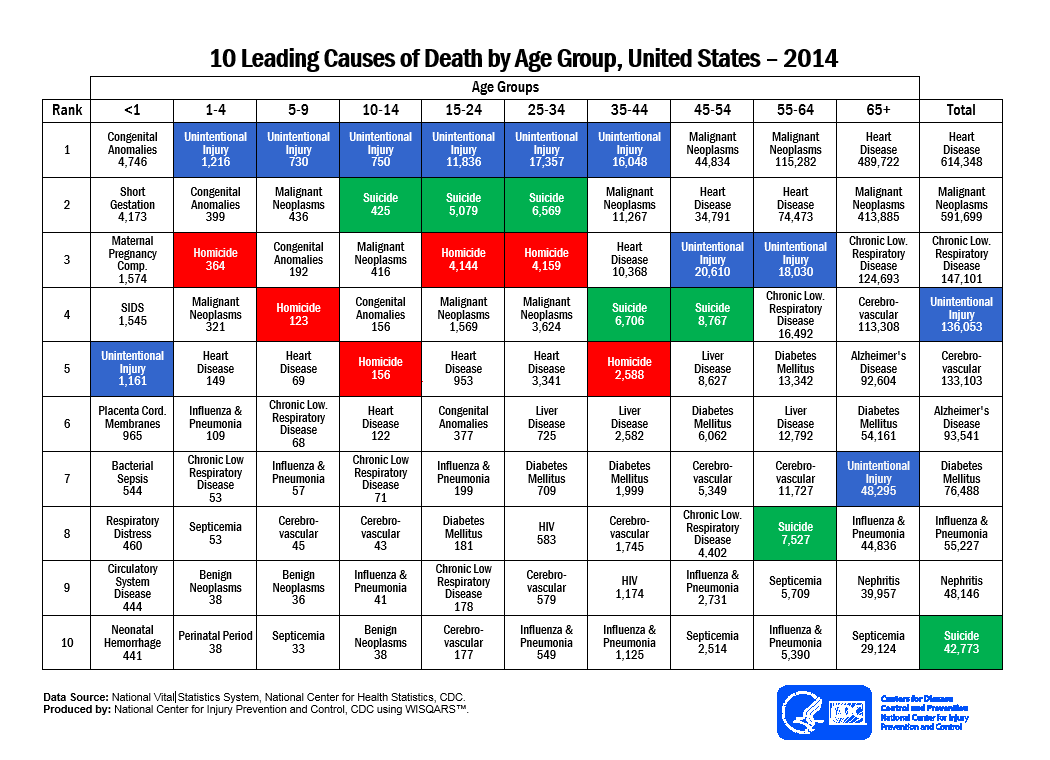
  • Car accidents are the leading cause of death for children ages 5 to 24. The obsession with car seats may not be saving all that many lives, while keeping children out of cars as much as possible would be 100% guaranteed to save lives. And one thing that would be guaranteed to help us create more walkable neighborhoods and therefore save children’s lives: getting rid of minimum parking requirements in cities once and for all. And yet you don’t hear this debate being framed in moral terms.

3 most hopeful stories

3 most interesting stories

  • Monsanto is trying to help honeybees (which seems good) by monkeying with RNA (which seems a little frightening). Yes, biotech is coming.
  • Some people think teaching algebra to children may actually be bad. Writing still seems to be good.
  • There have been a number of attempts to identify and classify the basic types of literary plots.
minimum parking requirements

Here’s a short, visually engaging video about the problem with minimum parking requirements. Apparently, this worked in Ottawa. I don’t want to be cynical, but I am not convinced the residents, politicians, and bureaucrats of my town would respond similarly to such a logical argument. I would love for everyone to prove me wrong.

leading cause of death among children

This quote in a Strong Towns article caught my eye:

According to the Centers for Disease Control, for children ages 5 through young adults age 24, the leading cause of deathis auto accidents. For accidental causes of mortality, there is no close second. Even drowning, which we are militant about here in terms of baths, pools and time at the lake, is just a fraction of auto accidents. Imagine two 9/11 attacks each year that killed just kids and you still would not have the number of child fatalities America has each year from auto accidents…

If we are serious about wanting what is best for kids, shouldn’t we be doing everything we can to reduce the number of auto trips people are required to take each day? And when people do take trips, shouldn’t our top priority be reducing the travel speeds on local streets? Once outside of the local street network, shouldn’t our top priority be the removal of the greatest source of accidents – intersections – so traffic can flow smoothly?

The best thing we can do for the safety of our children is to get them out of the car by building mixed-use, walkable neighborhoods.

The post also mentions a controversial Freakonomics article suggesting that the biggest increase in children’s safety came from putting them in the back seat of cars, not from car seats.

This brings up a couple interesting questions that I grapple with. First, I think it is crystal clear that the less your child is in cars, the safer they are. So living in a neighborhood where they can walk to school, and you can walk together on most shopping and recreation trips, is a big win for the child’s safety. The difficult questions are, when you are occasionally caught in the rain or late for school, is it okay to jump in the back seat of a cab or Uber with your child, even though you haven’t lugged along the car seat, and it may even be illegal? And second, if you have a school within walking distance that doesn’t have the reputation of a school that requires a car or bus ride everyday, what is the overall best choice for the child? My wife and I make these decisions every day, and the choices we make are not the ones most people we know would make in the same situation. In fact, we just don’t talk about these choices much because people tend to have strongly held opinions. So I’ve added car seats and urban school districts along with politics and religion to the list of topics I don’t bring up in polite company. And yet, to me the choices are clear and I feel perfectly fine about the ones I have made.

parking benefit districts

This article explains why eliminating minimum parking requirements is such a good idea, and suggests the idea of parking benefit districts as a way to get past misguided political and neighborhood opposition.

Eliminating existing requirements currently on the books in almost every city, namely that housing builders install lots of off-street parking spaces, is a key strategy for housing affordability. Most people wouldn’t guess it, but parking requirements (or “quotas”) raise the rent—and not just by a little, but by a lot. Here’s a full rundown of how they do so, but some major ways include:

  • Parking quotas raise the cost of building housing, especially inexpensive housing, and they suppress the number of apartments and houses that can fit on a lot—often by a quarter to a half.
  • Parking quotas block adaptive reuse of old buildings, such as vacant warehouses, to housing.
  • Parking quotas disperse housing by suppressing housing units per city block, which exacerbates sprawl and therefore distances traveled, which makes transit less practical and driving more common. And driving is expensive.

I’m all for it. The only concern I can think of is that neighborhoods with higher-cost parking (likely to be more desirable, richer, less diverse neighborhoods in most cities) would get greater benefits than other neighborhoods. So it seems like maybe a portion of it could stay in the neighborhood, and a portion could be shared across all neighborhoods in a city or even metro area that agree to the policy.

This is both a great example of progressive policy innovation, and a market-based way of aligning peoples’ economic incentives with the best policies. So it should be able to gain support across the political spectrum. But the article also talks about how bureaucrats at existing transit agencies can be an obstacle to this sort of policy (as they can to other good ideas like flexible bus routes). This is sad. In my ideal world, there would be a single agency in charge of getting people from point A to point B and using space in the most efficient, safest and healthiest ways, open to innovation and stakeholder input.

hidden parking costs

Hidden parking costs drive up the cost of rent in U.S. metropolitan areas by an average of 17% according this article. The implication is that people are paying for housing and parking together, and don’t realize it. By separating the two, the cost of housing would be reduced, and people would be free to choose to pay for parking, or use the money saved on other transportation options.

Hidden Costs and Deadweight Losses: Bundled Parking and Residential Rents in the Metropolitan United States

There is a major housing affordability crisis in many American metropolitan areas, particularly for renters. Minimum parking requirements in municipal zoning codes drive up the price of housing, and thus represent an important potential for reform for local policymakers. The relationship between parking and housing prices, however, remains poorly understood. We use national American Housing Survey data and hedonic regression techniques to investigate this relationship. We find that the cost of garage parking to renter households is approximately $1,700 per year, or an additional 17% of a housing unit’s rent. In addition to the magnitude of this transport cost burden being effectively hidden in housing prices, the lack of rental housing without bundled parking imposes a steep cost on carless renters—commonly the lowest income households—who may be paying for parking that they do not need or want. We estimate the direct deadweight loss for carless renters to be $440 million annually. We conclude by suggesting cities reduce or eliminate minimum parking requirements, and allow and encourage landlords to unbundle parking costs from housing costs.

transportation megaprojects exceed cost estimates by 28%

According to this Danish study, worldwide transportation “megaprojects” exceed their projected costs by an average of 28%.

  • In 9 out of 10 transportation infrastructure projects, costs are underestimated.
  • For rail projects, actual costs are on average 45% higher than estimated costs (sd=38).
  • For fixed-link projects (tunnels and bridges), actual costs are on average 34% higher than estimated costs (sd=62).
  • For road projects, actual costs are on average 20% higher than estimated costs (sd=30).
  • For all project types, actual costs are on average 28% higher than estimated costs (sd=39).
  • Cost underestimation exists across 20 nations and 5 continents; it appears to be a global phenomenon.
  • Cost underestimation appears to be more pronounced in developing nations than in North America and Europe (data for rail projects only).
  • Cost underestimation has not decreased over the past 70 years. No learning that would improve cost estimate accuracy seems to take place.
  • Cost underestimation cannot be explained by error and seems to be best explained by strategic misrepresentation, i.e., lying.
  • Transportation infrastructure projects do not appear to be more prone to cost underestimation than are other types of large projects.

June 2016 in Review

3 most frightening stories

  • Coral reefs are in pretty sad shape, perhaps the first natural ecosystem type to be devastated beyond repair by climate change.
  • Echoes of the Cold War are rearing their ugly heads in Western Europe.
  • Trump may very well have organized crime links. And Moody’s says that if he gets elected and manages to do the things he says, it could crash the economy.

3 most hopeful stories

  • China has a new(ish) sustainability plan called “ecological civilization” that weaves together urban and regional planning, environmental quality, sustainable agriculture, habitat and biodiversity concepts. This is good because a rapidly developing country the size of China has the ability to sink the rest of civilization if they let their ecological footprint explode, regardless of what the rest of us do. Maybe they can set a good example for the rest of the developing world to follow.
  • Genetic technology is appearing to provide some hope of real breakthroughs in cancer treatment.
  • There is still some hope for a technology-driven pick-up in productivity growth.

3 most interesting stories

more Donald Shoup!

Like I keep saying, you can never get too much Donald Shoup. Urban policy can get so complicated, but getting rid of minimum parking requirements would just be such a simple and easy thing to do, and have so many benefits.

Minimum parking requirements create especially severe problems. In The High Cost of Free Parking, I argued that parking requirements subsidize cars, increase traffic congestion and carbon emissions, pollute the air and water, encourage sprawl, raise housing costs, degrade urban design, reduce walkability, damage the economy, and exclude poor people. To my knowledge, no city planner has argued that parking requirements do not have these harmful effects. Instead, a flood of recent research has shown they do have these effects. We are poisoning our cities with too much parking…

Parking requirements reduce the cost of owning a car but raise the cost of everything else. Recently, I estimated that the parking spaces required for shopping centers in Los Angeles increase the cost of building a shopping center by 67 percent if the parking is in an aboveground structure and by 93 percent if the parking is underground.

Developers would provide some parking even if cities did not require it, but parking requirements would be superfluous if they did not increase the parking supply. This increased cost is then passed on to all shoppers. For example, parking requirements raise the price of food at a grocery store for everyone, regardless of how they travel. People who are too poor to own a car pay more for their groceries to ensure that richer people can park free when they drive to the store.

It’s one of those issues where the evidence is clear, but it may take a generation for professionals, bureaucrats, and politicians to pay attention to the evidence, reach the right conclusions, and act on them. Why is this so hard?

index of redevelopment potential

This is an index of redevelopment potential for individual properties in Philadelphia and other cities. The application to real estate is obvious, but I can also see a number of applications to public policy. For example, changes to codes and ordinances can improve the overall health, safety, and environmental impact of a city. But these get implemented slowly and incrementally, especially in older cities with fixed boundaries, where most development is redevelopment. If you had a reasonable prediction of where and when redevelopment is likely to occur, you would know which areas to sit back and be patient, and which areas of the city to intervene more directly if you want to see change on any reasonable time frame.

It’s a little bit of a shame the person is not sharing their methodology. I’ve had a number of urban planners and economists tell me over the years this is very hard to do, and seen a few try and give up. So this is either brilliant, or it is little more than a guess. If it’s brilliant it could be very valuable indeed, so I guess I can see the financial incentive not to publish the details. But there is no way to know the difference without knowing how it is done. The author could at least publish a white paper showing some back testing of the algorithm against historic data.