Tag Archives: economic growth

McKinsey on high-growth industries

McKinsey has a post with a data visualization on industries it predicted in 2022 would be growing quickly by now (May 2026 as I write), versus how they actually turned out. I find it interesting both for the industries/technologies themselves and for which are overperforming and underperforming. Overperforming ones include, of course, “AI software and services” and semiconductors. Robotics, however, has not kept up with expectations at least in terms of widespread commercialization (I think it is still coming, just behind schedule). Electric vehicles are also both high-growth and overperforming, while “shared autonomous vehicles” are high growth and were not considered in the original study due to “negligible baseline revenue” – more evidence that in the U.S. we are being duped as this combination of technologies explodes globally. Interestingly, batteries have not kept up with expectations as a high-growth, profitable industry/investment even though we know the technology itself has seen massive improvements in cost-efficiency. Biotechnology is a mixed bag – “obesity drugs” have exploded while “non-medical biotechnology” has seen no growth in the profitable investment sense. The holy grail of turbocharging construction productivity by making it more like manufacturing (“modular construction”) is about 50 years behind schedule. Maybe the robots can help with this eventually. And finally, even with all our fossil fuel woes the nuclear energy industry never seems able to capitalize, probably because of its long lead times and public risk-aversion on this particular technology.

My big picture analysis – technological progress is slow and steady, but when it comes to which will “hit” in a widespread profitable commercialization/investment sense, it is hard to identify the needles in the haystack at least in any sense of precise timing. In a personal investing sense, you can either gamble and go for broke, or you can diversify and be patient. In a broader economic sense, governments can use policy to try to give a particular industry a nudge, but there is a gambling aspect to this too, and my view is they would be better off focusing on reducing economic friction (great infrastructure, ease of starting a business, predictability, level playing field in terms of taxes and regulation) while protecting the environment and workers. Maybe provide childcare, health care, and education so people can start a business without worrying about those things, and have healthy skilled workers available when they do.

https://www.mckinsey.com/mgi/our-research/The-race-takes-off-in-the-next-big-arenas-of-competition

April 2026 in Review

In fast-moving current events as I write (Saturday, May 2), active so-called “kinetic” warfare seems to have subsided in and around Iran. Let’s hope the trend continues in this hopeful direction. Human rights violations elsewhere and global economic impacts persist.

Most frightening and/or depressing story: We have heard horror stories about U.S. government debt over the decades, many not grounded strictly in evidence. But this time really seems to be different, where the absolute size of the debt at the moment means higher than normal interest rate payments as a fraction of the economy and tax revenue. At the risk of stating the obvious, this means the government has less money for things other than interest payments. Meanwhile the trends are increasing debt level, increasing interest rates, and potentially lackluster economic and tax revenue growth, all pointing toward a runaway train. Hoping for a pickup in economic growth seems to be the main strategy being pursued to counteract this feedback loop.

Most hopeful story: AI science seems to have a theme of mine in April. We can constraint an AI scientist to actually respect the laws of physics, potentially accelerating scientific and technological progress. AI should also be good at synthesizing past research to form a basis for future progress, and organizing data in an accessible way so that others (human and/or AI) can confirm findings or make new discoveries from that same data. I know some very nice people who work in today’s academic publishing industry, but this may not be an area of rapid future growth. The future of engineering and scientific modeling will probably consist of giving an AI a very detailed specification for what you want it to accomplish, then reviewing/validating the result when it comes back.

Most interesting story, that was not particularly frightening or hopeful, or perhaps was a mixture of both: Augmented (aka mixed) reality glasses are getting pretty common in China, and slowly catching on elsewhere. Early adopters include cheating students, of course.

How problematic is U.S. national debt?

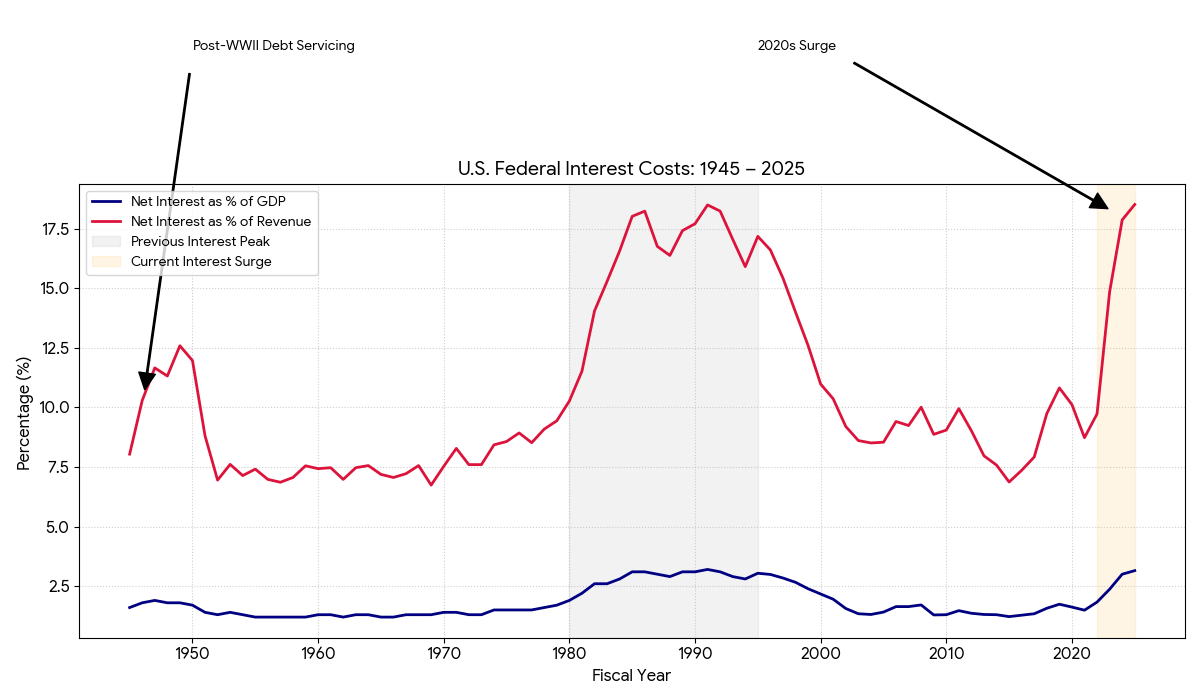
Here’s a plot from Gemini, not fact checked by me or any other human. Thanks Gemini!

I’ve always thought reporting “debt as % of GDP” is dumb. What really matters is how much interest payments on the debt are relative to the size of our economy. Or, in a more rational, less political environment, that is all that would matter – but in our real world politics matters a lot, and because politics limits our government’s ability to use taxes to pay the debt, debt payments as % of tax revenue also matter.

So…after World War II interest payments on the debt were very high, but this wasn’t a big deal because the economy was growing very quickly. In the 1980s and 1990s, interest payments spiked as interest rates spiked and growth slowed down. Eventually interest rates came down and got us out of that particular pickle. But now, from the plot we can see that current interest payments as a % of GDP are spiking to a similar level to how they did in the 1980s and 1990s. Interest rates are higher than they have been in recent decades, but not crazy high like in the 1980s. The difference really is the size of the debt relative to the economy. We can hope for faster growth to get us out of this one – there is some hope for AI-led productivity gains, but at the same time we have our government shooting itself in the foot by gutting research, development, and education spending, the historical underpinnings of our nation’s growth, while also blowing enormous sums on reckless, illegal wars of aggression with no end in site, and actually reducing taxes on affluent tax payers and corporations. We have inflation and interest rates both seemingly ramping up. So the situation does indeed seem pretty dire. Do I really even have to suggest solutions here? Sure, don’t stand in the way of the AI thing, but also don’t put all our eggs in that basket and do the opposite of all the obviously stoopid policies I just mentioned.

February 2026 in Review

In fast-moving current events as I write on March 1, 2026, the United States (executive branch, which is unconstrained in this moment by the other supposedly co-equal branches or public opinion) has launched an unprovoked military attack on Iran, in crystal clear violation of the UN Charter and domestic law. Theoretically, there are mechanisms both international (International Criminal Court) and domestic (impeachment – which can apply to cabinet members, agency heads, and federal judges in addition to the President and Vice President; and court martial which applies to military officers who follow illegal orders) that could eventually hold the criminals involved accountable for their crimes. Lots of people have lots to say and we will see how this unfolds. I am just documenting that I am present at this particularly sad moment in history.

Most frightening and/or depressing story: I hadn’t heard of mirror life, technology we apparently have right now which can destroy all life on Earth. This new, shocking, theoretically existential threat narrowly edged out the usual stream of depressing climate disaster news, the existential threat known to be currently unfolding, but which I suppose I am somewhat desensitized to.

Most hopeful story: Falling consumer prices in China might represent a new industrial revolution analogous to the age of railroads and electricity in the west in the late 1800s, rather than a textbook financial recession which seems to be the (propaganda-tainted?) conventional wisdom. I put this in the win column because if it is true, I am hopeful we will see it spread peacefully to the rest of the world rather than representing a threat.

Most interesting story, that was not particularly frightening or hopeful, or perhaps was a mixture of both: Ray Kurzweil predicts broad consensus that Artificial General Intelligence has arrived by 2029 (defined as AI equal to the leading experts in all fields), “longevity escape velocity” in 2032 (which would reverse the US slipping in recent decades), universal basic income in the U.S. sometime in the 2030s, and the Singularity in 2045 (defined as 1000X human intelligence – always pronounced TIMES according to me), but most importantly and the only thing that truly matters, robots doing my dishes in a couple years.

Is China going through an economic slump or a second industrial revolution?

The rate of GDP growth in China is slowing, and prices for consumer goods are dropping. This article from Warwick Powell argues that the situation is not an economic problem at all, but rather caused by a sudden acceleration of productivity analogous to a period of rapid industrial progress in the west from about 1870 to 1890.

The period from roughly 1870 to 1890 in the industrialising world is often called the Great Deflation because consumer and producer prices fell steadily for nearly two decades. Yet this was simultaneously a period of rapid industrial expansion: steelmaking, railways, shipbuilding, chemicals, and textiles all experienced extraordinary increases in output, fixed capital formation, and labour productivity. Real wages also rose, even as nominal prices and, in some cases, nominal wages remained flat or declined. Conventional monetary interpretations – where deflation is associated with falling demand, recession and financial stress – don’t explain this apparent contradiction.

The key is that this deflation was supply-led. Massive technological change (Bessemer steel, open-hearth furnaces, mechanised weaving and rail distribution networks), dramatic extensions of energy inputs (coal and steam), and economies of scale fundamentally changed production cost structures. Unit costs fell faster than aggregate demand could absorb the increased output. Prices therefore declined not because the economy was weak, but because the production system became structurally more efficient. This is what we could call “good deflation.” An excellent paper by Borio et al., (2015) explores this in more detail…

China’s current economic conditions – marked by soft consumer prices, prolonged factory-gate deflation and extraordinary expansion in clean-energy and advanced-manufacturing output – mirror the paradox of the Great Deflation of 1870–1890. Then, as now, falling prices were not signs of contraction, but the surface expression of deep productivity shifts and sectoral transformation. China today is experiencing a similar structural reconfiguration.

In our high school (U.S.) history classes, we tend to learn that the late 19th century was a time of rapid technological and industrial progress, but that was also coupled with rapidly growing inequality, labor unrest, and unregulated pollution. Maybe China’s system and leaders will be able to reap the benefits of progress while keeping these problems under control. My thinking is authoritarian political and economic systems can appear to work better than democratic capitalist systems when they have leadership in place that is rational and genuinely has the citizens’ best interests at heart. This might actually describe the majority of authoritarian places and points in time. But then they don’t have the safeguards in place to stop bad leadership from metastasizing if and when it does pop up, and that is how you get history’s worst and longest-lasting geopolitical disasters. I’m not guaranteeing the U.S. has the immune system to successfully fight off our currently spreading political and economic cancer, only time will tell.

January 2026 in Review

Well, I seemed to be in a political mood in January. I try to stay on the policy side of the line, but that is hard when bad politics makes good policy impossible. Inspired by a Nate Silver post, I took a look back at what I see as key moments in the last 25 years of U.S. history, and there were just so many that were on a knife edge and ended up going the wrong way, in my view. Maybe there are other universes where things went better, but remember my scientific theory that once they make a Spiderman movie about a scientific theory, it is almost certainly wrong. I find it depressing how we got here, but there is no sense crying over it. We need to learn from the past yes, but then face up to the present moment and start picking up the pieces from where we are.

Most frightening and/or depressing story: Evidence is crystal clear that sabotaging R&D spending is a very effective way to sabotage economic growth and progress. Attaboy to the fools, assholes and traitors currently in nominal charge of the U.S. government. Meanwhile, if a more rational administration ever takes hold, research on learning curves might provide some clues on where to concentrate our efforts for the greatest gains.

Most hopeful story: New York City congestion pricing was a hard-won U.S. transportation policy win in 2025. This is just good, economically sound urban policy that would be apolitical in a more rational world.

Most interesting story, that was not particularly frightening or hopeful, or perhaps was a mixture of both: I reviewed book reviews from 2025, one of which was Ezra Klein’s Abundance (not the 2012 book Abundance by Peter Diamandis, which while I am not a huge fan I continue to be puzzled how Ezra Klein could either not be aware of that book or intentionally choose to name his book the same thing.) I still find it hard to summarize that book in a sound bite, which would need to be done if it were ever going to serve as the basis for a political campaign. But here is an attempt: (1) Continuously review and streamline federal regulations, (2) increase public and private investments in critical technology and infrastructure, including recommitting to clean energy, and (3) address market failures in housing, health care, and education. #3 is a doozy of course, but the un-sexy answer just has to be understand and implement the latest evidence-backed policies. I would think ramp up housing supply, Medicare for All, and free (tax-funded) college or trade school for all. And um, if we want a chance for any domestic agenda to succeed, we also need serious plans to manage international risks including war, ecosystem collapse, famine, and massive refugee flows that may be coming. Now, I just want to acknowledge that there is a rosy future scenario where AI magically solves all these problems. The way that could work is that technological progress and economic growth suddenly pick up so drastically that we are awash in cash and resources to the point that even the wildly suboptimal operations of our dysfunctional political system are adequate to solve the problems. I don’t think it is safe to put all our eggs in that basket! We better assume that we will need to continue doing the hard work of allocating scarce resources to manage difficult problems for the foreseeable future.

AI predictions for 2026

It’s easy to find predictions for where AI technology, the “AI race”, and the knock-on effects for the US and world economies might go in 2026. I find myself slightly fatigued from hearing about it, but nonetheless it is important.

Here’s one knowledgeable sounding blogger’s predictions:

  • Artificial general intelligence will not be achieved in 2026.
  • Robots will not be able to clean my bathroom in 2026.
  • ‘No country will take a decisive lead in the GenAI “race”.’
  • “Work on new approaches such as world models and neurosymbolic will escalate.”
  • The AI-driven stock market bubble may pop, or it may not. The exact words here are “the beginning of the end”. Well, I can predict with 100% confidence that the stock market will either go up, down, or stay the same.
  • AI will be discussed in the US midterm elections.

Okay, nothing too earth shattering here. On the subject of “countries in the AI race”, one perspective is that the US is focusing nearly all its investment on private sector AI, while China is spreading its investments across a basket of technology and infrastructure investments including AI, “electric vehicles, batteries, robotics, solar panels, wind turbines and other forms of advanced manufacturing” (“the Antimonopolist” blog). The US was also at least trying to do this during and after the Covid-19 pandemic era, but that sensible long-term strategy has been monkey-wrenched by a certain fool in 2025.

Then again, we could ask whether the basic econ 101 lessons are completely disproven? Is it possible we should invest more in what we are good at and sell it to others, while buying things from them that they can make better, faster, or cheaper? There’s a tension of course between being highly efficient and focused on comparative advantage, and also being diversified so you are resilient if something happens to upset your trade flows. But we are certainly not seeing rational debate about all this in the US political context.

Chartbook makes an argument that if you compare the US and European economies, it is really just the performance (measured by profits and stock market values) of the “superstar” US tech firms that makes the US look better. And while life at the top of the heap may skew the US numbers, quality of life for the average working European aided by their bumbling, stumbling social welfare systems is actually not that bad.

evidence for the return on (U.S.) government non-defense R&D

This 2024 report from the Dallas Fed provides very clear evidence of the positive returns from past U.S. government research and development funding.

Total factor productivity is a noisy but generally accepted measure of the amount of GDP/productivity growth that is due to innovation rather than increases in inputs. Summary: The return CAUSED BY non-defense R&D spending is 140-210% over 8-12 years, which is higher than investments in infrastructure (which still provide a positive return) and defense R&D (NO CAUSAL EFFECT IDENTIFIED).

Since it’s noisy, maybe I would smooth it in the graph above, but nonetheless there is a very clear relationship between falling R&D spending and falling economic growth. Conversely, if you wanted to intentionally reduce growth and innovation in our economy, a good way to do that would be to reduce R&D spending. Another implication is that if R&D spending on weapons and war does NOT provide as great benefits, there is an opportunity cost to spending your R&D money on weapons and war rather than peaceful or at least dual-use technologies. So it’s pretty clear the actions of the current US administration (drastically cutting R&D spending and shifting it from civilian to military applications) do not match their stated intentions to boost economic growth.

Where does the global economy stand at the end of 2025?

Well, I’m writing this on December 20 so there is always the chance things could change drastically in the next 11 days. And of course, I have no idea when you my dear reader might be reading this. I will just assume you are an alien archaeologist reading this in 3025 as you sift through the rubble of our vanished civilization.

Anyway, a few themes right now:

  • The possible “AI bubble”. This can refer to the stock market index gains being dominated by AI-related companies. In rational econ world, this should mean that investors collectively think the future earnings of these companies are most likely to be very large.
  • The companies certainly think their future earnings are likely to be very large, and this justifies borrowing large amounts of money to invest in the technology and infrastructure. This might be okay, but there are a couple concerns. First, loans are being made to these companies under a framework of “speculative private credit“, which some say resembles the sub-prime mortgages leading up to the 2008 crash. You would like to think the banks might know what they are doing, but of course they didn’t leading up to the 2008 crash and the world is still paying the price today.
  • Second, there are some suggestions that all the borrowing and investing in AI is driven by a fear of not being a “first mover” in some sort of winner-take-all, zero-sum race to artificial general intelligence. And if that is the case, it might come crashing down if the market at some point collectively decides that particular milestone is not in fact on the near term horizon. In other words there is a risk of a hype bubble popping even though the underlying trend of slow, steady, technological progress is bumping along just fine. This is analogous to the dot-com bubble. Technological progress tends to be exponential, but we don’t know if we are on the early, slow and steady part of the curve or close to the knee where it will take off. But collective opinion can be wrong on this either one way or the other.
  • My head spins when I try to understand the relationships between bond yields, prices, economic growth, and investment returns across countries. But Reuters says real bond yields are negative in many countries and “Five of the Group of Seven major economies have experienced growth contraction this year, with Japan and the euro zone already half way into recession — defined as two quarters of negative growth.” [Um, so if my calculations are correct they had a quarter of negative growth?] There is also a clear real estate bubble deflation going on in China, which looks something like the one in 1980s Japan, but whether it will usher in several “lost decades” like it did there I am not able to say. The quality of life for many citizens of Japan seems to be just fine, I note. And China just really seems to have a winning approach to the intertwined manufacturing, education and research, infrastructure, and export issues.
  • Climate change is manifesting itself in extreme weather. There is some evidence that recent extreme weather, and not just the steady creeping advance of average temperature and sea levels, has caused gains in crop yields to plateau globally. Then, there are projections showing these yields falling steadily in the future, with the rate of decline of course dependent on the climate scenario chosen. The rate of population growth has slowed and seems likely to eventually plateau itself, but that will take awhile and the world is still projected to add around 2 billion more people (these forecasts themselves subject to scenarios, of course.) Less food and more mouths to feed translates in economic terms to inflation in more developed economies and potentially malnutrition/starvation in less developed ones, and in the segments of society left behind in the more developed ones.

So what did we just learn about the global economy at the end of 2025? Nothing really, except that things are objectively not that bad for many of us humans here on Earth, and yet we are nervous and have some good reasons to be nervous. At a policy level, we can be cautiously optimistic but clearly need contingency plans if things don’t go well. At an individual level, it seems like a good idea to scrape together some well-diversified savings. Maybe owning a bit of land and learning how to grow a bit of one’s own food would not be a terrible contingency plan, and besides this can be fun and rewarding.

AI investment compared to railway boom

The blog Urbanomics has a comparison of the current AI investment concentration to the 19th century railroad investment boom in England and the United States. In this particular case, the blogger neglected to provide the original source, which he or she normally does. Financial Times and Economist are typical sources. Anyway, here are some stats mentioned:

  • Peak “railway mania” in the UK was around the 1840s, and railroad investment accounted for around half of all investment at that time.
  • Between about 1830 and 1870 in the UK, railroad investment accounted for about 20% of all investment.
  • In the US, episodic railroad investment booms occurred in the 1840s and 1870s. Railroad investment at these times was around 40% of all investment. This accounted for GDP growth of about 6-10%.
  • The brief clip actually doesn’t tell us how much of total US investment in 2025 is directed to AI. But it accounts for GDP growth of around 2%.

These are interesting numbers, but I don’t think comparing 19th century and 21st century US GDP growth is a very good comparison. That is essentially comparing a fast-growing developing country to a slow-growing advanced economy. If I had to pick one or the other to live in, I would probably go with the one that has safe drinking water, antibiotics, vaccinations, relatively painless dentistry, and air conditioning.