Tag Archives: U.S. economy

How problematic is U.S. national debt?

Here’s a plot from Gemini, not fact checked by me or any other human. Thanks Gemini!
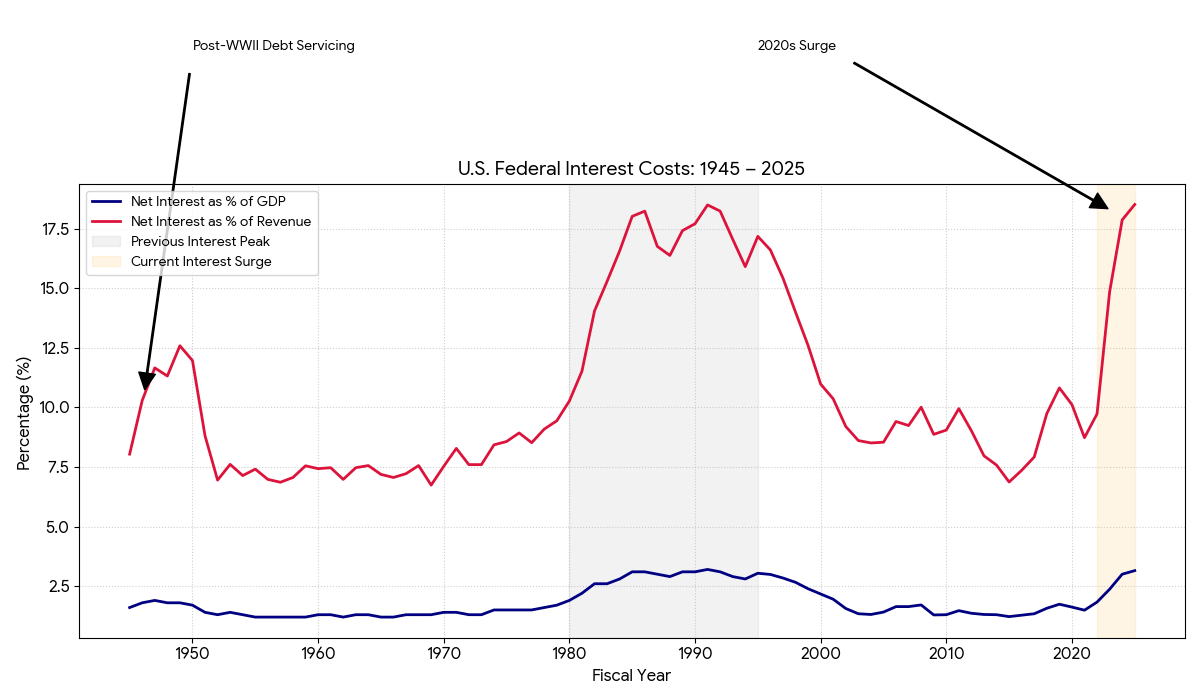
I’ve always thought reporting “debt as % of GDP” is dumb. What really matters is how much interest payments on the debt are relative to the size of our economy. Or, in a more rational, less political environment, that is all that would matter – but in our real world politics matters a lot, and because politics limits our government’s ability to use taxes to pay the debt, debt payments as % of tax revenue also matter.

So…after World War II interest payments on the debt were very high, but this wasn’t a big deal because the economy was growing very quickly. In the 1980s and 1990s, interest payments spiked as interest rates spiked and growth slowed down. Eventually interest rates came down and got us out of that particular pickle. But now, from the plot we can see that current interest payments as a % of GDP are spiking to a similar level to how they did in the 1980s and 1990s. Interest rates are higher than they have been in recent decades, but not crazy high like in the 1980s. The difference really is the size of the debt relative to the economy. We can hope for faster growth to get us out of this one – there is some hope for AI-led productivity gains, but at the same time we have our government shooting itself in the foot by gutting research, development, and education spending, the historical underpinnings of our nation’s growth, while also blowing enormous sums on reckless, illegal wars of aggression with no end in site, and actually reducing taxes on affluent tax payers and corporations. We have inflation and interest rates both seemingly ramping up. So the situation does indeed seem pretty dire. Do I really even have to suggest solutions here? Sure, don’t stand in the way of the AI thing, but also don’t put all our eggs in that basket and do the opposite of all the obviously stoopid policies I just mentioned.

The New New South

This article in Bloomberg gives some hard numbers on migration of U.S. population and business from the Northeast to the Southeast and Gulf states. It’s a long term trend, but it seems to have blown wide open during the pandemic. Although I actually have a soft spot for the south and the more positive aspects of its culture, I am disheartened by this trend in some other ways. People are moving into areas that sea level rise, coastal storms, inland storms, and extreme heat are expected to devastate in the coming decades. And say goodbye to the idea of walkable cities – these cities and states are the poster children for sprawl and automobile-dependence. We see in the headlines that insurance companies are starting to pull out of some of these areas, and the government may need to step in with more subsidy programs like the National Flood Insurance Program – in other words, the government may need to decide if it wants to support unsustainable development in these areas, and if so, we may need a national sea level rise and hurricane insurance program, and national thunderstorm insurance program, and a national fire insurance program. We will have to pay for this, or else go further into debt, and it will become one more reason why we can’t have nice things like health care, childcare, and equal access to high-quality education.

On the other hand, I am sitting here in Philadelphia, one of the most walkable northeastern cities and it is expensive, dangerous and just DIRTY AND BROKEN. And our voters just seemingly chose to keep it this way for at least four more years by re-electing the same if-it’s-not-invented-here-we can’t-do-it leadership that got us to this point. Boston, New York, Philadelphia, and DC are all coastal cities so I can’t argue that we have a leg up over the south in this area. And the U.S. Army Corps just came through with upgraded coastal flood protection for Houston.

James K. Galbraith on the coronavirus economy

Here is how James K. Galbraith, an economist at the University of Texas, explains the effects of coronavirus on the U.S. economy.

  • The global market for U.S. exports has shrunk drastically. The U.S. exports high-tech capital goods like airplanes and weapons.
  • The U.S. oil industry is pretty much shut down because hydraulic fracturing is not cost-effective at current prices, which are caused by low global demand.
  • Car sales are down because people are driving less, and their cars are going to last longer.
  • The service economy is largely shut down. He says it will not reboot quickly because many services are basic luxury goods, things people have been convinced to want but don’t necessarily need, and things that people can do at home if they really want or have too. To certain extent, people have gotten used to doing things at home, and there is also the problem that many people have lost jobs (in the service industry) and will not have extra income to spend on luxury goods.
  • The service industry business model typically depends on very high occupancy (i.e. crowding) to be viable. Businesses are starting to fail and will continue to fail. Once commercial districts start to have high vacancy, they tend not to come back quickly.
  • Unpaid bills and debts are starting to mount, and this will eventually become a problem for creditors and investors.

Here are his solutions, along with my thoughts in parentheses.

  • Redirect idle industries that export capital goods to internal goods such as public infrastructure. (Makes sense, although it’s not necessarily the same people and equipment. Retooling and retraining would be necessary.)
  • A federal jobs guarantee in industries like teaching and home health care. (Makes some sense, but it makes sense to let the private sector lead in markets that are functioning well. The trick is identifying which sectors like education represent genuine market failures.)
  • Nationalization (or the local government equivalent) of some firms and industries that can’t survive at the reduced volumes. (yuck, in general, but maybe industries where this already exists to some extent, like utilities and transportation.)
  • Domestic manufacturing (maybe, but makes sense to focus on industries where we have a competitive advantage, plus those with value for risk management, resilience, robustness – certainly food, medical equipment, etc.)
  • Just have a universal health care system like all other advanced countries. (For crying out loud, just do it now!)
  • Debt forgiveness, especially student and medical debt. This transfers some wealth from creditors to debtors. He says this will occur in either a controlled or uncontrolled way, so we might as well pick controlled. He says major financial reforms might be necessary, like turning banks into public utilities. (Sounds good to me, but can’t happen without major campaign finance reform.)