Tag Archives: climate change

Where does the global economy stand at the end of 2025?

Well, I’m writing this on December 20 so there is always the chance things could change drastically in the next 11 days. And of course, I have no idea when you my dear reader might be reading this. I will just assume you are an alien archaeologist reading this in 3025 as you sift through the rubble of our vanished civilization.

Anyway, a few themes right now:

  • The possible “AI bubble”. This can refer to the stock market index gains being dominated by AI-related companies. In rational econ world, this should mean that investors collectively think the future earnings of these companies are most likely to be very large.
  • The companies certainly think their future earnings are likely to be very large, and this justifies borrowing large amounts of money to invest in the technology and infrastructure. This might be okay, but there are a couple concerns. First, loans are being made to these companies under a framework of “speculative private credit“, which some say resembles the sub-prime mortgages leading up to the 2008 crash. You would like to think the banks might know what they are doing, but of course they didn’t leading up to the 2008 crash and the world is still paying the price today.
  • Second, there are some suggestions that all the borrowing and investing in AI is driven by a fear of not being a “first mover” in some sort of winner-take-all, zero-sum race to artificial general intelligence. And if that is the case, it might come crashing down if the market at some point collectively decides that particular milestone is not in fact on the near term horizon. In other words there is a risk of a hype bubble popping even though the underlying trend of slow, steady, technological progress is bumping along just fine. This is analogous to the dot-com bubble. Technological progress tends to be exponential, but we don’t know if we are on the early, slow and steady part of the curve or close to the knee where it will take off. But collective opinion can be wrong on this either one way or the other.
  • My head spins when I try to understand the relationships between bond yields, prices, economic growth, and investment returns across countries. But Reuters says real bond yields are negative in many countries and “Five of the Group of Seven major economies have experienced growth contraction this year, with Japan and the euro zone already half way into recession — defined as two quarters of negative growth.” [Um, so if my calculations are correct they had a quarter of negative growth?] There is also a clear real estate bubble deflation going on in China, which looks something like the one in 1980s Japan, but whether it will usher in several “lost decades” like it did there I am not able to say. The quality of life for many citizens of Japan seems to be just fine, I note. And China just really seems to have a winning approach to the intertwined manufacturing, education and research, infrastructure, and export issues.
  • Climate change is manifesting itself in extreme weather. There is some evidence that recent extreme weather, and not just the steady creeping advance of average temperature and sea levels, has caused gains in crop yields to plateau globally. Then, there are projections showing these yields falling steadily in the future, with the rate of decline of course dependent on the climate scenario chosen. The rate of population growth has slowed and seems likely to eventually plateau itself, but that will take awhile and the world is still projected to add around 2 billion more people (these forecasts themselves subject to scenarios, of course.) Less food and more mouths to feed translates in economic terms to inflation in more developed economies and potentially malnutrition/starvation in less developed ones, and in the segments of society left behind in the more developed ones.

So what did we just learn about the global economy at the end of 2025? Nothing really, except that things are objectively not that bad for many of us humans here on Earth, and yet we are nervous and have some good reasons to be nervous. At a policy level, we can be cautiously optimistic but clearly need contingency plans if things don’t go well. At an individual level, it seems like a good idea to scrape together some well-diversified savings. Maybe owning a bit of land and learning how to grow a bit of one’s own food would not be a terrible contingency plan, and besides this can be fun and rewarding.

Our World in Data 2025 Roundup

There is so much here you could spend all of 2026 digging into the data from 2025 and not get through it. This is a pretty amazing organization! I attempted a top 10 list and only got to 7 because I lumped together some similar things.

  1. Carbon dioxide emissions in the US and other developed countries peaked around 2006 and have been falling. Meanwhile they have skyrocketed in China and India and continue to increase more or less exponentially. Per capita emissions follow similar trends. Global sales of internal combustion engine cars appear to have peaked in 2018, and are very slowly declining while sales of electric vehicles are very slowly rising. Overall, the sale of cars in general appears to have declined slightly over the past decade or so. Interesting – does this represent other forms of mobility slowly coming to the fore? The world also appears to have passed “peak air pollution” a few years ago, with the one exception being ammonia from agricultural intensification. (I am not aware of ammonia as an air pollutant being a major human health risk, other than those exposed on or near farms. It is however a critical water pollutant and the intensification bodes badly for our surface and coastal waters. There may also be a connection between ammonia and nitrous oxide as a greenhouse gas that I do not fully understand.)
  2. Two different stories show a democracy index by country for the world and GDP per capita by country for the world. The two maps look about the same. Coincidence?
  3. Does the News Reflect What we Die From? The answer is no, of course. People die from heart attacks, cancer, and strokes, while the news focuses on homicide and other violence. I understand “If it bleeds, it leads” but I have always thought if they just put the anecdotal news in the context of some running statistics, it might help people put things in context. At the same time, another story shows that death rates from heart attacks and strokes have come down dramatically over the past century or so.
  4. Men commit suicide at higher rates than women in every country studied. In the US, the ratio is about 4 to 1 (access to guns, I wonder). In South Korea, only 2 to 1 but the overall rate of suicide is one of the world’s highest. In general, women live longer than men in most countries, but the gap is shocking in Russia. The Covid-19 death rate was also shocking in Russia. Now, part of the issue is the old one where choropleth maps draw your eye to the biggest countries.
  5. Overall, the world has made striking gains in poverty reduction because rates have gone from very high to very low in East Asia and South Asia between about 1990 and 2020. (But notably, Pakistan is lumped with the Middle East rather than South Asia and I am not sure about Bangladesh.) However, the progress stalled around then and has been reversed by increasing poverty in Africa.
  6. The map of where same sex marriage is legal looks a lot like the map of democracy and per capita income. One interesting thing is that many countries recognize foreign same sex marriages even if they do not allow their own citizens to marry. Homophobic attitudes have dropped dramatically in western countries between 1984 (75% in the United States) and 2022 (28%) although they are still higher than in Europe. (The way I look at it, trans-phobia is sort of the new homophobia, now that straight-up homophobia does not represent a viable political stance. Kind of like singling out Haitian or Somali immigrants is the mutated form of racism, now that straight-up anti-black racism is mostly out of style. So ugly as these things are, you could see them as indicators of progress.)
  7. Renewable electricity generation is growing exponentially, led by solar energy.

November 2025 in Review

Most frightening and/or depressing story: Wait, I actually had trouble coming up with a frightening or depressing story this month! It’s not because I was in a particularly good mood. Okay, I’ll go with all the terrible things identified in Project Censored’s yearly roundup of terrible things. These include PFAS, melting ice sheets, police violence, and the generally sorry state of the Native American community.

Most hopeful story: RENEWABLE ENERGY IS NOW CHEAPER THAN FOSSIL FUELS, AND ANYBODY WHO CLAIMS OTHERWISE IS EITHER MISINFORMED OR LYING. Note I said “misinformed”, because I try to be nice and “ignorant” is not a nice word. But they are synonyms. Despite the propaganda coming from the U.S. fossil fuel industry, government, and press, the renewable energy transition is happening and the fossil fuel stranded assets problem (for that industry) is real. Speaking of propaganda, Noam Chomsky is 96, still writing, and surer than ever that people don’t want war and only acquiesce to it because of the propaganda machine.

Most interesting story, that was not particularly frightening or hopeful, or perhaps was a mixture of both: The Tyranny of Small Decisions posits that many small but well-intentioned decisions made at inappropriately low levels within an organization can cause it to stray from its mission.

RENEWABLE ENERGY IS NOW CHEAPER THAN FOSSIL FUELS

Anybody who says renewable energy is a drag on the economy or a hoax is either misinformed or lying. Below are the numbers, from Financial Times.

https://www.ft.com/content/d0c25a97-cb18-4e7d-aeb3-8f5a93b9b2c1

The fossil fuel industry is fighting for its life through propaganda and bribery of public officials (which is legal in the United States). They can’t win in the end, but they may be able to obscure the truth from at least the U.S. public for a few more decades, which may take our entire planetary civilization down with them.

maybe global warming isn’t causing as much drying as we thought?

I certainly have had the impression that both agriculture and natural ecosystems are becoming more water scarce due to global warming, and that this is going to be a big problem at some point. We hear that the Amazon (River basin) may be tipping into an arid ecosystem, which has implications for the entire global climate and food supply, for example. But this article in Water Resources Research suggests there may be some feedback loops being overlooked. If I can try to summarize in a couple sentences, the concern is that higher temperatures cause greater evaporation from soil and transpiration (evaporation of soil moisture through the pathway of plant roots and leaves), and this will lead to drying both in agricultural and natural ecosystems. But plants have mechanisms to resist this loss of moisture, specifically by closing stomata which are the openings in leaves through which transpiration takes place. The mechanism can offset some but not all of the increased drying effect.

The CO2 Balancing Act: Why Global Warming and Greening Don’t Dry Earth as Much as We Thought

While air warming and vegetation greening are widely assumed to intensify terrestrial drying through enhanced evapotranspiration, rising atmospheric CO2 concentration ([CO2]) may counteract this effect by inducing stomatal closure and reducing water depletion. However, the complex interplay between these factors has obscured their net impact on global terrestrial drying. Here, we develop a model that physically and effectively quantifies the relationships among evapotranspiration, [CO2], and climate and vegetation changes, which can explicitly reflect how CO2-mediated stomatal regulation interacts with climate and vegetation changes to modulate evapotranspiration. We find that, globally, the drying effects of warming and greening are largely offset by CO2-induced reductions in surface conductance (69.4% ± 16.9%) and associated meteorological feedbacks. This compensatory mechanism is overlooked in traditional drying indicators, that is, the Palmer Drought Severity Index (PDSI) overestimates trends in drought-affected area (63.2% ± 10.1%), drought duration (58.7% ± 9.5%), and drought intensity (43.9% ± 7.7%) during 1982–2014 by ignoring CO2-vegetation-climate interactions, and similarly, potential evapotranspiration-based aridity index underestimates wetting trends by 66.1% ± 3.5%. Our results reveal a systematic bias in current global drying assessments, which exaggerate drying in aridifying regions while underestimating wetting trends elsewhere. These findings reinterpret the hydrological impacts of global change, demonstrating that [CO2] rise acts as a critical buffer against terrestrial drying. The study provides a mechanistic framework to reconcile observed greening with hydrological trends, offering transformative insights for ecohydrological modeling and water resource management in a high-[CO2] climate.

7 of 9 planetary boundaries breached

The Planetary Health Check 2025 updates the status of Johan Rockstrom’s “planetary boundaries” using new data. I’ve pointed out that the indicators chosen are a sort of muddle of stocks and flows from a systems perspective, but nonetheless I think it is a good attempt at scientific communication. It distills complex underlying data into a set of indicators ordinary busy/distracted (I try to avoid words like “ignorant”, but the result is the same whether we can’t or won’t educate our selves) people can understand. I still like the “ecological footprint” concept personally because it is a single system-based metric, and you can drill down a level into its individual components if you want to. Nonetheless, it seems to be out of fashion and replaced by this. Anyway, 6 of 10 planetary boundaries were already previously outside the “safe space”, and this time ocean acidification is added to the list. Only ozone and stratospheric aerosol loading are in the safe space, and paradoxically the latter exacerbates global warming somewhat. There is some nuance, with indicators like nitrogen pollution and biodiversity loss in the “high risk zone” and others like land use and carbon dioxide in the increasing risk zone and headed in the wrong direction.

September 2025 in Review

Most frightening and/or depressing story: We are most likely on a path to the AMOC tipping point. I distinguished between the tipping point, which is when collapse becomes inevitable, and the actual collapse itself. These are separated in time, which means the tipping point may only be called in retrospect when it is too late to prevent the collapse. This why being “on the path to the tipping point” is important, because we can still do something.

Most hopeful story: Spain has been so successful at rolling at solar power that the price of solar power has “collapsed”. I’ve been beating a drum lately that economic incentives have tipped in favor of renewable energy worldwide and this fact is being largely hidden from us in the US by propaganda.

Most interesting story, that was not particularly frightening or hopeful, or perhaps was a mixture of both: Brain-machine interfaces have been quietly advancing behind the scenes.

Wikipedia

fossil fuel demand scenarios

This Bloomberg article called “The Myth of Peak Fossil-Fuel Demand Is Crumbling” looks like a good example of a journalist writing a fair and balanced data-driven article, and an editor then giving it an idiotic headline. So let’s ignore the headline. The article summarizes the International Energy Agency’s World Energy Outlook. I couldn’t find the 2025 edition online, so Bloomberg must have an advance copy.

Anyway, I found the scenarios interesting. They have a Current Policy Scenario, which assumes countries will continue their current policies (behaviors? these aren’t the exact same thing are they?) indefinitely into the future, a Stated Policies Scenario, which includes “policy proposals”, and an Announced Pledges Scenario which includes “political aspirations”. Under “Current Policies”, fossil fuel demand continues to rise through 2050, while in the other two it turns a corner right about now. I’m not sure I buy the graph though, because it shows a notable acceleration over the past few years, then a sharp corner today where a decline begins. That is generally not how trends work, unless we are expecting some catastrophic external event to happen today. Let’s hope not.

Am I hopeful? Not really, because this is only saying that the trend of too high emissions may get more too high or less too high over the next couple of decades. It is too high, and this is pushing our world toward or possibly already past a point of no return which we will never be able to fully recover from. Regardless, it is never too late to make things less bad than they could have been if no action was taken. The fact that our past actions have closed off some good outcomes forever is not an excuse not to take action that can avoid some really bad outcomes.

The real question to me is whether economic forces are pushing policy in the right direction, because if they are, politics can’t buck economics forever. So the most hopeful thing I can say is that economics may be creating some headwinds for bad policy. Trying to go full bore on renewables like parts of Europe have may be overreach in terms of near-term policy, but being ready to make a push on electrifying the transportation system when political winds shift may be a practical strategy. Let’s have those policies ready.

“fastest growing suburbs” vs. climate havens

A research group at University of Illinois makes population projections for US cities (suburbs? municipalities? this is a little unclear from the article) through 2100, and the top 40 hits are in the metro areas outside Phoenix, Dallas, Houston, Austin, Oklahoma City, Miami, Tampa, Orlando, Riverside (greater greater Los Angeles), Salt Lake City, Las Vegas, Denver, Boise, Fargo. These would seem to be heat, drought, flood, and fire prone areas, so this does not square with the idea that disaster-driven insurance rate increases will force mass population movements out of these areas.

Part of the answer to the insurance paradox is that political pressure causes states to set up “high risk pools” initially intended to assist small numbers of highly vulnerable homeowners, and the scope of these tends to creep up over time. This has particularly happened in Florida, although Florida has taken steps to move people out of their program recently. Another piece of the puzzle is that a big factor in private insurance rates is not disasters but credit scores, and this “mutes the market signals”. I tend to think that insurance companies, evil or at least amoral as they are, know what they are doing in terms of the math, and credit scores must be highly correlated with claims and losses. They also probably have no reason to take a long term view because they can drop policies any time they want as conditions worsen. Mortgage companies might have something to say about this, but remember that they are implicitly government subsidized for the most part.

the AMOC tipping point

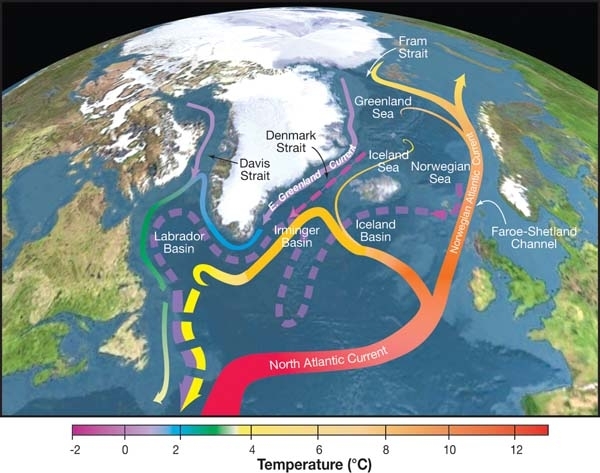
AMOC is of course the Atlantic Meridional Overturning Current, and a new study summarized by Guardian suggests we are on a path to its tipping point.

Climate models recently indicated that a collapse before 2100 was unlikely but the new analysis examined models that were run for longer, to 2300 and 2500. These show the tipping point that makes an Amoc shutdown inevitable is likely to be passed within a few decades, but that the collapse itself may not happen until 50 to 100 years later.

The research found that if carbon emissions continued to rise, 70% of the model runs led to collapse, while an intermediate level of emissions resulted in collapse in 37% of the models. Even in the case of low future emissions, an Amoc shutdown happened in 25% of the models.

Scientists have warned previously that Amoc collapse must be avoided “at all costs”. It would shift the tropical rainfall belt on which many millions of people rely to grow their food, plunge western Europe into extreme cold winters and summer droughts, and add 50cm to already rising sea levels.

I admit that when I am sort of lazily thinking about this, I don’t distinguish in my mind between the tipping point and the collapse. But they are different, as this article illustrates. The tipping point is the point of no return, but because there is a time lag between the tipping point and the consequences, the tipping point is going to be called in hindsight rather than in real time. And this is very bad for our increasingly short-attention-span species and civilization.