Tag Archives: renewable energy

Charlie Stross on renewable energy

I always enjoy Charlie Stross‘s take on things. He’s a fiction writer, sure, but he seems to have his finger on the pulse of politics and technology, and from an international perspective. He says he is writing more escape fiction now because his past near-future dystopian writings have come true, and that is too depressing to write any more. I still love the Laundry Files and Merchant Princes series though. Anyway, his ideas below are consistent with some recent thoughts I’ve expressed that market incentives have actually shifted to favor renewable energy and electrification, but in the U.S. at least a massive onslaught of oil and gas industry propaganda is successfully keeping us from realizing what we are missing…

Renewables have definitively won: last year it became cheaper to buy and add new photovoltaic panels to the grid in India than it was to mine coal from existing mines to burn in existing power stations. China, with its pivot to electric vehicles, is decarbonizing fast enough to have already passed its net zero goals for 2030: we have probably already passed peak demand for oil. PV panels are not only dirt cheap by the recent standards of 2015: they’re still getting cheaper and they can be rolled out everywhere

The oil and coal industries have tens of trillions of dollars of assets stranded underground, in the shape of fossil fuel deposits that are slightly too expensive to exploit commercially at this time. The historic bet was that these assets could be dug up and burned later, given that demand appeared to be a permanent feature of our industrial landscape. But demand is now falling, and sooner or late their owners are going to have to write off those assets because they’ve been overtaken by renewables.

Politics and propaganda can’t buck economic forces forever (because economic forces are ultimately, eventually constrained by our real physical universe). The question is how long these trends can take to play out. Charlie says he doesn’t expect to see it, and this is sad to me. I am one decade younger, and that makes my odds only a little bit better. Unlike Charlie, I am not an extremely talented writer making a gift of the contents of my brain to the entire world. Lately it has been making me sad when I learn that the author of a book or series I have enjoyed is dead. I find myself looking up what age they died and what they died from, and wondering what is going to come for me and when. Sad, I know. Such is the existential dread of late middle age.
September 2025 in Review

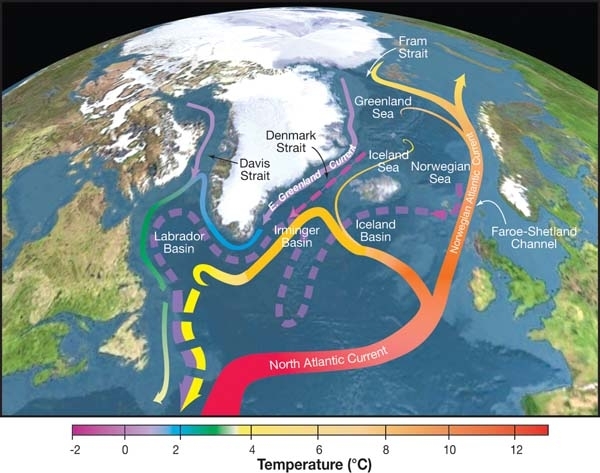
Most frightening and/or depressing story: We are most likely on a path to the AMOC tipping point. I distinguished between the tipping point, which is when collapse becomes inevitable, and the actual collapse itself. These are separated in time, which means the tipping point may only be called in retrospect when it is too late to prevent the collapse. This why being “on the path to the tipping point” is important, because we can still do something.

Most hopeful story: Spain has been so successful at rolling at solar power that the price of solar power has “collapsed”. I’ve been beating a drum lately that economic incentives have tipped in favor of renewable energy worldwide and this fact is being largely hidden from us in the US by propaganda.

Most interesting story, that was not particularly frightening or hopeful, or perhaps was a mixture of both: Brain-machine interfaces have been quietly advancing behind the scenes.

Wikipedia

Spain’s “solar power meltdown”?

This article in (paywalled) Financial Times is called “The Story Behind Spain’s Solar Power Meltdown”. But the “meltdown” turns out to be in the price of solar power following an extraordinarily successful implementation effort. So maybe it’s a meltdown for some corporations and their investors who created too much capacity in the short term, but it has resulted in abundant renewable energy, which has to be good for the long term.

The other issue apparently is that Spain and its electrical industry did not invest enough in their electric grid and storage capacity at the same time they invested in all this supply, and that has also caused issues. Recent blackouts have been blamed on solar power, whether that is really fair or not (this article says mostly no).

Spain may be sunnier than many parts of the US, but certainly not the desert southwest. I think the lesson here is that solar supply probably doesn’t need government subsidies any more to take off. It may need a level playing field, in other words dirtier, less efficient fossil fuels not to be unfairly subsidized with our taxpayer money while propaganda convinces us the opposite is happening. But the grid, vehicle charging, and storage infrastructure seems like it still needs government help to get over the hump. That is not where the political winds are blowing at the moment, but political winds eventually shift in the face of overwhelming economic forces. Just check in with the coal industry on that one.

August 2025 in Review

Good bye summer 2025!

Most frightening and/or depressing story: A gigantic incoming object could be the alien ship that will put us out of our misery. Okay, probably not. The interesting and scary thing is that as our ability to look at the nearby universe improves, we are seeing more surprising stuff. But how are we supposed to think about let alone do anything about a very low probability existential threat like this one? We are not even responding to the “somewhat likely” (nuclear war, pandemics) and “likely happening right now” (a climate tipping point leading to future collapse) existential threats in front of us. I suggested that the tipping point will be called in retrospect, and 2025 might be a nice round number for the history books.

Most hopeful story: No matter what impression we are being given in the U.S., economic forces continue to push towards renewable energy and electrification worldwide.

Most interesting story, that was not particularly frightening or hopeful, or perhaps was a mixture of both: Designer babies are here, and the trend towards the rich and powerful accelerating their own evolution (and a few governments making this available to the masses) can only accelerate.

undersea energy storage

This idea seems to make a lot of sense. When the wind is blowing, you can use excess energy from an offshore turbine to pump water out of an underwater tank. When the wind dies down, you open a valve and water pressure will push water back into the tank, turning a turbine in the process which can generate electricity. This way, you can generate electricity whether the wind is blowing or not. You have the problem of maintaining equipment in the marine environment and transporting the electricity to shore, but since you have an offshore turbine you have presumably solved those problems. I don’t know that this idea is enough to make offshore wind turbines a great option where they otherwise wouldn’t be.

On land, it seems like you can accomplish something similar with a basic water tower. Use wind or solar energy to pump water up there when you have excess electricity, then drain it down to turn a turbine when the wind is not blowing. If you have a hill, you can put a reservoir up there and run pipes to it rather than building the water tower. Maybe you can use a your water tower or reservoir both for water supply and energy storage, but the turbine itself is going to dissipate some of the energy you need to create water pressure in your pipes, so there are some physics and economics to consider.

https://www.zmescience.com/future/sinking-giant-concrete-orbs-to-the-bottom-of-the-ocean-could-store-massive-amounts-of-renewable-energy/

Vaclav Smil

New Yorker has a long profile of Vaclav Smil. His books have been on my list of too-many-books-to-read-before-i-die for a long time, and have occasionally been semi-finalists, but I have not yet gotten to any of them. The latest is called How the World Really Works.

Basically, he sees himself as bringing relentless rationality and quantitativeness to discussing the world’s energy situation, and is often characterized as an anti-environmentalist as a result. He points out how much energy we really use to make modern civilization possible and how fossil fuels mostly make this possible. For example,

…the power under the direct control of an affluent American household, including its vehicles, “would have been available only to a Roman latifundia owner of about 6,000 strong slaves, or to a nineteenth-century landlord employing 3,000 workers and 400 big draft horses.” He was making a characteristically vivid point about the impact of modern access to energy, most of it produced by burning fossil fuels. No one can doubt that twenty-first-century Americans’ lives are easier, healthier, longer, and more mobile than the lives of our ancestors, but Smil’s comparison makes it clear that most of us underestimate, by orders of magnitude, the scale of the energy transformations that have made our comforts possible.

New Yorker

Increases in efficiency and renewable energy technology are happening, but when he does the math he finds that they are not happening fast enough to bend the curve of consumption and pollution back downwards in the face of relentlessly increasing consumption, especially in the developing world.

The recent slowing of China’s rate of industrialization—S-shaped curves eventually flatten—has not ended its reliance on fossil fuels; the Chinese are still building new coal-fired power plants at the rate of roughly two a week. Not that long ago, Beijing was still a city of bicycles; today, it’s plagued by air pollution, much of it produced by cars. China is the world’s leader in the manufacture of electric vehicles, but it’s also the world’s leader in generating electricity by burning coal. India’s road network, which is already the world’s second longest, after ours, is growing rapidly.

China’s energy consumption will likely peak before 2030, Smil said, but India, Pakistan, Indonesia, and countries in sub-Saharan Africa, among others, are already aiming to follow its growth example. “Don’t forget that at least two and a half billion people around the world still burn wood and straw and even dried dung for everyday activities—the same fuels that people burned two thousand years ago,” he continued. For many years to come, he added, economic growth in such places will necessarily be powered primarily by coal, oil, and natural gas. “They will do what we have done, and what China has done, and what India is trying to do now,” he said. The rate at which the world decarbonizes, he continued, will be determined by them, not by us.

(still New Yorker, but I’m a good little intellectual property rights respecting monkey)

I had this sense when I lived in Asia, that Asia is just so vast and the potential for explosive growth is so enormous that what we do in the US and western Europe will be overwhelmed by their impacts.

I am definitely on the side of math, logic, and reason which are in short supply in this world. I don’t like cynicism disguised as realism to be a substitute for making and having a plan. If math, logic, and reason show that the sort of half-assed plan the world has is not going to work, then the world needs to go back to the drawing board and come up with something that is going to work. It’s like saying your train is headed for a cliff and the the breaks on your train are not strong enough to stop the train before the cliff. If you throw up your hands and do nothing, you are going off the cliff which is not really an option. Trying to do literally anything is a better option than doing nothing. You would find ways to try to slow down the train or improve the brakes even if you thought the chances of success were low, right?

August 2023 in Review

Most frightening and/or depressing story: Immigration pressure and anti-immigration politics are already a problem in the U.S. and Europe, and climate change is going to make it worse. The 2023 WEF Global Risks Report agrees that “large scale involuntary migration” is going to be up there as an issue. We should not be angry at immigrants, we should be angry at Exxon and the rest of the energy industry, which made an intentional choice not only to directly cause all this but to prevent governments from even understanding the problem let alone doing anything to solve it. We should be very, very angry! Are there any talented politicians out there who know how to stoke anger and channel it for positive change, or is it just the evil genocidal impulses you know how to stoke?

Most hopeful story: Peak natural gas demand could happen by 2030, with the shift being to nuclear and renewables.

Most interesting story, that was not particularly frightening or hopeful, or perhaps was a mixture of both: There are a number of theories on why “western elites” have not been (perceived to be) effective in responding to crises in recent years and decades. Many have to do with institutional power dynamics, where the incentives of the individual to gain power within the institution do not align with the stated goals of the institution. Like for example, not killing everyone. The possible silver lining would be that better institutions could be designed where incentives aligned. I have an alternate, or possibly complementary, theory that there has been a decline in system thinking and moral thinking. Our leaders aren’t educated to see the systems and or think enough about whether their decisions are on the side of right or wrong.

December 2022 in Review

Most frightening and/or depressing story: The U.S. legalized political corruption problem is getting worse, not better. This was one of Project Censored’s most censored stories of 2022.

Most hopeful story: Space-based solar. This just might be the killer energy app, the last energy tech we need to come up with for awhile. Imagine what we could do with abundant, cheap, clean energy – reverse global warming, purify/desalinate as much water as we need, grow lots of food under lights in cities, power homes/businesses/factories with little or no pollution, get around in low-pollution cars/buses/trains, electrolyze as much hydrogen from water as we need for fuel cells to power aircraft and even spacecraft. Solve all these problems and we would eventually come up against other limits, of course, but this would be an enormous step forward. And space-based solar seems like much less of a fantasy than nuclear fusion or even widespread scaling up of new-generation fission designs.

Most interesting story, that was not particularly frightening or hopeful, or perhaps was a mixture of both: The Liver King, obviously. What is it about the Liver King I just can’t get enough of. Is it the abs? The huge pectoral muscles?

bouncing between layers of limits

This Asia Times article is dramatically titled The Renewable Energy Transition is Failing. This seems overly dramatic to me, but the point to me is that if we overcome one limit, in this case the atmospheric sink for carbon dioxide, we will encounter other limits. In this article, the author focuses on availability of raw materials like metals. If we overcome that limit, we may have an issue of sinks for these metals and other waste products produced. So we bounce back and forth between sources and sinks being the limiting factor.

EIA Annual Energy Outlook 2022

The U.S. Energy Information Administration (EIA) has a new report out with projections through 2050. The graphs are worth staring at. Here are some takeaways for me.

  • Coal use has crashed from over 20% of energy consumption 10 years ago to around 10% now. The rise in renewable energy mirrors it, from less than 5% to nearly 20%. Natural gas also surged during this period to replace the decline in coal, from around 20 to 30+ percent. Oil just kind of bumps along in the 30-40% range. The projection in 2050 is something like oil 40%, natural gas 35%, renewables 20%, everything else less than 10%.
  • The carbon footprint of electric power generation a decade ago was greater than the transportation sector. It has declined significantly (I assume this reflects the substitution of natural gas and renewables for coal), and is projected to continue to decline. The carbon footprint of transportation and industry is projected to remain relatively flat.
  • The biggest gains in renewable energy are projected to come from solar. Solar is projected to grow regardless of changes in cost, whereas wind and other sources are shown as more sensitive to cost, meaning if cost is high their share stops growing. I assume this has a lot to do with the cost of solar being pretty low already.
  • They show solar energy and battery storage being used extensively to meet peak mid-day demand by 2050.
  • Somewhat disappointing and surprising to me, they show electric vehicles sales only slowly displacing a small portion of gasoline-powered (3%?) vehicle sales over the next 30 years. I hope they are wrong about this one.

I can imagine a past world where safe civilian nuclear technology had been used more widely over the last 50 years or so, and we are not in the climate mess we are in today. Maybe this is even a world where the proliferation of nuclear weapons is less prevalent, but I am not sure about that. This is not the world we live in.

I can imagine a near-future world where homes, businesses, industry, and vehicles are increasingly electrified, and electricity generation is increasingly shifted to renewables. I still think nuclear power might be able to play an important role in this world. But it does not seem like we are headed in the direction of this world, at least not quickly enough to avoid a major train wreck. I hope I am wrong.