Tag Archives: urban planning

IBM’s Smarter Cities

What exactly has IBM been up to all this time with its Smarter Cities program? It’s been hard to figure out. The marketing hype and media coverage have seemed to die down a bit. But here is an article in Cities with some research on it.

An investigation of IBM’s Smarter Cites Challenge: What do participating cities want?

In 2010, IBM created the Smarter Cites Challenge to address critical issues of the 21st century through its digital expertise, in collaboration with city governments. Despite questions about the origin and intentions of IBM’s involvement, 130 cities from all around the world took up the challenge in the first five years. There is limited case study research available on a number of participating cities which has not been able to unpack cities’ rationale for working with IBM. This paper provides an index of all participating cities in the Smarter Cities Challenge, to understand the areas of interest in which urban governments have been seeking IBM’s consulting service. Findings present the state of smart city thinking in urban governments, and raise questions about the multidimensional integration, if any, across the areas of focus in which digital technologies are shaping contemporary cities.

Thomas More’s utopia

Here’s an interesting article on Thomas More’s utopia from the 1500s. He envisioned a series of economically specialized medium-scale cities (a couple hundred thousand people, keeping in mind a million-person city was enormous at the time and there were only a few in the world) separated by farm and natural lands and connected by transportation links.

October 2016 in Review

3 most frightening stories

  • The U.S. electric grid is being systematically probed by hackers working for foreign governments.
  • According to James Hansen, the world needs “negative” greenhouse gas emissions right away, meaning an end to fossil fuel burning and improvements to agriculture, forestry, and soil conservation practices to absorb carbon. Part of the current problem is unexpected and unexplained increases in methane concentrations in the atmosphere.
  • The epidemics that devastated native Americans after European arrival were truly some of the most horrific events in history, and a cautionary tale for the future.

3 most hopeful stories

  • New technology can read your heartbeat by bouncing a wireless signal off you. Mark Zuckerberg has decided to end disease.
  • While he still has people’s attention, Obama has been talking about Mars and zoning. Elon Musk wants to be the one to take you and your stuff to Mars.
  • Maine is taking a look at ranked choice voting. Ironically, the referendum will require approval by a simple majority of voters. Which makes you wonder if there are multiple voting options that could be considered and, I don’t know, perhaps ranked somehow? What is the fairest system of voting on what is the fairest system of voting?

3 most interesting stories

Edward Glaeser on infrastructure

Edward Glaeser questions the idea of massive federal spending on infrastructure.

While infrastructure investment is often needed when cities or regions are already expanding, too often it goes to declining areas that don’t require it and winds up having little long-term economic benefit. As for fighting recessions, which require rapid response, it’s dauntingly hard in today’s regulatory environment to get infrastructure projects under way quickly and wisely. Centralized federal tax funding of these projects makes inefficiencies and waste even likelier, as Washington, driven by political calculations, gives the green light to bridges to nowhere, ill-considered high-speed rail projects, and other boondoggles. America needs an infrastructure renaissance, but we won’t get it by the federal government simply writing big checks. A far better model would be for infrastructure to be managed by independent but focused local public and private entities and funded primarily by user fees, not federal tax dollars.

I get the argument that investing without a plan leads to waste. We don’t really have any real planning at the federal level. I think it would help for the federal government to set a vision and direction for what the smart infrastructure of the future should look like, and not just transportation (public, private and human muscle-powered) but energy, water, communications, freight, manufacturing, housing and even green infrastructure. One of the problems with local authorities and companies doing the planning is that they focus on only one of these things at a time, so they miss out on potential synergies and opportunities for hybrid infrastructure. An example might be highway corridors that serve as rights of way for high speed rail, high-voltage lines, pipelines and movement corridors for wildlife. Another might be a system of parks that move water resources, improve water and air quality, absorb floodwaters, counteract climate change, provide habitat and improve peoples’ health.

He is right though that a lot of planning needs to be at the metropolitan area scale and incorporate hard-nosed cost-benefit analysis. This is already done to a certain extent by designated “metropolitan planning organizations”, but this only applies to transportation. It could be more comprehensive. I also see a middle ground between pure local funding and pure federal funding. Federal funds can be targeted only to projects that are in line with the national vision and the local comprehensive plan. They could be low- or no-interest loans rather than outright grants. They could be grants but require local matching funds and encourage private investment. They could be loans that are partially forgiven if the projects meet performance and cost-effectiveness criteria.

Having both federal and local plans ready to go, along with a federal infrastructure bank able to issue bonds, would also mean the country could really take advantage of periods of unemployment and low interest rates both to stimulate the economy in the short run and boost productivity and prosperity in the long run.
Obama on housing

The Obama administration has come out with a “housing development toolkit“. I think they have this about right. Of course, the federal government has very little control over local land use. Maybe some local politicians will take the trouble to try to understand this stuff and support policies that help people and the economy rather than policies that just kind of sound good but are ultimately counterproductive.

Over the past three decades, local barriers to housing development have intensified, particularly in the high-growth metropolitan areas increasingly fueling the national economy. The accumulation of such barriers – including zoning, other land use regulations, and lengthy development approval processes – has reduced the ability of many housing markets to respond to growing demand. The growing severity of undersupplied housing markets is jeopardizing housing affordability for working families, increasing income inequality by reducing less-skilled workers’ access to high-wage labor markets, and stifling GDP growth by driving labor migration away from the most productive regions. By modernizing their approaches to housing development regulation, states and localities can restrain unchecked housing cost growth, protect homeowners, and strengthen their economies.

Locally-constructed barriers to new housing development include beneficial environmental protections, but also laws plainly designed to exclude multifamily or affordable housing. Local policies acting as barriers to housing supply include land use restrictions that make developable land much more costly than it is inherently, zoning restrictions, off-street parking requirements, arbitrary or antiquated preservation regulations, residential conversion restrictions, and unnecessarily slow permitting processes. The accumulation of these barriers has reduced the ability of many housing markets to respond to growing demand.

This toolkit highlights actions that states and local jurisdictions have taken to promote healthy, responsive, affordable, high-opportunity housing markets, including:

  • Establishing by-right development
  • Taxing vacant land or donate it to non-profit developers
  • Streamlining or shortening permitting processes and timelines
  • Eliminate off-street parking requirements
  • Allowing accessory dwelling units
  • Establishing density bonuses
  • Enacting high-density and multifamily zoning
  • Employing inclusionary zoning
  • Establishing development tax or value capture incentives
  • Using property tax abatements

“artificial rainforest” in Dubai

I continue to think that places like Dubai and Singapore with extremely inhospitable climates are preparing humanity for its future in space. They are creating cities that consist of climate-controlled high rise apartments, office buildings, malls, and indoor parks, all connected by subway lines, so there is really no reason to go outside. It’s not too hard to imagine transferring one of these cities to Mars.

September 2016 in Review

3 most frightening stories

  • The U.S. and Russia may have blundered into a proxy war in Syria. And on a loosely related war-and-peace note, Curtis LeMay was a crazy bastard.
  • The ecological footprint situation is not looking too promising: “from 1993 to 2009…while the human population has increased by 23% and the world economy has grown 153%, the human footprint has increased by just 9%. Still, 75% the planet’s land surface is experiencing measurable human pressures. Moreover, pressures are perversely intense, widespread and rapidly intensifying in places with high biodiversity.” Meanwhile, as of 2002 “we appropriate over 40% of the net primary productivity (the green material) produced on Earth each year (Vitousek et al. 1986, Rojstaczer et al. 2001). We consume 35% of the productivity of the oceanic shelf (Pauly and Christensen 1995), and we use 60% of freshwater run-off (Postel et al. 1996). The unprecedented escalation in both human population and consumption in the 20th century has resulted in environmental crises never before encountered in the history of humankind and the world (McNeill 2000). E. O. Wilson (2002) claims it would now take four Earths to meet the consumption demands of the current human population, if every human consumed at the level of the average US inhabitant.” And finally, 30% of African elephants have been lost in the last 7 years.
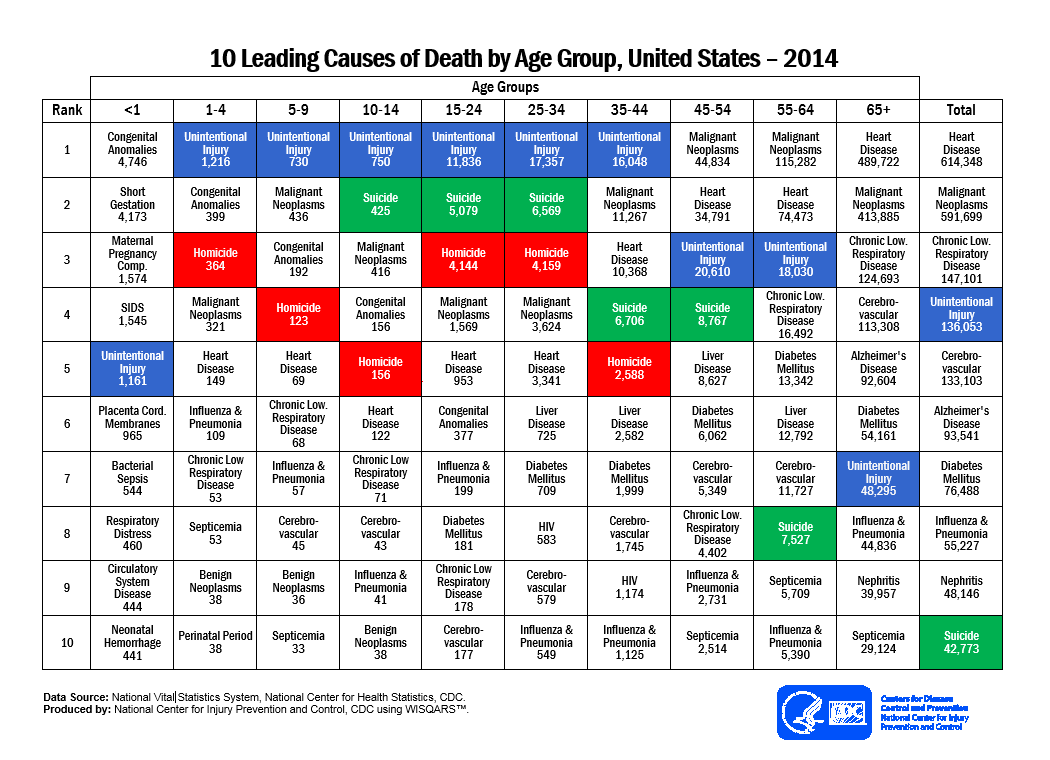
  • Car accidents are the leading cause of death for children ages 5 to 24. The obsession with car seats may not be saving all that many lives, while keeping children out of cars as much as possible would be 100% guaranteed to save lives. And one thing that would be guaranteed to help us create more walkable neighborhoods and therefore save children’s lives: getting rid of minimum parking requirements in cities once and for all. And yet you don’t hear this debate being framed in moral terms.

3 most hopeful stories

3 most interesting stories

  • Monsanto is trying to help honeybees (which seems good) by monkeying with RNA (which seems a little frightening). Yes, biotech is coming.
  • Some people think teaching algebra to children may actually be bad. Writing still seems to be good.
  • There have been a number of attempts to identify and classify the basic types of literary plots.

minimum parking requirements

Here’s a short, visually engaging video about the problem with minimum parking requirements. Apparently, this worked in Ottawa. I don’t want to be cynical, but I am not convinced the residents, politicians, and bureaucrats of my town would respond similarly to such a logical argument. I would love for everyone to prove me wrong.

leading cause of death among children

This quote in a Strong Towns article caught my eye:

According to the Centers for Disease Control, for children ages 5 through young adults age 24, the leading cause of deathis auto accidents. For accidental causes of mortality, there is no close second. Even drowning, which we are militant about here in terms of baths, pools and time at the lake, is just a fraction of auto accidents. Imagine two 9/11 attacks each year that killed just kids and you still would not have the number of child fatalities America has each year from auto accidents…

If we are serious about wanting what is best for kids, shouldn’t we be doing everything we can to reduce the number of auto trips people are required to take each day? And when people do take trips, shouldn’t our top priority be reducing the travel speeds on local streets? Once outside of the local street network, shouldn’t our top priority be the removal of the greatest source of accidents – intersections – so traffic can flow smoothly?

The best thing we can do for the safety of our children is to get them out of the car by building mixed-use, walkable neighborhoods.

The post also mentions a controversial Freakonomics article suggesting that the biggest increase in children’s safety came from putting them in the back seat of cars, not from car seats.

This brings up a couple interesting questions that I grapple with. First, I think it is crystal clear that the less your child is in cars, the safer they are. So living in a neighborhood where they can walk to school, and you can walk together on most shopping and recreation trips, is a big win for the child’s safety. The difficult questions are, when you are occasionally caught in the rain or late for school, is it okay to jump in the back seat of a cab or Uber with your child, even though you haven’t lugged along the car seat, and it may even be illegal? And second, if you have a school within walking distance that doesn’t have the reputation of a school that requires a car or bus ride everyday, what is the overall best choice for the child? My wife and I make these decisions every day, and the choices we make are not the ones most people we know would make in the same situation. In fact, we just don’t talk about these choices much because people tend to have strongly held opinions. So I’ve added car seats and urban school districts along with politics and religion to the list of topics I don’t bring up in polite company. And yet, to me the choices are clear and I feel perfectly fine about the ones I have made.

parking benefit districts

This article explains why eliminating minimum parking requirements is such a good idea, and suggests the idea of parking benefit districts as a way to get past misguided political and neighborhood opposition.

Eliminating existing requirements currently on the books in almost every city, namely that housing builders install lots of off-street parking spaces, is a key strategy for housing affordability. Most people wouldn’t guess it, but parking requirements (or “quotas”) raise the rent—and not just by a little, but by a lot. Here’s a full rundown of how they do so, but some major ways include:

  • Parking quotas raise the cost of building housing, especially inexpensive housing, and they suppress the number of apartments and houses that can fit on a lot—often by a quarter to a half.
  • Parking quotas block adaptive reuse of old buildings, such as vacant warehouses, to housing.
  • Parking quotas disperse housing by suppressing housing units per city block, which exacerbates sprawl and therefore distances traveled, which makes transit less practical and driving more common. And driving is expensive.

I’m all for it. The only concern I can think of is that neighborhoods with higher-cost parking (likely to be more desirable, richer, less diverse neighborhoods in most cities) would get greater benefits than other neighborhoods. So it seems like maybe a portion of it could stay in the neighborhood, and a portion could be shared across all neighborhoods in a city or even metro area that agree to the policy.

This is both a great example of progressive policy innovation, and a market-based way of aligning peoples’ economic incentives with the best policies. So it should be able to gain support across the political spectrum. But the article also talks about how bureaucrats at existing transit agencies can be an obstacle to this sort of policy (as they can to other good ideas like flexible bus routes). This is sad. In my ideal world, there would be a single agency in charge of getting people from point A to point B and using space in the most efficient, safest and healthiest ways, open to innovation and stakeholder input.